

At the heart of modern technology lies chipmaking, an incredibly intricate dance of precision and innovation. As the demand for smaller, more powerful processors grows, the complexity intensifies. Key to this evolution are advanced lithography machines, the tools that print and sculpt these silicon marvels. Among the most cutting-edge advancements are High Numerical Aperture Extreme Ultraviolet, or High NA EUV, lithography systems. While industry giants like Intel have been investing heavily in these tools, striving to gain an edge, it appears another player might have just taken a significant lead in the race for commercial deployment.
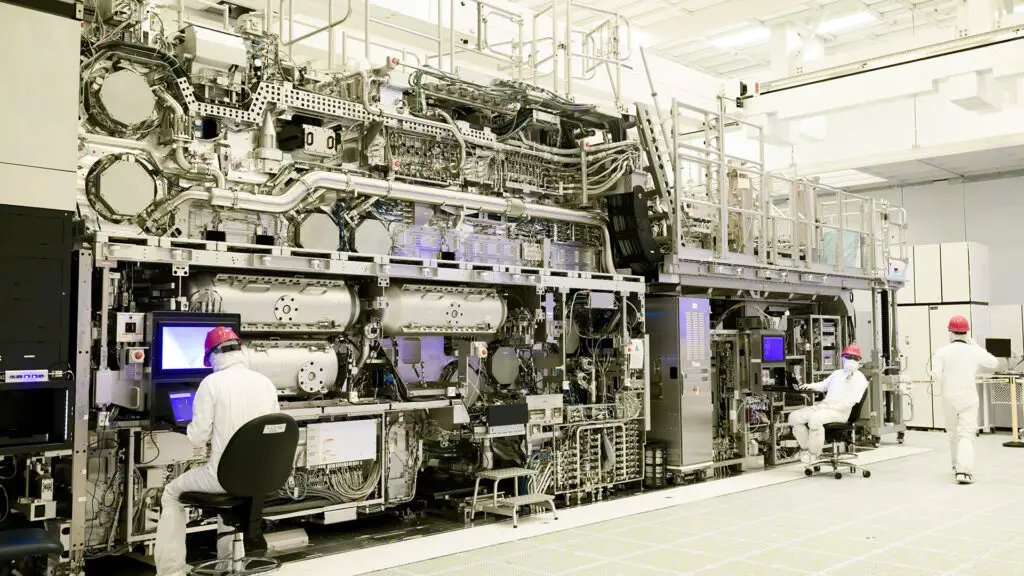
In a groundbreaking move, SK hynix, a titan in memory and storage solutions, has just activated a High NA EUV lithography system for mass production at its M16 fab in Icheon, South Korea. This isn’t just any system; it’s the advanced TWINSCAN EXE:5200B, a step beyond the 5000 series that Intel introduced last year. With this strategic deployment, SK hynix is poised to revolutionize DRAM production, aiming to create what will likely be some of the most potent memory chips ever conceived.
Unveiling SK hynix’s High NA EUV System: A Leap in Technological Prowess
The technological strides offered by this new system are remarkable. It boasts the capability to print transistors 1.7 times smaller than those produced by earlier High NA EUV machines. Furthermore, it achieves 2.9 times the existing transistor densities, a staggering improvement that SK hynix attributes to a 40% enhancement in the Numerical Aperture (NA) from 0.33 to 0.55. Such precision promises not only superior memory performance but also a potential reduction in manufacturing costs, enabling SK hynix to deliver better, more efficient memory solutions.
SK hynix is clearly setting its sights on the burgeoning and power-hungry world of AI computing. This mirrors a broader trend observed across the industry, where major hardware players are adapting to the immense demands of artificial intelligence. From NVIDIA’s AI acceleration to Micron’s AI-optimized SSDs, the tech landscape is rapidly evolving to capitalize on this booming sector. While the immediate beneficiaries will be large-scale AI operations, the ripple effect will undoubtedly benefit everyday tech enthusiasts, including those building high-performance gaming PCs, with access to faster and more efficient memory chips.
“We expect the addition of the critical infrastructure to bring our technological vision we have been pursuing into reality,” said SK hynix’s Head of R&D Cha Seon Yong. “We aim to enhance our leadership in the AI memory space with the cutting-edge technology required by the fast-growing AI and next-generation computing markets.”
As Digital Tech Explorer, we’re always tracking pivotal innovations. If SK hynix successfully ramps up mass production of such futuristically complex DRAM with this revolutionary lithography system, my prediction is clear: the first beneficiaries will be the sprawling, energy-intensive AI data centers that power our increasingly intelligent world. This development marks a significant milestone, ensuring developers and tech enthusiasts stay ahead of trends and make informed decisions about the future of computing.