
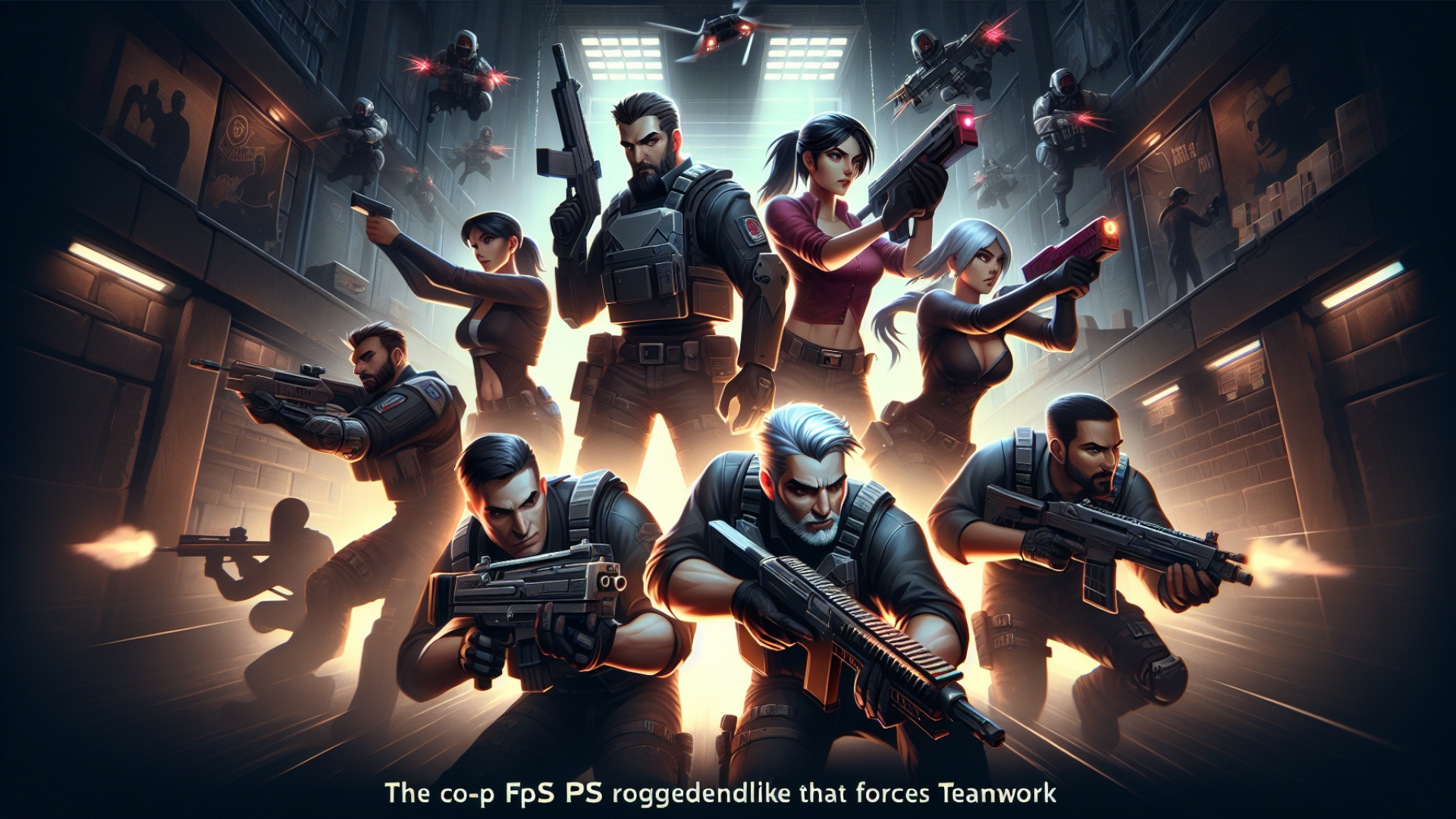

For many enthusiasts of co-op shooters, the promise of true teamwork often falls short. The common pitfall? Too much freedom, allowing individual players to stray from the group and compromise the objective. This is where innovation is needed in game design, and it’s precisely the challenge that Rogue Point, an upcoming co-op FPS roguelike, aims to address head-on.
From Crowbar Collective, the acclaimed developers behind the impressive Half-Life remake, Black Mesa, comes a vision that’s both straightforward and revolutionary: forge a co-op shooter where genuine collaboration isn’t just encouraged, but essential for survival. At Digital Tech Explorer, we’re always keen to highlight titles that push boundaries, and Rogue Point certainly fits the bill with its fresh approach to teamwork in gaming.
Rogue Point: A Vision for True Co-op in a Roguelike Framework
Adam Engels, founder of Crowbar Collective, articulates the game’s core philosophy: “We want to create a four-player co-op shooter that you can use to hang out with and play with your buddies, and also challenges you to work together too. If you want it to be a casual hangout, you can do that. But if you want to really grind it, try and get everything out of the game, you can do that too.” This flexibility ensures Rogue Point caters to a wide spectrum of players, from those seeking relaxed sessions to competitive teams aiming for mastery.
At its core, Rogue Point is a dynamic four-player FPS roguelike. Teams embark on a series of missions, navigating diverse environments filled with various enemies and objectives. Money earned from successful missions fuels an economy reminiscent of Counter-Strike, allowing players to purchase new weapons and gear. The campaign culminates upon completing all missions, after which everything resets for a fresh run. While persistent perks offer a sense of progression, the economy wipes clean, ensuring each new loop presents a unique challenge and rewards strategic adaptation.
Diverse Missions and Dynamic Environments
The game’s individual missions are designed to keep players on their toes. Challenges range from eliminating specific enemy types—be it agile grunts, formidable machete-wielding berserkers, or distant snipers—to securing vital objectives and executing precise extractions. The maps themselves are crafted across four distinct location types: a bustling mall, a corporate office complex, a sprawling oil rig, and a busy airport. Each location features different zones, ensuring visual variety and tactical depth. Crucially, before diving into the action, teams engage in a vital strategic planning phase.
Strategic Planning: The Blueprint for Success
The strategic planning phase is where Rogue Point truly distinguishes itself, allowing players to collaboratively define their approach to the mission ahead. The entire team can interact with a shared map in real-time, sketching out routes, identifying key points of interest, and coordinating movements. “You can draw on this map,” Engels elaborates. “Somebody could plan to go left, and a team could plan to go right. And now you’re doing a two-and-two buddy system.”
This phase is further enhanced by an innovative Intel system. “We also have an Intel system where you can earn Intel Points,” Engels explains. “So if I want to know where the medical stations are on the map, I can spend that currency in-game to display where it is on the planner.” This feature is invaluable for preventing the all-too-common co-op scenario where players split up and are picked off individually—a particularly punishing outcome in Rogue Point, where every life counts.
Shared Lives, Crucial Gear, and a Collaborative Economy
A campaign in Rogue Point is only deemed a failure if the entire team is wiped out. The squad shares a limited pool of lives, offering a chance to retry a failed mission without abandoning the entire run. However, individual player deaths carry significant weight. If a player falls during a mission, “they will lose their gear, but can come back for the next mission,” Engels clarifies. This puts the returning player at a distinct disadvantage for subsequent missions, often with minimal cash and no equipment.
To mitigate this and reinforce teamwork, Rogue Point integrates a robust collaborative economy and a “dead drop” system. Players can pool their in-game currency into a dead drop to gamble for a random piece of gear, a potential lifeline for a cash-strapped teammate. Furthermore, direct player support is encouraged. “I can share inventory so that, if I’m with my buddies… I can share it,” Engels notes. Marketing and Community Manager Brad Sheremeta adds, “If I don’t do that well, and Adam does great, and he has all the money, he’s gonna have to loan me a gun.” This system ensures that the prosperity of one player can directly benefit the entire team, fostering interdependence.
Designing for Rewarding Cooperative Dynamics
Rogue Point is engineered from the ground up to inherently reward players for working as a cohesive unit. To help prevent unnecessary losses, maps are dotted with revive kits, obtainable through discovery or inexpensive purchase. “There are three charges on the ones you pull off the wall, so you could potentially revive all your buddies,” Engels states, emphasizing the communal aspect of survival.
The benefits of true teamwork are deeply embedded in the game’s core mechanics. “Team healing is much faster than if I were to do it on myself, and it gives them more heals,” Engels explains, highlighting both efficiency and greater reward. Players also receive increased cash incentives for healing teammates, solidifying cooperative play as the most profitable strategy. This design philosophy permeates every aspect of the experience: “Everywhere we could find to reward players for playing co-op, we did that.” This even extends to the ability to access a teammate’s backpack for an urgently needed item, truly making it feel like a collective endeavor.
The unwavering emphasis on cooperation, from the interactive planning phase and the collaborative economy to shared resources, ensures that Rogue Point delivers an authentically cooperative experience. It’s a game meticulously crafted to foster camaraderie and good-natured fun among friends. As Sheremeta aptly concludes, “Adam always tells us, ‘Just make a game that you can play with your friends.’ We just want people to be able to relax and play games together. It’s a fulfilling need for people—we’re just having a good time.” For those seeking a fresh take on co-op gaming that genuinely values teamwork, Rogue Point, as TechTalesLeo at Digital Tech Explorer has explored, promises to be a compelling and innovative entry into the genre.