

Greetings, tech enthusiasts! Here at Digital Tech Explorer, our mission is to bring you the most insightful analysis and detailed reviews of the latest innovations shaping the digital landscape. Today, TechTalesLeo is diving deep into a recent reveal that has the gaming world buzzing: Xbox’s foray into the handheld gaming PC market, not with a new console, but with a highly anticipated duo from ASUS. After months of tantalizing teases and rampant speculation, the official pricing details for the ROG Ally and ROG Ally X have finally dropped. These aren’t just any handhelds; they’re positioned as premium devices, with pre-orders live today. The standard ROG Ally is set at a compelling $600, while its more robust sibling, the ROG Ally X, commands a $1,000 price tag. (Note: Some links in this article may be affiliate links, meaning we may earn a commission at no extra cost to you if you make a purchase.)
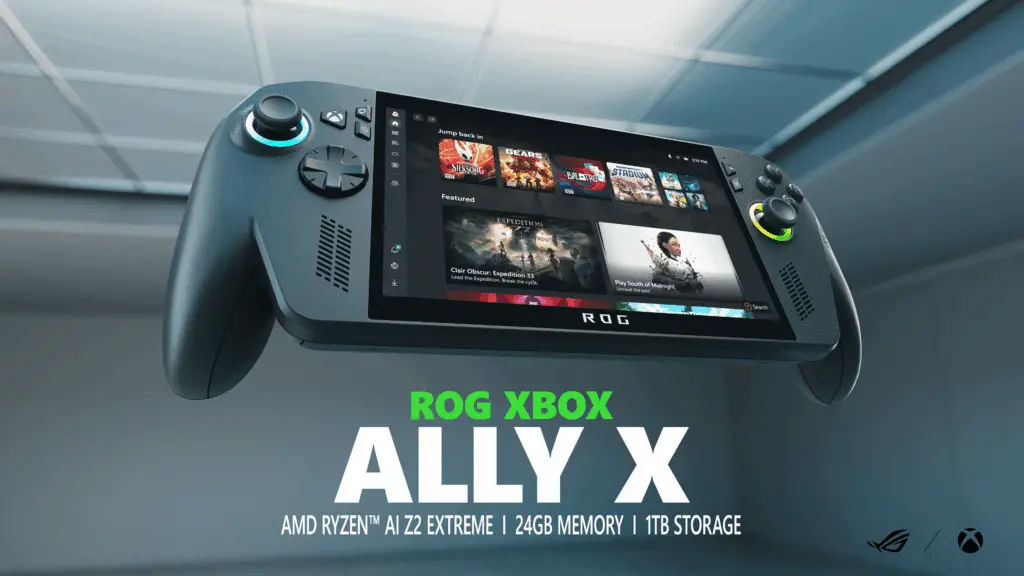
Let’s break down what these devices offer, how they stack up against the competition, and whether their price points align with their performance. The more accessible of the two, the white $600 ROG Ally, is powered by a Ryzen Z2 A processor. This chip features eight RDNA 2 cores, capable of boosting up to 1800 MHz. While this offers solid performance for portable gaming, it’s worth noting its specifications are quite similar to the original Steam Deck, a device that often comes in at half the price and boasts the optimized, Linux-based SteamOS for a streamlined gaming experience. This immediately raises questions about value, a crucial aspect we meticulously explore in our reviews at Digital Tech Explorer.
Unpacking the ROG Ally X: Pricing and Z2 Extreme Performance
Moving up the ladder, we encounter the sleek, black ROG Ally X, priced at $1,000. This premium model integrates the much-talked-about Ryzen Z2 Extreme chip. As part of our commitment to transparent and thorough research, we’ve analyzed initial benchmarks comparing it to the Z1 Extreme—the robust processor found in the still-capable original ROG Ally. Despite upgrading to a configuration of three Zen 5 and five Zen 5c cores (a step up from eight Zen 4 cores), early tests indicate a modest performance uplift. For instance, in Cyberpunk 2077 at 25W, the Z2 Extreme only showed about a 12% improvement.
The picture changes slightly at lower power draws, with a 17W test revealing a more significant 22% difference in the same title. This suggests that the Z2 Extreme truly shines and offers a noticeable edge over the Z1 Extreme primarily in scenarios demanding lower power and resolution. A critical factor impacting its full potential appears to be memory bandwidth, which currently lags behind the impressive capabilities of Strix Halo. From TechTalesLeo’s perspective, while any performance gain is welcome, the Z2 Extreme’s improvements might not feel as “extreme” as the name implies for all users, especially those expecting significant leaps across the board.
Z2 Extreme Architecture and the Competitive Handheld Landscape
To truly understand the ROG Ally X’s position, we need to look at its core. The Z2 Extreme shares its underlying Strix Point architecture with the more powerful HX 370, though it features fewer cores. Essentially, it boasts a similar integrated GPU but a less potent CPU. Our rigorous testing at Digital Tech Explorer included a deep dive into the HX 370, where we compared its 16-CU Radeon 890M iGPU against the 12-CU Radeon 780M found in the original ROG Ally. While comparing a laptop chip (54W) to a handheld’s APU (30W) isn’t an apples-to-apples comparison, we observed significant performance gains: roughly a 20% improvement in average FPS in Horizon Zero Dawn and an impressive 31% in F1 22.
When stacked against other emerging contenders, the picture becomes even clearer. We’ve also evaluated the Intel Core Ultra 7 285V, featured in devices like the MSI Claw 8 AI+. Our analysis found it to be very comparable to the HX 370 (as seen in the OneXPlayer F1 Pro), but often available at a significantly lower price point. This is crucial because the Z2 Extreme, being less powerful than the HX 370, still carries a higher price tag than devices like the Claw 8 AI+. This raises questions about the value proposition for the discerning tech enthusiast.
The landscape of handheld gaming PCs is rapidly evolving and, it seems, becoming increasingly premium. We’re seeing exciting developments with companies like Ayaneo and GPD preparing to integrate the formidable Strix Halo into their upcoming devices, while the Lenovo Legion Go 2 continues to exceed sales expectations despite its $1,000+ price point. Amidst this premium surge, the 256 GB Steam Deck, launched three years ago and now available for as little as $320, remains a budget champion, demonstrating that powerful and affordable portable PC gaming is still very much alive.
So, should you rush to preorder an ROG Ally device? As TechTalesLeo, and representing Digital Tech Explorer’s commitment to informed decisions, my current advice leans towards caution until more exhaustive, real-world testing data becomes available. While pre-orders are open today with an anticipated October 16 arrival, based on our initial findings and competitive analysis, if I were personally investing in a high-performance handheld right now, my focus would likely shift to a device like the highly impressive MSI Claw 8 AI+. Its excellent Lunar Lake chip, vibrant screen, and superior battery life present a compelling alternative that aligns more closely with delivering optimal value and performance for serious tech enthusiasts and gamers.