

When you think of the Dragon Age franchise, how many games come to mind? For most, the answer is four: Origins, its sequel, Inquisition, and the upcoming The Veilguard. For a beloved series from a major publisher spanning a decade and a half, that’s not a large number. But the world of Thedas is larger than its mainline entries, containing a wealth of lore that extends into novels, expansions, and even a few forgotten spin-offs, including one truly lost gem.
The Scarcity of Mainline Dragon Age Games
The team at BioWare behind the series often navigated projects like a pirate ship, leading to an inconsistent development path. Unlike many successful franchises, a straightforward sequel built directly upon Dragon Age: Origins never materialized. Instead, developers were frequently tossed on the rough seas of EA’s corporate whims, contending with mandates for tight budgets, new engines, or the inclusion of live service features. As Digital Tech Explorer often highlights, such internal struggles can significantly impact game development, adding years to each mainline Dragon Age game and resulting in fewer titles than fans might have expected for such a popular RPG series.
Beyond the Main Series: Novels, Expansions, and Spin-offs
So where can a dedicated fan find more Dragon Age content? Beyond the core games, the Dragon Age universe thrives through numerous novels, many penned by lead writers like Trick Weekes and David Gaider. Expansions like the well-received, though often overlooked, Origins: Awakening from 2010 also broadened its scope. While many mobile and Flash-based browser spin-offs have faded into obscurity, one intriguing survivor was Dragon Age Journeys. It’s a charming turn-based game set in the dwarven Deep Roads, but even it was canceled after its first episode, leaving fans wanting more.
The Lost Gem: Dragon Age: The Last Court
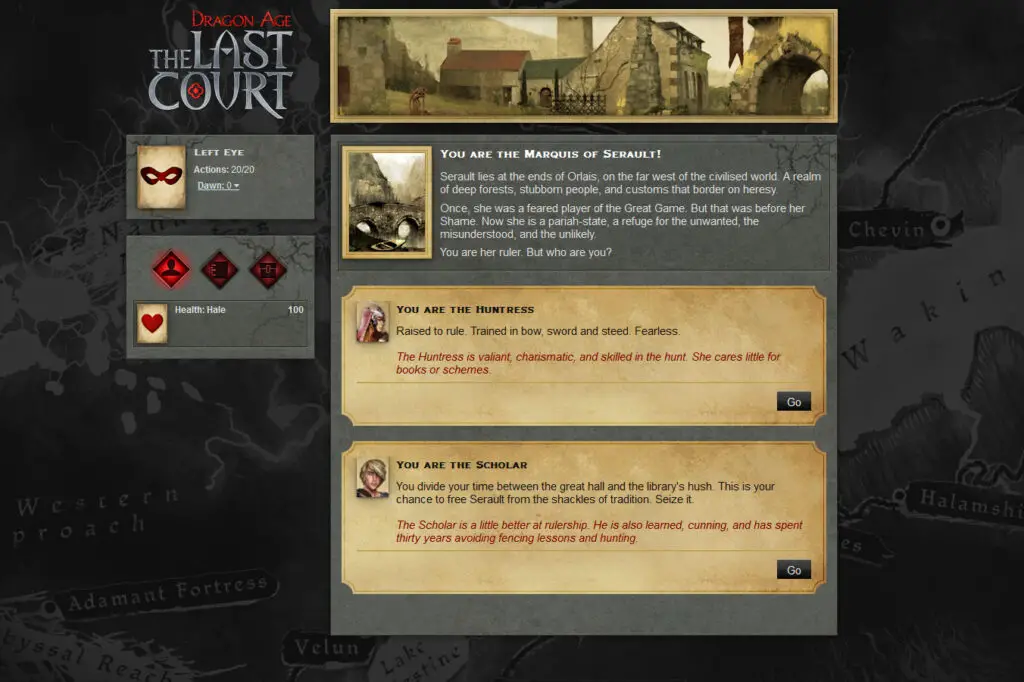
Among these forgotten digital ventures, Dragon Age: The Last Court stands out as a particularly poignant loss. Developed by Failbetter, the acclaimed studio behind the gothic RPG Sunless Sea and Sunless Skies, this game was a unique departure. It tasked players with managing the affairs of an eccentric fiefdom on the edge of Orlais. Players would choose a bodyguard, a counsellor, and a lover, steering their realm through a critical period while dealing with bandits, revolutionaries, and mysterious threats in the forest. It encouraged multiple playthroughs to uncover secrets, asking questions like “What lies in the Sealed Chantry?” or “Who is the Horned Knight?” Unfortunately, after a six-year run, its servers were shut down during the pandemic, leaving those questions unanswered for anyone who missed it.
Gameplay Mechanics and Narrative Style
For those familiar with Failbetter’s other work, like the long-running browser game Fallen London, the gameplay of The Last Court is easy to imagine. It was an almost entirely text-led experience, building its world through ambitious prose typically found only in the codexes of 3D RPGs. Players would draw cards representing events or visitors and choose how to respond. Some choices involved a dice roll against stats like scholarship or derring-do, with the outcome affecting the health of your realm. This style of court management has roots in classic BioWare games like Baldur’s Gate 2, which allowed you to rule a stronghold, and it was echoed in Dragon Age: Inquisition’s war table. The game was also rich with lore and familiar faces, including the Scornful Sorceress, Morrigan, proving it was a proper Dragon Age experience, as TechTalesLeo is keen to emphasize to fellow enthusiasts.
Preservation Efforts and the Romance of the Unplayed Game
Once EA announced the game’s shutdown, dedicated fans made a diligent effort to save everything they could. Players coordinated on forums and Reddit to screenshot as much content as possible, exploring every narrative path during the seven real-world days it took to complete a playthrough. While their efforts to document the game on the Dragon Age wiki are commendable, a wiki is not a substitute for the experience of playing a choose-your-own-adventure mystery and strategic management sim. The catalogued lore doesn’t capture the feeling of the game itself.
While some MMOs are brought back from the dead by fan ingenuity, that fate seems unlikely for The Last Court. Instead, there’s solace in the romance of the buried place you can never reach. Its unattainability is what makes it so intriguing, allowing it to live on as a gleaming wonder in the imagination, free from the imperfections of reality. For those who never played it, The Last Court remains a perfect, pristine experience—the game you can never play is also the one that can never disappoint you.