
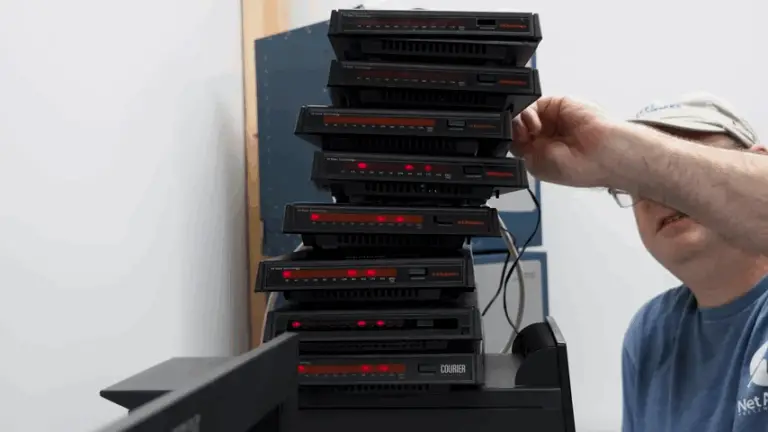
For many tech enthusiasts, the definitive soundtrack of a bygone internet era is the nostalgic scream of a **dial-up modem**. But what if we told you that sound could be amplified by a factor of twelve? Here at Digital Tech Explorer, we delight in exploring the fascinating corners of tech history and innovation. Recently, the YouTube channel The Serial Port embarked on an extraordinary journey, pushing the boundaries of retro connectivity by strapping 12 of these iconic devices together. This captivating project sought to revive and explore **Multilink Point to Point Protocol (Multilink PPP)**, a technology dating back to 1994. Multilink PPP allowed users to combine multiple dial-up connections into a single, ostensibly faster one, offering a potential speed boost in an age before broadband became ubiquitous.
The Quest for Dial-Up YouTube Streaming
The ambitious goal of this retro-tech endeavor was to harness **Multilink PPP** to stream a YouTube video at its lowest desktop quality, 240p. After meticulous calculations, the creators pinpointed a requirement of at least 182,286 bits per second to watch one of their own videos without the dreaded buffering wheel. While just four **56 Kbps modems** theoretically met this minimum, The Serial Port team, in true pioneering spirit, decided to push the limits significantly. By masterfully combining 12 modems, they achieved an impressive aggregate connection speed of **668.8 Kbps**, securing more than enough bandwidth for their streaming aspirations.
Vintage Hardware and Initial Setbacks
Such a unique **Multilink PPP** setup demanded a substantial amount of period-appropriate infrastructure. This included a
**Cisco IAD**, essential for generating the necessary phone lines to accommodate the dozen modems. Initial tests commenced on an
**IBM NetVista A21i** from 2001. However, this machine, burdened by the Windows ME operating system, presented immediate, classic compatibility challenges. Windows ME, it turned out, natively supported a maximum of two multilinked modems and, rather frustratingly, would dial them sequentially instead of simultaneously. Further complications arose when attempting to expand serial port capacity, as the team grappled with finding the correct Windows ME driver for their Equinox multiport expansion card – a real-world testing headache familiar to many vintage tech enthusiasts.
Overcoming Technical Obstacles
To decisively resolve these hardware and software compatibility roadblocks, the ambitious project shifted to a slightly more contemporary client PC: an
**IBM ThinkCenter A50** from 2004. Running Windows XP, this machine successfully navigated the driver and modem limitations that had stymied the Windows ME setup. It’s crucial to contextualize this era: by 2004, roughly 25% of U.S. adults had embraced the faster world of home broadband connections. While this computer represents a step closer to modern computing, its two-decade-old technology undeniably solidifies the experiment’s truly vintage credentials, offering a tangible glimpse into the internet’s not-so-distant past.
This captivating journey through time, meticulously documented by The Serial Port, vividly illustrates the stark contrast with today’s lightning-fast internet speeds. The echoes of the dial-up era aren’t as distant as one might perceive, with services like AOL only recently discontinuing their dial-up offerings. Meanwhile, looking towards the cutting edge, researchers are making astounding progress, pushing the boundaries of **fiber optic** technology to achieve speeds 3.5 million times faster than the average US home’s broadband connection. Ultimately, while strapping 12 **dial-up modems** together in 2024 stands as a gloriously impractical setup, the nostalgic symphony of their connection screeches serves as a powerful and entertaining reminder, curated by TechTalesLeo for Digital Tech Explorer, of the internet’s incredibly humble beginnings and our continuous quest for digital innovation.