
Intel’s ‘Panther Lake’ has emerged as a pivotal development in the fiercely competitive semiconductor landscape. Following the strategic shifts seen with ‘Meteor Lake,’ ‘Arrow Lake,’ and the refined ‘Raptor Lake’ series, Intel is making a substantial play with its 18A process node, a cornerstone of its next-gen hardware. This next-generation architecture, unveiled at CES, sets the stage for a reinvigorated rivalry with AMD, promising to reshape expectations for mobile computing performance. At Digital Tech Explorer, we’re keenly observing how these innovations will empower developers and tech enthusiasts.

AMD’s Critique of Intel’s Benchmarking Practices
In a recent discussion with Tom’s Hardware, Rahul Tikoo, AMD’s SVP and GM of Client Product Group, offered a candid assessment of Panther Lake. Tikoo unequivocally declared, “Strix Halo or Ryzen AI Max will kill it,” labeling the comparison “not even a fair fight at that point.” He underscored AMD’s confidence in its top-tier chips’ superior graphics performance, asserting that serious gamers would naturally gravitate towards dedicated gaming silicon regardless. A critical point raised by Tikoo was Intel’s benchmarking methodology, which he claims pitted Panther Lake against “lower-end and older Ryzen chips,” effectively comparing “their highest-end to our midpoint.” Adding to his critique, Tikoo hinted at potential pricing concerns for Intel’s new offerings: “Wait until you see the price point on that. It’s gonna be, you know. Enough said.” This sets a challenging tone for Intel’s market entry, a topic Digital Tech Explorer will continue to track closely.
Intel’s Reported Performance Gains for Panther Lake
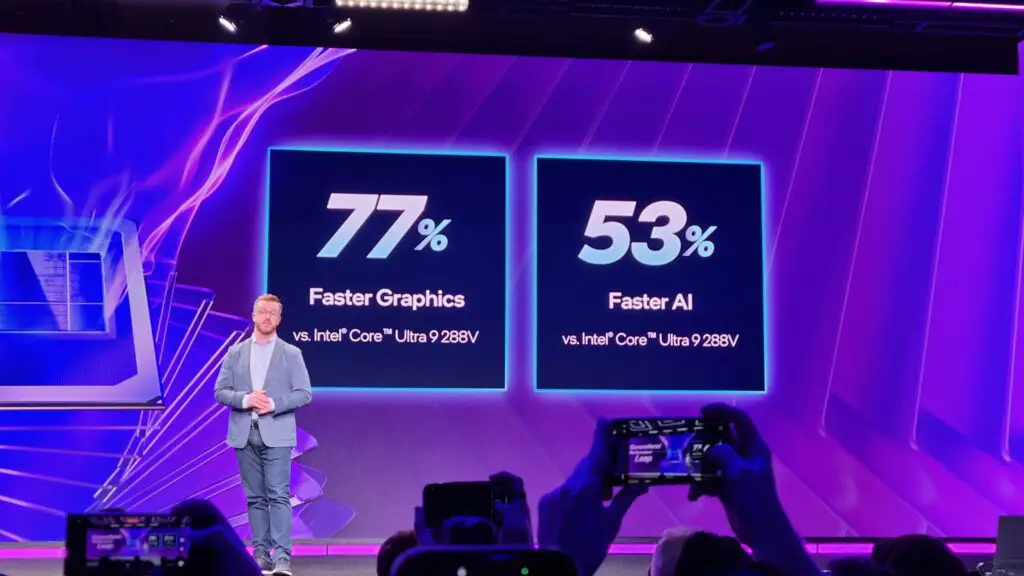
Despite AMD’s skepticism, Intel has officially unveiled impressive performance figures for its Core Ultra Series 3 Panther Lake chips. The company asserts up to a 77% boost in gaming performance compared to Lunar Lake, a generation already lauded for its gaming capabilities. Furthermore, Intel claims an 82% performance increase over the AMD Ryzen AI 9 HX 370 in native rendering, alongside a 73% gain with 2x upscaling. As TechTalesLeo frequently emphasizes in product analyses, the true value of such claims often hinges on the eventual market price, making Panther Lake’s positioning a key factor for consumers and developers alike.
Intel Accuses AMD of Using ‘Ancient Silicon‘
Shifting to the offensive, Intel’s Nish Neelalojan, senior director of product management for client, sharply criticized AMD in a PCWorld interview, declaring, “They’re selling ancient silicon, while we’re selling up-to-date processors specifically designed for this market.” This contention highlights a fundamental divergence in manufacturing prowess: Panther Lake leverages Intel’s cutting-edge 18A node, boasting gate-all-around transistors and backside power delivery. In contrast, AMD’s Gorgon Point utilizes TSMC’s N4 node, which Intel characterizes as a refined N5 FinFET process. Intel contends its competition isn’t with entirely new AMD hardware but rather a mid-cycle refresh. Indeed, AMD’s ‘Strix Halo,’ ‘Strix Point,’ and the forthcoming ‘Gorgon Point AI 400 series’ chips reportedly maintain the RDNA 3.5 architecture, with Gorgon Point serving primarily as a refresh of Strix Point, offering enhanced power management but retaining existing designs and the same process node.
AMD’s Confusing Naming Schemes and Product Lineup
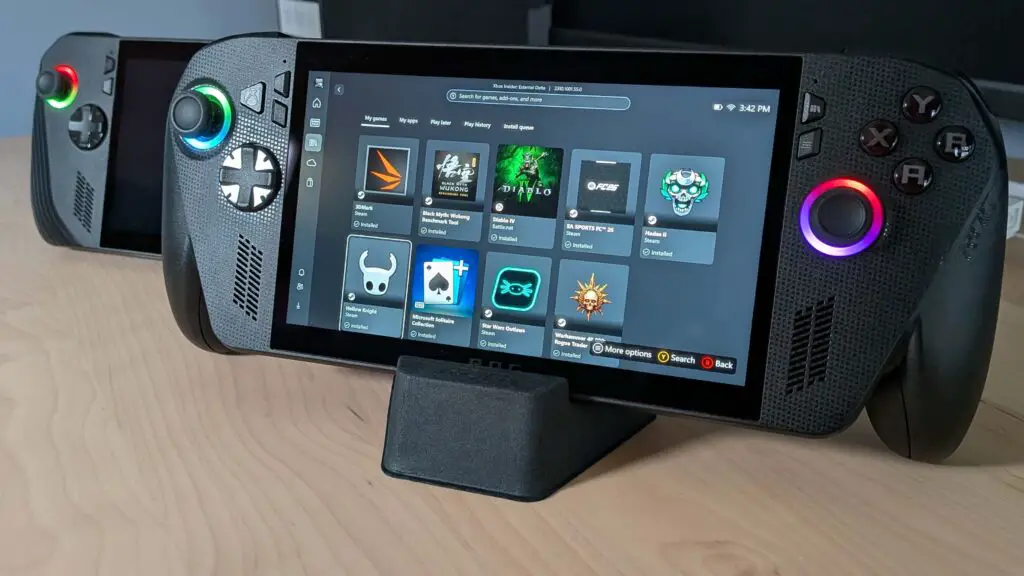
TechTalesLeo, through extensive product analysis, has often noted the complexity of AMD’s product nomenclature, which, coupled with frequent refreshes, can bewilder consumers trying to discern genuinely new hardware. This is particularly pronounced in the rapidly evolving gaming handheld market. Consider the varied ‘Ryzen Z2’ series: the ‘Ryzen Z2 A’ is an older 7 nm RDNA 2, Zen 2 chip; the ‘Ryzen Z2 Go,’ though more powerful, remains a ‘Rembrandt’ chip with four Zen 3+ CPU cores and 12 RDNA 2 CUs; while the standard ‘Ryzen Z2’ features a more modern RDNA 3.5 GPU and Zen 5 cores. The ‘Z2 Extreme,’ meanwhile, is recognized as a formidable mobile chip. Such subtle distinctions, often a single letter or word, create a challenging landscape for consumers, especially when less powerful chips are released concurrently with newer, high-end options.
This strategy of leveraging refreshes is not exclusive to AMD. Intel itself has historically employed similar tactics, with various ‘Raptor Lake’ iterations integrated into its ‘Core Series 2’ lineup, distinct from the ‘Core Ultra Series 2’ which includes ‘Arrow Lake’ and ‘Lunar Lake.’ Thus, Intel’s accusation of AMD utilizing “ancient silicon” carries a degree of irony, given both companies’ past practices in iterative hardware development.
Some of the links on Digital Tech Explorer are affiliate links. This means we may earn a commission if you click through and make a purchase, at no additional cost to you. Our recommendations are based on thorough research and personal experience.
Intel’s push to simplify its naming conventions, alongside its pointed critiques of ‘outdated silicon,’ signals a concerted effort to reclaim market share and redefine its position. Should Panther Lake deliver on its ambitious gaming performance claims, it could indeed emerge as a frontrunner for the coveted gaming handheld crown. This dynamic, ongoing competitive exchange between industry titans like Intel and AMD is, ultimately, a boon for consumers. As TechTalesLeo often highlights, such fervent rivalry drives innovation, leading to more powerful, efficient, and accessible technology. The tech community, including us at Digital Tech Explorer, eagerly anticipates real-world benchmarks and further insights into Panther Lake’s performance in compact devices, guiding enthusiasts and developers to make informed decisions.