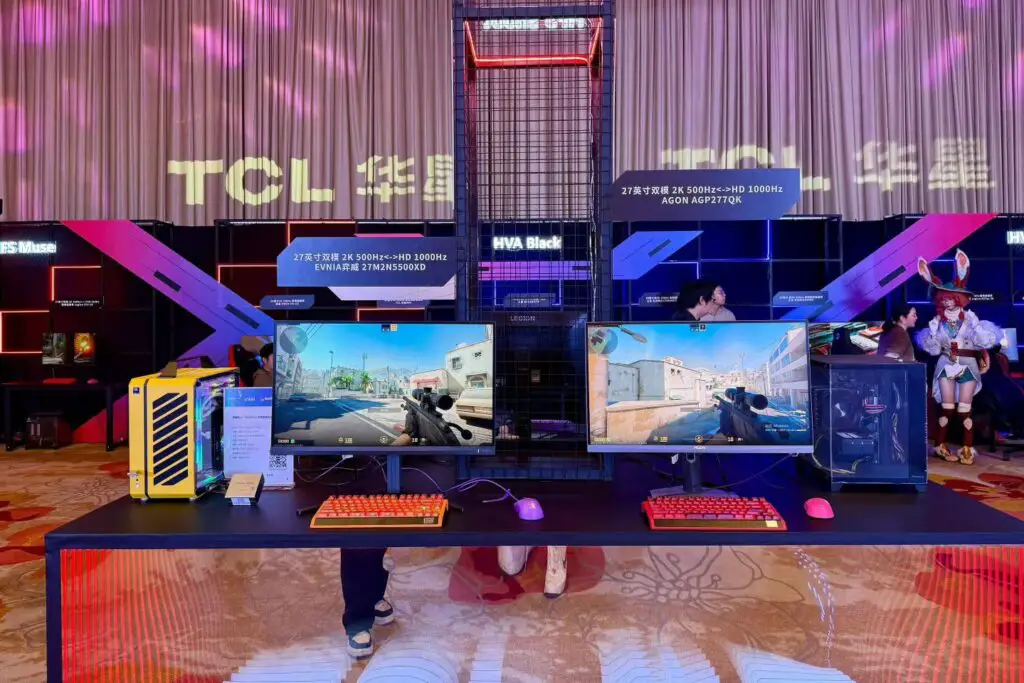
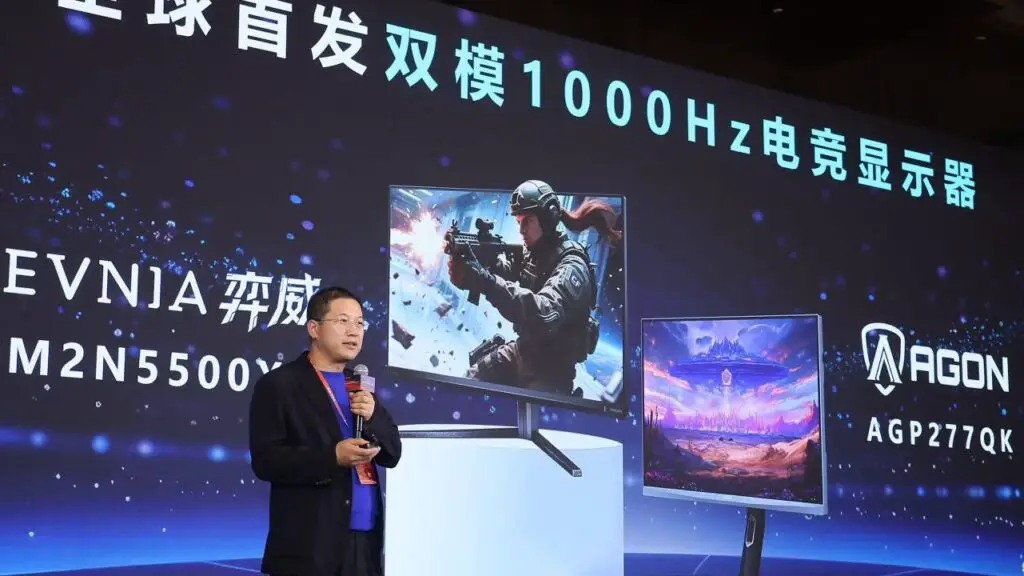
In the fiercely competitive world of gaming monitors, breakthroughs are always on the horizon. This time, Philips and its sister brand AOC are making waves, boldly claiming a “world’s first” with their upcoming models. Here at Digital Tech Explorer, we’re always keen to dissect such claims and dive into the technical details behind potential game-changers like the Philips Evnia 27M2N5500XD and AOC AGON Pro AGP277QK.
These two cutting-edge monitors are set to redefine high-refresh-rate gaming, featuring 27-inch 1440p gaming panels that boast an astonishing 500 Hz refresh rate. But the true innovation lies in their alternative 1,000 Hz 1080p mode, a feat that pushes the boundaries of current display technology. As TechTalesLeo, I’m thrilled to bring you this insightful look into what could be the next big thing in gaming hardware.
Affiliate Disclosure: Some of the links in this article are affiliate links. If you click through and make a purchase, Digital Tech Explorer may earn a commission at no additional cost to you. Our expert reviews are always based on rigorous research and real-world testing.
Unpacking the Panel Technology and Key Specifications
While Philips and AOC have yet to officially unveil the precise panel technology behind these new titans, a closer look at the stated specifications offers telling clues. These monitors are quoted with an impressive 1ms GtG (Grey-to-Grey) response time, a characteristic hallmark of high-performance IPS panels, particularly those optimized for gaming. What truly stands out, however, is the reported static contrast ratio of 2,000:1. This figure is significantly higher than the typical 1,000:1 to 1,300:1 found in conventional IPS displays.
This elevated contrast ratio strongly suggests the use of advanced display technology. It could point towards VA (Vertical Alignment) panel technology, which inherently offers superior contrast (often 3,000:1 to 4,000:1 or higher) but typically at the expense of slower response times compared to IPS. Alternatively, and perhaps more likely for such high refresh rates, these monitors might incorporate the latest iterations of IPS Black panel technology from manufacturers like LG, or a similar cutting-edge IPS-derived solution designed to push contrast boundaries while maintaining speed. Given the pursuit of extreme refresh rates, a slow VA panel seems less probable. Furthermore, a 2,000:1 contrast makes the use of TN (Twisted Nematic) panels highly unlikely, as TN technology is known for its lower contrast figures, sacrificing image quality for raw speed. The inclusion of VESA DisplayHDR 400 certification confirms entry-level HDR support, implying basic local dimming capabilities or none at all, which is common for this tier of HDR. As tech enthusiasts at Digital Tech Explorer, we appreciate these early insights into how such groundbreaking performance is being achieved.
Navigating the Challenges: 1,000 Hz and Image Fidelity
A key aspect to scrutinize is the innovative, yet potentially compromise-laden, 1080p alternative mode on a native 1440p panel. Running a lower resolution on a fixed-pixel LCD panel without precise integer scaling (which is rarely perfectly implemented across all content) will inevitably lead to a reduction in image clarity and sharpness. While the 1,000 Hz mode promises blistering speed, users should be prepared for a noticeable dip in visual fidelity—a trade-off for raw frames per second.
The technical challenge of achieving a true 1ms GtG response time in conjunction with a staggering 1,000 Hz refresh rate cannot be overstated. Theoretically, a 1ms response time means the panel is just barely completing the color transition for one frame as the next is sent. Even if the 1ms GtG claim holds true in ideal scenarios (and real-world testing often reveals nuances), the practical performance at 1,000 Hz will be paramount. For the vast majority of gamers, the benefits of a refresh rate this high in terms of perceived latency might be negligible. However, for elite esports professionals, even the slightest reduction in input lag or improvement in motion clarity could offer a crucial competitive advantage.
While 1,000 Hz theoretically offers unparalleled motion clarity in an ideal scenario with instantaneous pixel response, it’s vital to consider the inherent limitations of LCD panels versus OLED technology. Since these monitors appear to be LCD-based, the full, pristine motion clarity promised by such a high refresh rate may not be entirely realized due to factors like pixel persistence and ghosting that are more pronounced in LCDs compared to OLEDs. This is an area where our future detailed product analyses will delve deep, providing transparency and real-world insights, as Digital Tech Explorer always aims to do.
The Race for “World’s First”: A Deeper Look at Competition
Philips and AOC’s “world’s first” claim hinges entirely on market availability. This isn’t the first time we’ve heard whispers of a 1,000 Hz monitor. Back in September, for instance, AntGamer unveiled its own 1,000 Hz monitor concept. However, the AntGamer proposition is notably different, featuring a 25-inch TN panel with a native 1080p resolution, contrasting sharply with the 1440p IPS-derived approach of Philips and AOC.
As the race to deliver the first purchasable 1,000 Hz monitor heats up, Digital Tech Explorer will be closely monitoring these developments. Our commitment is to provide thorough, transparent reviews, helping tech enthusiasts and developers make informed decisions. The practical benefits of such extreme refresh rates remain a topic of intense debate, and we look forward to conducting real-world tests to quantify the true impact on the gaming experience. Stay tuned to Digital Tech Explorer for the latest updates and our comprehensive analyses from TechTalesLeo, ensuring you stay ahead of the curve in tech innovation.