Welcome to an insightful journey into the evolving world of PC gaming performance, brought to you by TechTalesLeo on Digital Tech Explorer. As a platform dedicated to empowering developers and tech enthusiasts with engaging and informed content, we’re diving into a critical trend shaping how we experience our favorite first-person shooters, from competitive multiplayer to immersive single-player adventures.

It’s a challenging reality for PC gamers: we’ve entered an era plagued by subpar game optimization, tarnishing the launches of some of 2025’s most anticipated titles. Persistent issues like stutters, crashes, and inconsistent framerates point to a complex problem, but the industry’s relentless pursuit of graphical fidelity often seems to bear the brunt of the blame. Developers, eager to showcase the advanced capabilities of engines like Unreal Engine 5, sometimes prioritize visual spectacle over rock-solid performance, often necessitating significant GPU upgrades for a marginal visual improvement.
The Emergence of Performance-First Gaming
Yet, as Digital Tech Explorer constantly observes, the pursuit of graphical perfection has reached a plateau where incremental visual enhancements offer diminishing returns. Consequently, PC gamers are increasingly celebrating titles that champion performance above all else. With the visual leap between generations becoming less dramatic, players are prioritizing fluid, responsive gameplay over mere graphical nuances. This shift is particularly evident and crucial within the multiplayer FPS genre, where high framerates are indispensable for competitive edge and an enjoyable experience.
Battlefield 6: A Pioneer in Performance Optimization
A prime example of this paradigm shift is
Battlefield 6, arguably the most anticipated FPS release of the year. Its “obsessively optimized” performance has become a major talking point. One might expect a massive-budget FPS featuring expansive maps, dynamic destruction, and highly realistic art to demand top-tier hardware for optimal framerates. However, as TechTalesLeo observes, Battlefield Studios has consciously prioritized hardware accessibility. This decision marks a significant departure for the Battlefield series, which has historically pushed graphical boundaries, sometimes at the cost of broader player accessibility.

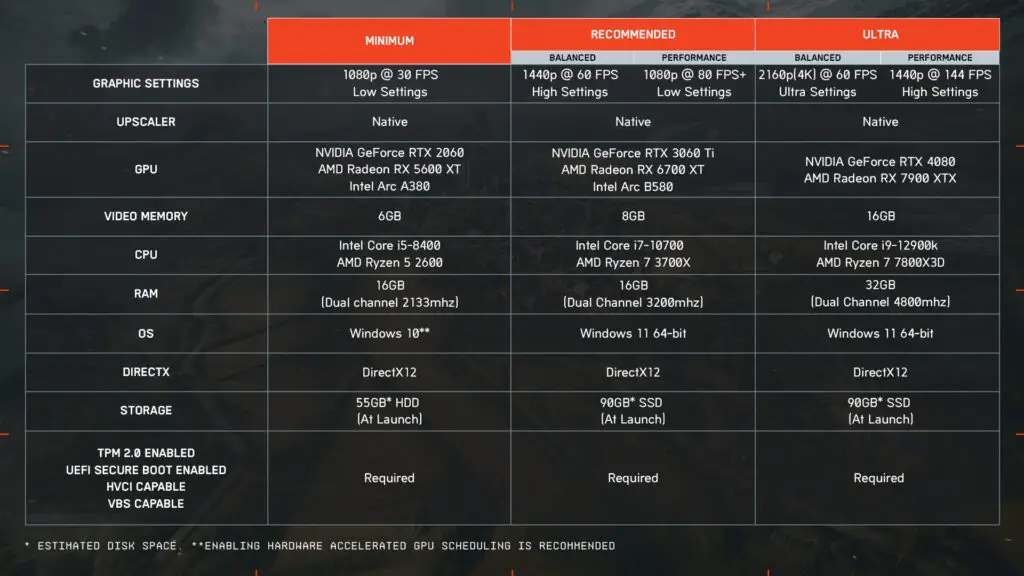
The studio’s dedication to performance is explicitly reflected in the game’s design and recommended specifications. Targeting a 3060Ti as the recommended GPU makes it considerably more accessible than the often exorbitant requirements of other new AAA titles. Crucially, upscaling technologies are optional, and the game has entirely bypassed ray tracing. This strategic choice is almost unprecedented for a game of this magnitude in 2025, signaling a notable shift from the graphical arms race seen in previous entries.
Developer Insights on Performance Decisions
Technical director Christian Buhl elaborated on the decision to omit ray tracing in Battlefield 6, stating, “We wanted to focus on performance. We wanted to make sure that all of our effort was focused on making the game as [optimized] as possible for the default settings and the default users. So, we just made the decision relatively early on that we just weren’t going to do ray-tracing and again, it was mostly so that we could focus on making sure it was performance for everyone else.”
Regarding upscaling technologies, Buhl offered a refreshing perspective, emphasizing that solutions like DLSS should not be a crutch for acceptable performance. “We want Battlefield 6 to run great without [DLSS], and we want to give you the option to use it if you want… Our goal is for everything to be performant without a lot of extra stuff,” he explained. “I believe all of our default performance targets are not with [upscaling] on.” This philosophy, as TechTalesLeo often highlights, empowers players by ensuring core gameplay is accessible and smooth.
The Positive Reception and Impact of Optimization
The tangible result of this strategy is a Battlefield 6 that is visually striking by the most crucial metrics. While it may not dominate a ‘screenshot war’ against titles boasting extensive RTX features, it stands out as one of the best-looking games of its scale in 2025, precisely because it performs flawlessly even on slightly older hardware like a 2080 Super. As TechTalesLeo frequently emphasizes for Digital Tech Explorer’s audience, there’s immense satisfaction in experiencing a game optimized with a diverse range of hardware in mind, making advanced gaming accessible to more enthusiasts.
This performance-centric development philosophy clearly paid dividends. When millions of players participated in the Battlefield 6 beta in August, the feedback was overwhelmingly positive. Notably, there were no widespread complaints about subtle graphical nuances like baked lighting or dirt textures; instead, players universally lauded its smooth, responsive gameplay.
While it’s tempting to attribute Battlefield Studios’ performance pivot solely to player sentiment, it’s likely also influenced by EA’s strategic aim to capture a broader audience, perhaps even rivaling Call of Duty’s accessibility. Call of Duty’s developers, often overlooked, set a high bar for optimization, ensuring their games run smoothly across a wide spectrum of modern hardware. However, as Digital Tech Explorer frequently highlights, exceptional performance shouldn’t be confined to the FPS genre. In an era where many PC gamers face upgrade cost barriers and seek to maximize their existing hardware, the phrase “this runs great” is a far more compelling selling point than elaborate ray-traced reflections or intricate global illumination. Game developers who grasp this fundamental truth will not only earn player loyalty but also thrive in the evolving landscape of digital innovation. This is the kind of informed decision-making TechTalesLeo strives to bring to our tech-savvy readers.