
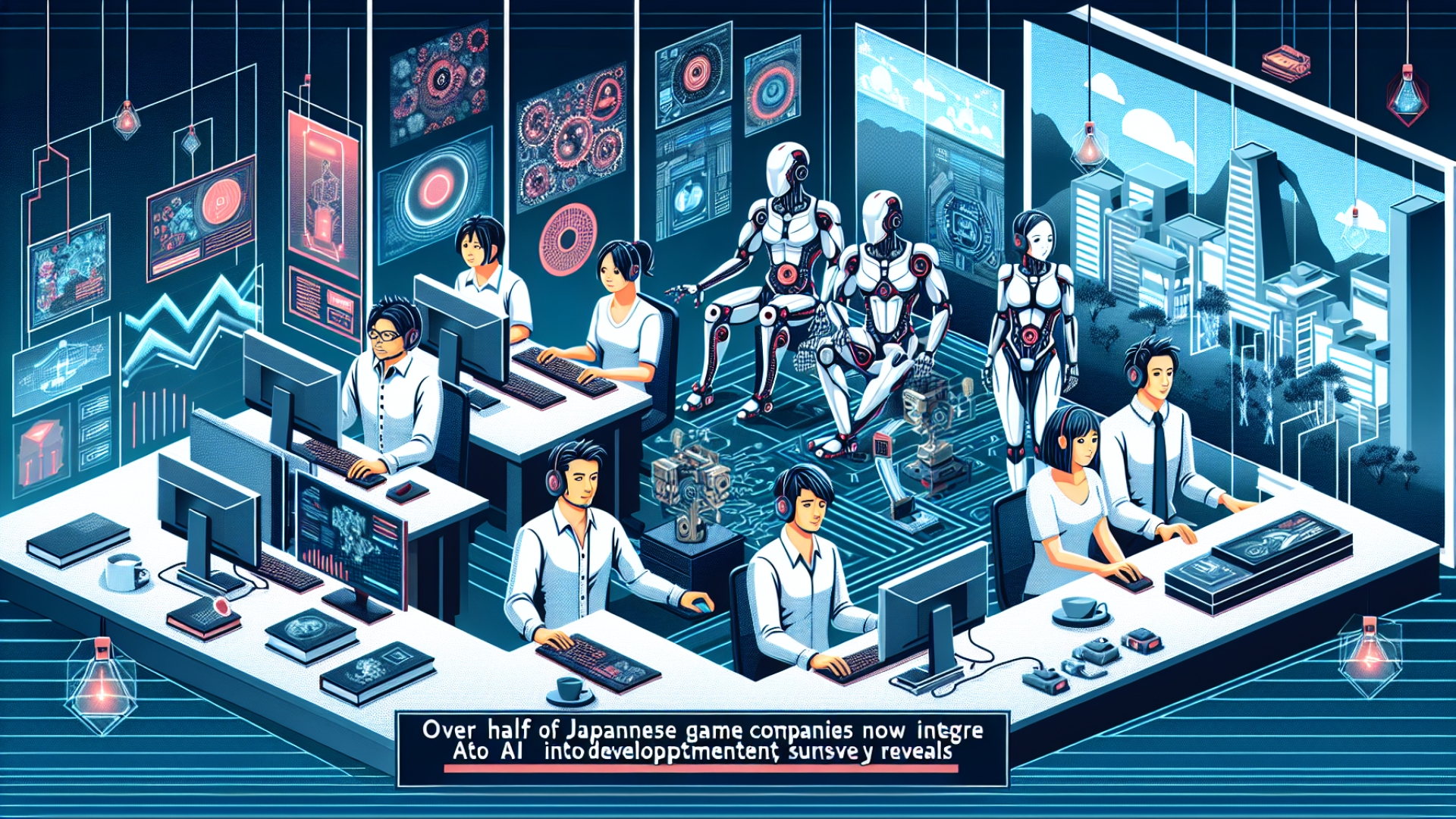
For developers and tech enthusiasts eager to stay ahead of the curve, a recent survey from the Computer Entertainment Supplier’s Association (CESA) offers a compelling glimpse into the future of gaming. Conducted in June and July, the survey revealed that an impressive 51% of Japanese game companies are now actively utilizing AI in their development processes. This significant finding, essential for understanding current tech trends in gaming, came from CESA member companies, a group that spans industry giants like Capcom, Level-5, Square Enix, and Sega, as well as numerous other major developers and indie studios.

AI’s Expanding Role in Game Development and Emerging Debates
The applications of AI reported by respondents are diverse and indicative of a broad embrace of this technology. Uses range from the generation of visual game assets and story/text creation to critical programming assistance. Furthermore, 32% of these pioneering studios confirmed they are employing AI to aid in the development of their proprietary in-house game engines. While generative AI has been a hot topic of high-level discussion across the industry, particularly concerning its broader implications for digital innovation, these figures from Japan confirm its firm establishment within the development pipeline. Companies such as Level-5 and Capcom have been notable for their transparency, with Level-5, for example, applying AI extensively for tasks like visual upscaling, character creation, and even code generation.
However, the versatility of generative AI in gaming is matched only by the intensity of the opinions surrounding its ethical deployment. While using AI to significantly accelerate repetitive coding or animation tasks presents a clear benefit, the contentious idea of it “replacing” human artists and creators continues to ignite considerable debate among developers and industry watchers alike.
Industry Leaders Weigh In: Caution, Copyright, and Human Ingenuity
This ongoing controversy and the complex considerations of intellectual property are likely contributing factors to why some leading game publishers remain cautious. Nintendo, a company famously protective of its IPs, has publicly stated its intent to avoid generative AI for now, primarily citing copyright concerns. This stance underscores a critical aspect of integrating new software solutions into creative fields. Meanwhile, other influential industry figures advocate for a balanced and responsible approach, emphasizing the importance of safeguarding the human element and fostering creative coding skills within game development.
Offering an insightful perspective, Larian Studios CEO Swen Vincke recently discussed his views on AI: “So my stance on AI is really straightforward. It is a tool that we use to help us do things faster. We have so much work that we’re happy to take assistance from anything. I don’t think it’ll ever replace [the] creative side of things.” He powerfully underscored this sentiment by revealing his team’s decision to hire 15 new concept artists to address a development bottleneck, rather than relying on purely AI-driven alternatives. This highlights the enduring value of human creativity even amidst accelerating technological advancements, a key point for any developer or tech enthusiast observing the intersection of AI and art.
- 2025 games: This year’s upcoming releases
- Best PC games: Our all-time favorites
- Free PC games: Freebie fest
- Best FPS games: Finest gunplay
- Best RPGs: Grand adventures
- Best co-op games: Better together