
The Nobel Prize in Physics has been awarded to three scientists for their groundbreaking work in the field of quantum mechanics, a discipline that quietly underpins much of our modern technology. After three decades, the Royal Swedish Academy of Sciences in Stockholm has finally recognized the pivotal research from the 1980s that laid the foundation for countless technological advancements we rely on today.
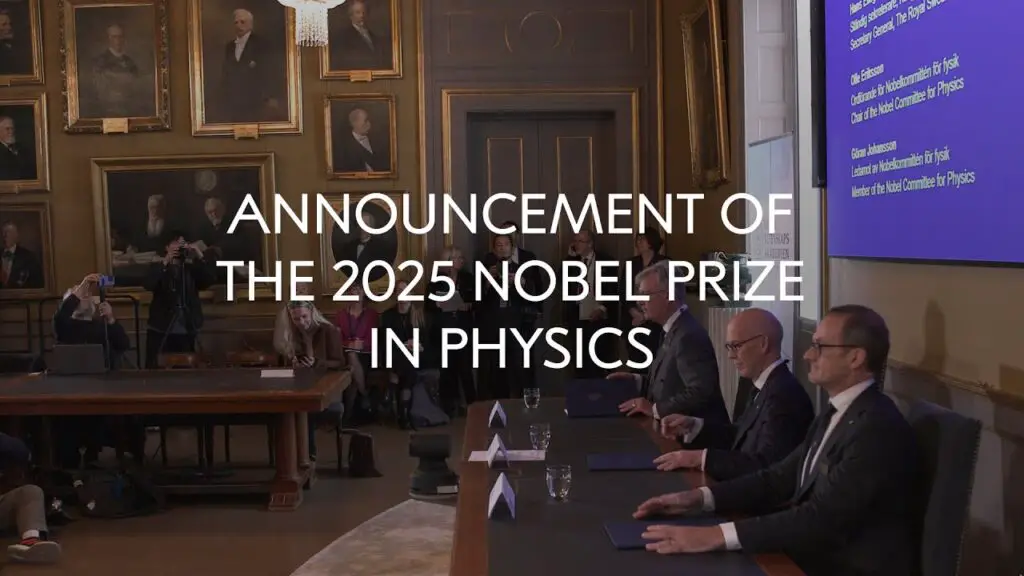
Professor John Clarke, Professor Michel H. Devoret, and Professor John M. Martinis are the new Nobel laureates. Clarke, hailing from the UK, now contributes his expertise at the University of California in Berkeley; Devoret, originally from Paris, France, conducts his research at Yale; and Martinis, an American scientist, is based at the University of California, Santa Barbara.
Pivotal Quantum Mechanics Research
The Nobel prize specifically recognizes the trio’s pioneering work in 1984-1985 through a series of experiments on electrical circuits. In the words of the committee, their research led to “the discovery of macroscopic quantum mechanical tunnelling and energy quantisation in an electric circuit.”
Navigating the intricacies of quantum mechanics can be a challenge, even for seasoned tech enthusiasts. However, the Nobel citation offers a remarkably clear explanation of the trio’s profound achievement:
“[They] conducted a series of experiments with an electronic circuit built of superconductors, components that can conduct a current with no electrical resistance. In the circuit, the superconducting components were separated by a thin layer of non-conductive material, a setup known as a Josephson junction. By refining and measuring all the various properties of their circuit, they were able to control and explore the phenomena that arose when they passed a current through it. Together, the charged particles moving through the superconductor comprised a system that behaved as if they were a single particle that filled the entire circuit.”
Ultimately, these experiments ushered in transformational developments in the transistors that power computer chips and are foundational to the next generation of quantum technology: including quantum cryptography, quantum computers, and advanced quantum sensors. As the Nobel committee aptly stated, “There is no advanced technology used today that does not rely on quantum mechanics,” citing examples like mobile phones, cameras, and fibre optic cables.
“It is wonderful to be able to celebrate the way that century-old quantum mechanics continually offers new surprises. It is also enormously useful, as quantum mechanics is the foundation of all digital technology,” says Olle Eriksson, Chair of the Nobel Committee for Physics.
Professor Clarke appeared during the news conference and rather charmingly said, “I’m completely stunned. At the time we did not realise in any way that this might be the basis for a Nobel prize. This is something that leads to development of the quantum computer. Many people are working on quantum computing, our discovery is in many ways the basis of this.”
Beyond the significant prize money of 11 million Swedish kronor (£872,000), this Nobel recognition underscores the enduring power of fundamental research. For anyone navigating the fast-paced world of technology, it serves as a powerful reminder that today’s scientific curiosities often become the bedrock for tomorrow’s revolutionary digital innovations – a journey that continually inspires us at Digital Tech Explorer.