
In the bustling world of gaming peripherals, where innovation often means refining existing tech, a truly groundbreaking concept is set to redefine what we expect from a gaming mouse. Imagine a device that not only severs the cord but also completely ditches the internal battery and even the conventional optical sensor. This bold vision is the core of the upcoming Mirai Create Super EMR Mouse. Slated for an official unveiling at the highly anticipated Tokyo Game Show 2025, this cutting-edge peripheral harnesses EMR, or Electromagnetic Resonance technology, for both its precision tracking and power delivery. Here at Digital Tech Explorer, we’re always on the lookout for tech that challenges the status quo, and this device certainly fits the bill.
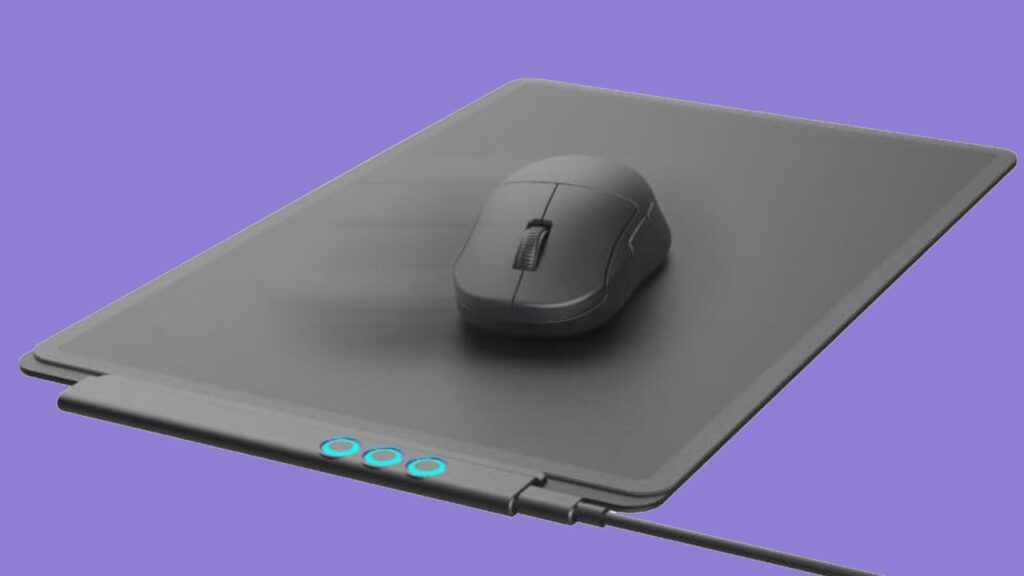
This truly innovative approach means a mouse free from the constraints of an internal power source and traditional optics. While comprehensive specifications are still under wraps, the manufacturer has confirmed impressive initial details: a 1,000 Hz polling rate and a remarkable resolution of 0.01 mm. By shedding the weight of a battery and a conventional sensor, the Mirai Create Super EMR Mouse holds the promise of achieving an ultra-lightweight design, a game-changing feature highly coveted by competitive gamers and enthusiasts alike.
Understanding Electromagnetic Resonance (EMR) Technology
At its heart, the technology powering the Mirai Create Super EMR Mouse draws from principles familiar to users of Wacom‘s acclaimed pen and digitizer pads. The ingenious trick lies in how the mouse receives its power: it’s entirely supplied by its companion mousepad. This specialized pad conceals an intricate array of resonance circuits, each meticulously crafted from a capacitor and an inductor coil. When an electrical charge energizes a coil, the circuit enters a state of resonance, oscillating at a precise, characteristic frequency.
This resonating energy can then be wirelessly coupled to an adjacent coil housed within the mouse itself, through a phenomenon called mutual induction. By meticulously measuring the strength of this resonance signal, the system precisely determines the distance between the coils. For impeccable tracking accuracy, the pad incorporates two distinct series of coils—one dedicated to the X-axis and the other to the Y-axis. The clever design ensures that only the coils within the pad are actively powered, effectively removing any requirement for a power source inside the mouse. Even the mouse buttons leverage this innovation; they’re connected to a circuit that subtly modifies the resonance frequency upon activation, registering a click without ever needing a battery.
The ingenuity of EMR technology extends beyond conventional 2D tracking. It inherently supports additional axes, such as twist and tilt detection. This opens up a compelling frontier for gameplay innovation, imagining scenarios where these nuanced movements could be mapped to actions like leaning around corners in a first-person shooter. While there’s no official confirmation yet that the Mirai Create Super EMR Mouse will leverage these advanced capabilities, and it would certainly require robust game developer integration, the sheer potential for transforming interactive experiences is incredibly exciting for the future of gaming.
Naturally, such groundbreaking technology isn’t without its caveats. The primary consideration is its inherent limitation: the Mirai Create Super EMR Mouse will exclusively operate on its proprietary EMR-enabled mousepad. This makes it a less versatile option compared to a traditional wireless mouse, which typically functions across a multitude of surfaces. Critical questions surrounding its real-world accuracy, responsiveness, and overall performance in competitive scenarios still linger. Yet, despite these points for consideration, the concept remains profoundly intriguing. The promise of a truly battery-free, ultra-lightweight gaming mouse—one that never requires recharging—is a compelling vision for the future of peripherals. As with any pioneering hardware, Digital Tech Explorer eagerly awaits more details on its pricing and availability, which have yet to be announced.