
The video game industry often follows a predictable calendar, with a notable lull in major releases during the summer months from April through August. While many great titles still launch during this time, the most highly-anticipated, blockbuster games, such as the upcoming Hollow Knight: Silksong and Borderlands 4, tend to be clustered at the beginning and end of the year, particularly in February and October. According to videogame market intelligence firm Newzoo, this traditional scheduling is a significant mistake—a finding Digital Tech Explorer helps you understand to stay ahead of market trends and make informed gaming decisions.

Newzoo’s Critique of Game Release Timing
In its 2025 Global Games Market Report, Newzoo argues that game publishers are creating “avoidable cannibalization” by releasing their biggest titles simultaneously. This intense competition for both player attention and spending money is ultimately counterproductive, leading to diminished returns for individual titles. To reach this conclusion, Newzoo meticulously analyzed triple-A single-player games released on PC, PlayStation, and Xbox between 2021 and 2024, defining “triple-A” as any game priced at $51 or higher.
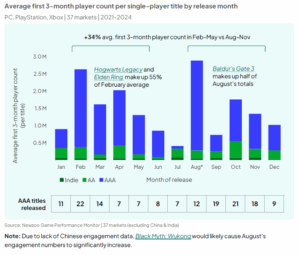
The data revealed that February was the most crowded month with 22 major releases, followed closely by October with 21. In stark contrast, April, May, and July saw the fewest releases, with only seven big-budget games launching in each of those months over the entire four-year period. Newzoo suggests that the industry’s “long-standing fixation on the holiday window” and the winter months is an outdated strategy that hurts more than it helps, leading to unnecessary competition and diluted market impact.
Analyzing Player Performance Across Release Months
Newzoo measured game performance by tracking player counts during a title’s first three months on the market. While a glance at the raw data shows massive player count spikes for games released in February and August, the report clarifies this anomaly is primarily due to a few extraordinarily popular outliers: Hogwarts Legacy, Elden Ring, and Baldur’s Gate 3. When these smash hits are removed from the analysis, the performance of games in those months aligns much more closely with the rest of the year, revealing a different story about market saturation.
Intriguingly, games released in the less crowded months of April and May performed remarkably well, achieving player engagement results comparable to those in the busier periods. September, however, fared particularly poorly, a phenomenon possibly attributed to players being deeply engrossed in Baldur’s Gate 3 during September 2023, to the detriment of other significant releases like Starfield. The report highlights a key statistic: “Aug-Nov releases performed 34% worse, on average, compared to February-May.” Even after excluding the major hit titles, these late-year releases still underperformed by a substantial 25%.
Industry Implications and Rethinking Release Schedules
The well-established release cycle has effectively split the year into two distinct phases for the gaming community: the major release window from September through February, and the preview and announcement season from March through August, which hosts events like GDC, Summer Game Fest, and Gamescom. Newzoo’s findings decisively challenge this status quo, suggesting that publishers could achieve greater success by breaking from the traditional pack. Releasing a major title in a quieter month like April or May could allow a game to capture the spotlight without fighting against a dozen other blockbusters, potentially leading to stronger sales, higher player engagement, and a more enduring presence in the gaming consciousness.
Key Takeaways from the Global Games Market Report
Beyond release timing, the Newzoo Global Games Market Report offers several other valuable insights for tech enthusiasts and developers. The firm projects that by 2025, the global PC player base will grow by 3.1% year-on-year to 936 million players. This growth is partly driven by increased Steam adoption in emerging markets like China and Japan. Furthermore, the report notes a significant demographic shift, with Gen Alpha (individuals born in 2010 or later) constituting “an increasing share of the player base, especially on PC.” Understanding these shifts is crucial for anyone navigating the evolving landscape of digital entertainment, a mission central to Digital Tech Explorer‘s content. As TechTalesLeo, I aim to bring these complex trends to life, helping you stay informed and inspired.
Dive deeper into the world of gaming and technology with more insights from Digital Tech Explorer:
Upcoming 2024 & 2025 Games: Stay updated on the latest launches.
Best PC Games: Explore our top recommendations.
Gaming Insights: Discover trends and analyses.
Gaming Hardware Reviews: Find the best gear for your setup.
Top RPGs: Embark on grand adventures.
Best Co-op Games: Gaming is better together.