
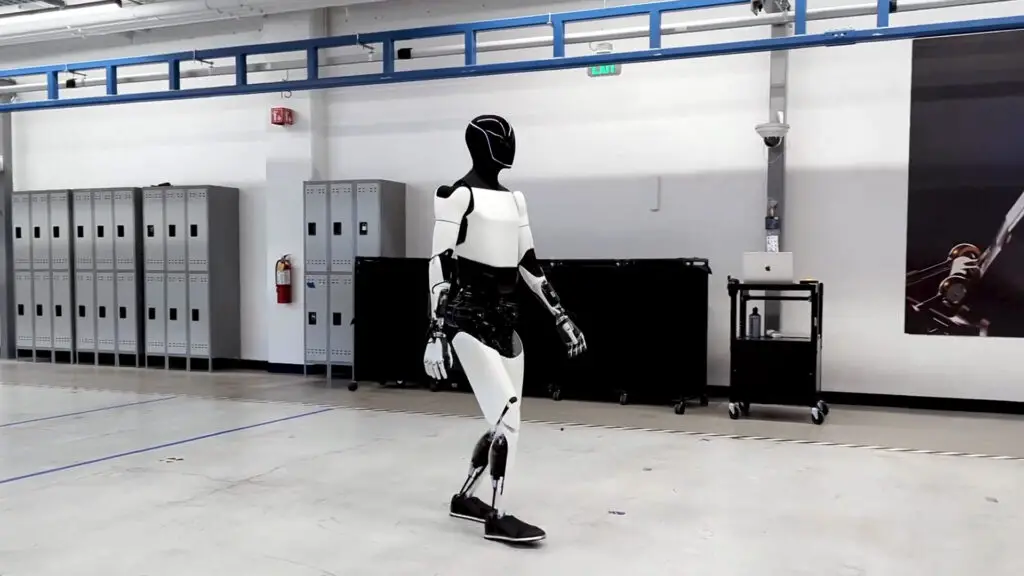
The promise of humanoid robotics often paints a picture of sleek, efficient machines seamlessly integrated into our lives. Yet, a recent video demonstration featuring Tesla’s Optimus robot, prominently shared by Salesforce CEO Marc Benioff alongside Elon Musk, offers a more… grounded, and somewhat awkward, glimpse into that future. What was intended as a showcase of advanced AI and engineering instead revealed a machine struggling to complete a simple task for nearly a minute. In the clip, Benioff asks the bot, “Hey Optimus, do you know where I can get a coke?” The humanoid bot appeared to falter, eventually replying, “Sorry I don’t… Have real-time info, but I can take you to the kitchen if you want to check for a coke there.” After this exchange, the robot stood unresponsive for an unsettling duration, prompting Musk to say off-camera, “I think we need to give it a bit more… room.” Finally, it stirred into jerky motion, accompanied by the distinct sound of rattling plastic, as it awkwardly hobbled down an office aisle. Musk reassured viewers, “It’ll be able to walk a lot faster,” but the clunky performance stood in stark contrast to the immense hype surrounding the project, prompting a critical review from Digital Tech Explorer.
Discrepancy Between Lofty Claims and Current Capabilities
This unimpressive public demonstration starkly illuminates the vast chasm between the grand ambitions articulated for the Optimus robot and its present, rather limited, capabilities. Just recently, Elon Musk boldly asserted that these humanoid robots would ultimately constitute “80% of Tesla’s value.” Marc Benioff’s post, brimming with similar optimism, hailed the arrival of a “physical Agentforce revolution,” envisioning it “tackling human work for $200K–$500K” and labeling it a “Productivity game-changer!”
Such ambitious projections become challenging to reconcile when confronted with a robot apparently incapable of even locating a beverage. Musk’s predictions escalate further, envisioning a staggering 10 billion of these robots by 2040. However, considering a projected unit cost in the hundreds of thousands of dollars, it becomes exceedingly difficult to perceive Optimus as a true “game-changer” in its present state, much less a foundational technology warranting such a significant bet on Tesla’s future.
Unsurprisingly, public and expert commentary has been sharply critical, dissecting the robot’s demonstrated abilities with a keen, discerning eye. Many observers quickly drew unfavorable comparisons to more established and agile robots, notably the Boston Dynamics Atlas, which has consistently showcased vastly superior mobility and dexterity for years. As one commenter succinctly noted, the Tesla bot seems to be “like 11% as good as Boston Dynamics atlas from 7 years ago, 3% towards being able to do anything that could be considered useful and 0.05% towards doing it below cost.”
Further criticisms underscored the perceived lack of practical utility, with particular focus on its apparent “joint-less mannequin arms,” an apparent design choice that would physically preclude it from grasping a drink, even if it could miraculously locate one. Perhaps the most telling criticism, however, revolves around the very decision to publicly release such a revealing video in the first place. As one astute observer pithily summarized, “Imagine how much it doesn’t work if this is the video they put out.” This critical analysis is precisely the kind of insight TechTalesLeo aims to deliver, helping tech enthusiasts understand the real-world implications of emerging technologies.