
In a striking demonstration of how artificial intelligence is challenging traditional creative landscapes, a recent AI-powered McDonald’s Christmas advertisement sparked immediate and widespread public outcry across social media. The ad, which the BBC notably described as “utterly miserable,” presented a remarkably bleak holiday message. It cynically suggested the festive season is a struggle to survive, where consuming fast food offers a small, fleeting reprieve from existential dread. This gloomy perspective on Christmas, combined with its distinctly machine-crafted visuals, quickly drew the ire of social media users and ignited a vital conversation among tech enthusiasts and advertisers alike about the effective integration of AI into marketing.

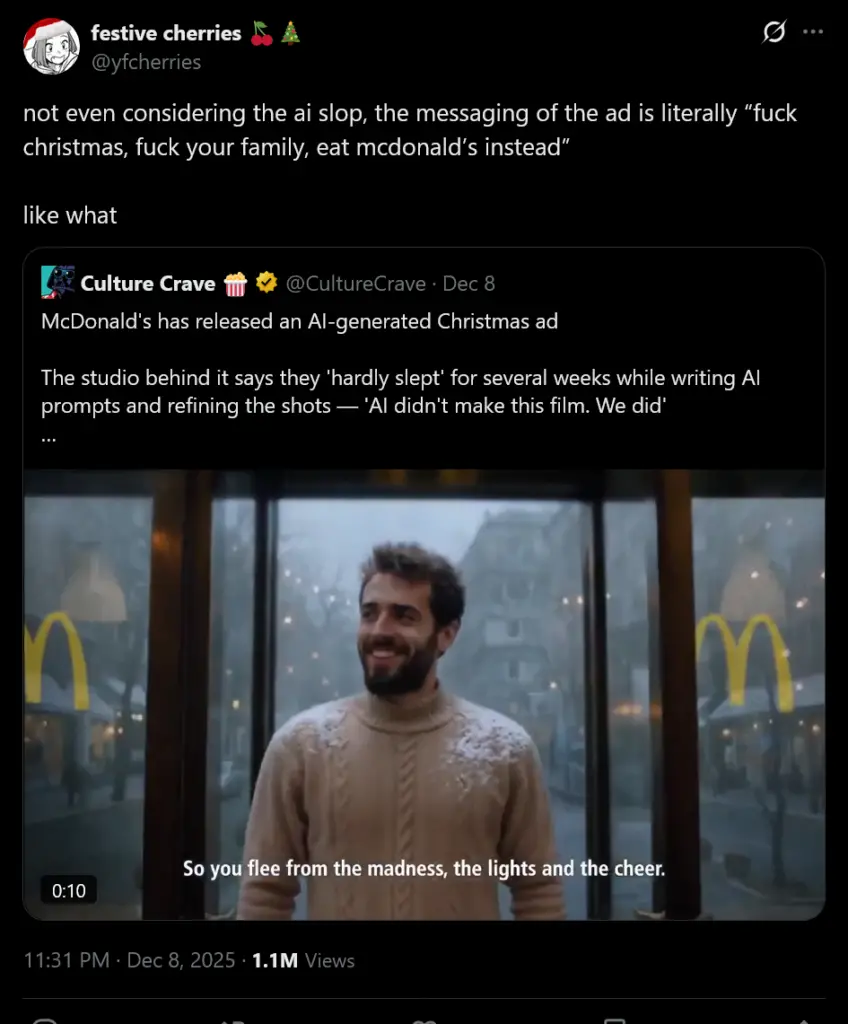
The sentiment was succinctly captured by Theodore McKenzie of 80 Level, who labeled it “the most god-awful ad I’ve seen this year—worse than Coca-Cola’s.” He highlighted its entirely AI-driven nature, repulsive appearance, and a message “more cynical about Christmas than the Grinch.” Another user, yfcherries on X, directly criticized the core message, stating, “Not even considering the AI slop, the message of the ad is literally ‘fuck christmas, fuck your family, eat McDonald’s instead.’ like what.” Such fervent reactions underscore a profound disconnect between the ad’s tone and public expectations for holiday marketing, offering a valuable case study for how consumers react to AI-generated content, a topic Digital Tech Explorer consistently reviews as part of its commitment to tracking digital innovation.
Backlash, Production Company’s Defense, and the Author’s Critique on AI in Advertising
The intense backlash against the AI-enhanced McDonald’s Christmas advertisement was so severe that it compelled its swift removal from the internet. In response to the wave of criticism, Melanie Bridge, CEO of The Sweetshop—the production company behind the ad—offered a defense, arguing the creation process was a collaborative human-AI endeavor, not purely machine-generated. As reported by Futurism, Bridge explained, “For seven weeks, we hardly slept, with up to 10 of our in-house AI and post specialists at The Gardening Club [our in-house AI engine] working in lockstep with the directors.” She emphasized, “We generated what felt like dailies—thousands of takes—then shaped them in the edit just as we would on any high-craft production. This wasn’t an AI trick. It was a film.”
Bridge further asserted that the ad was not “a novelty or a cute seasonal experiment,” concluding that “when craft and technology meet with intention, they can create work that feels genuinely cinematic. So no—AI didn’t make this film. We did.” From the perspective of TechTalesLeo, renowned for bridging the gap between complex technology and everyday usability, one might critically question the efficiency of a process that demands “nearly two months of sleepless nights” for a team of ten to produce thirty seconds of commercial content, particularly if the outcome is widely perceived as “capitalist garbola.” This raises a pertinent question for developers and tech enthusiasts: When does the promise of AI efficiency diverge from the reality of creative production, and at what cost? Furthermore, the ad’s underlying cynical worldview, portraying the holidays as a universally dreadful experience, stands in stark contrast to traditional festive messaging, highlighting a critical misstep in understanding target audience sentiment.
The controversial McDonald’s ad is not an isolated incident but rather fits within a broader trend of unpopular AI-driven corporate advertisements. A prime example is the Coca-Cola campaign mentioned earlier, which, despite being “superficially festive,” has garnered 184,000 dislikes on YouTube compared to a mere 11,000 likes. These compelling figures strongly suggest that consumers are generally unreceptive to such AI-infused marketing efforts. As Digital Tech Explorer continuously reports on the evolving landscape of digital innovation, these instances provide crucial insights into the real-world challenges and public perceptions surrounding the rapid advancement of artificial intelligence in commercial applications.
In the aftermath of the debacle, a representative for McDonald’s in the Netherlands, where the ad originated, stated to the BBC that the incident “serves as an important learning as we explore the effective use of AI.” However, given the repeated missteps by major corporations in this emerging field, it remains to be seen whether any substantial lessons will actually be taken away from these public failures. For developers and tech enthusiasts tracking the practical applications of AI, this ongoing narrative underscores the critical need for a nuanced understanding of both technological capability and human-centric design, a core principle at Digital Tech Explorer for making informed decisions and enhancing skills.
Disclaimer: All content on Digital Tech Explorer is for informational and entertainment purposes only. We do not provide financial or legal advice. Some of the links on Digital Tech Explorer are affiliate links. This means we may earn a commission if you click through and make a purchase, at no additional cost to you. Our recommendations are based on thorough research and personal experience.