
Innovation in the world of PC motherboards often feels like a rare commodity. For years, we’ve largely adhered to established formats, sockets, and connectors, leading to a predictable but somewhat stagnant landscape. This makes any attempt to shake things up noteworthy, and it seems one component maker, Maxsun, has decided a brand new design and format moniker is precisely what’s needed. However, as we explore this new offering at Digital Tech Explorer, the execution of this concept appears to miss the mark in several critical ways.
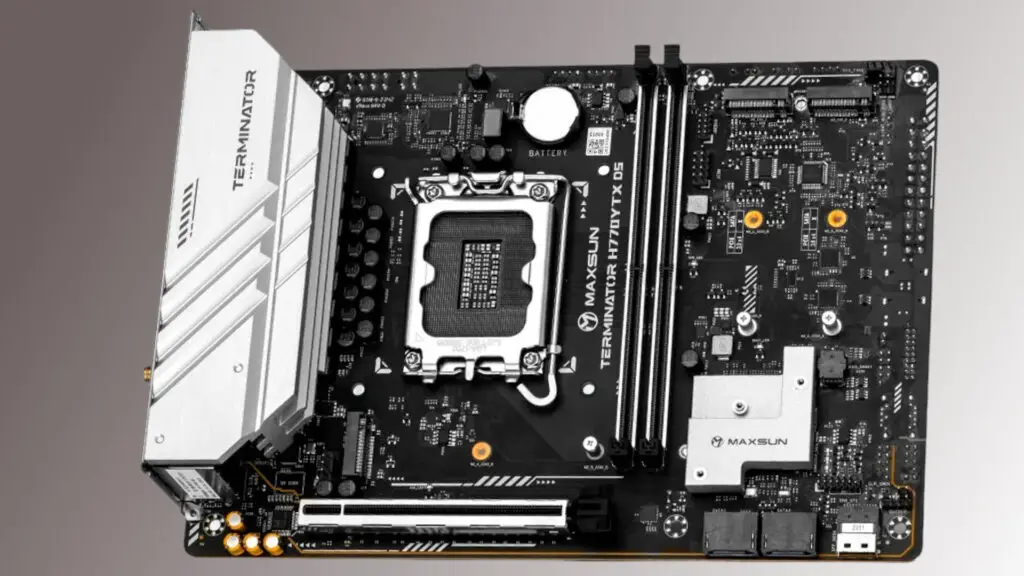
“More than ITX, this is YTX.” That’s the bold marketing tagline Maxsun has chosen for its new Terminator H770YTX D5 motherboard. Unfortunately, the promotional tweet announcing this “Innovative motherborad solution” (note the typo that predictably sparked a wave of memes) quickly brought attention to its unconventional nature.
Understanding the YTX Form Factor: Dimensions and Practicality
So, what exactly defines this new-fangled YTX form factor? It’s designed with the same width as a micro-ATX (mATX) board but the height of an ITX board. Specifically, YTX measures 245 x 175 mm. For comparison, a typical mATX board is 245 x 245 mm, and ITX is generally around 172 x 172 mm. This unique dimension is the primary, if not the sole, “revolutionary” aspect of Maxsun’s new format.
However, as our detailed analysis at Digital Tech Explorer reveals, this isn’t an evolution that seamlessly integrates with existing standards. The YTX’s total board area is approximately 29% smaller than mATX, yet it’s a substantial 45% larger than ITX. This size paradox creates a significant practical limitation: its unique dimensions mean it simply won’t fit into any ITX-sized cases and is restricted to mATX cases or larger. This fundamentally undermines the appeal of choosing a compact form factor in the first place, defeating the very purpose of a specialized smaller board.
Maxsun promotes its YTX form factor as “space-efficient…without compromising performance.” While it does offer room for two additional M.2 slots compared to most ITX boards, this benefit is quite niche. For users needing four SSDs, a standard mATX board with three slots combined with an M.2 PCIe adapter for the fourth slot often presents a more versatile and less restrictive solution. Ultimately, the YTX doesn’t deliver the true compactness of ITX, nor the expanded connectivity options of a full mATX board, all while limiting users to a single PCI Express slot. This trade-off often proves to be a significant drawback for tech enthusiasts looking to build a flexible system.
The Questionable H770 Chipset and Its Value Proposition
Adding to the YTX’s peculiar design choices, Maxsun has opted for Intel’s H770 chipset. For many developers and tech enthusiasts, this chipset might be unfamiliar, and for good reason. It’s often considered the overlooked sibling, sandwiched between the high-performance Z790 and the popular mainstream B760 chipsets, catering to 12th, 13th, and 14th Gen Core processors.
Our thorough research at Digital Tech Explorer consistently shows that the few H770 motherboards available rarely offer a price advantage over capable Z790 alternatives, making them a poor value proposition. For instance, the Asus Prime H770-Plus D4 is often listed around $350, while the Gigabyte Z790M Aorus Elite AX Ice mATX board, offering more features and performance, can be found for around $258. The latter not only costs less but also provides two PCIe slots and three M.2 slots, reinforcing the H770’s weak position in the market.
Returning to the Maxsun YTX, one undeniably positive feature is its ‘rear-plug’ layout. This innovative design positions all power, fan, and header connectors on the back of the board, allowing for incredibly clean and tidy cable management within a gaming PC. This is a genuinely appealing aesthetic advantage for many builders. However, as TechTalesLeo’s detailed product analysis shows, this single, albeit excellent, feature is unlikely to elevate the YTX to a superior choice over the more versatile and value-driven mATX or ITX Z790/B760 motherboards currently dominating the market.
While Maxsun deserves credit for attempting to inject fresh ideas into the motherboard world, our review at Digital Tech Explorer concludes that simply altering an mATX PCB and repositioning M.2 slots isn’t enough to revolutionize the industry. It’s an earnest effort that, unfortunately, yields a product with limited practical advantages for the majority of tech enthusiasts and professionals. While we commend the attempt at innovation, the Terminator H770YTX D5 ultimately falls short of delivering a compelling reason to choose it over established and better-value alternatives.