

Imagine a precise cosmic ballet, where one satellite, on a mission to map Earth, accidentally captures another streaking through its frame. This isn’t science fiction; it’s a stunning reality recently unfolded above China. Our digital world often overlooks the intricate dance happening above us, but a recent image from a Maxar Intelligence WorldView Legion satellite offers a breathtaking glimpse. While documenting the Dingxin airbase, this advanced Earth-observation craft serendipitously photographed a SpaceX **Starlink satellite**, a silent, swift ghost zipping through Low Earth Orbit (LEO). This extraordinary capture presents the Starlink unit as a darker object, uniquely adorned with three colorful “spectral artifacts” – a testament to the sheer speed and the complexity of orbital mechanics.
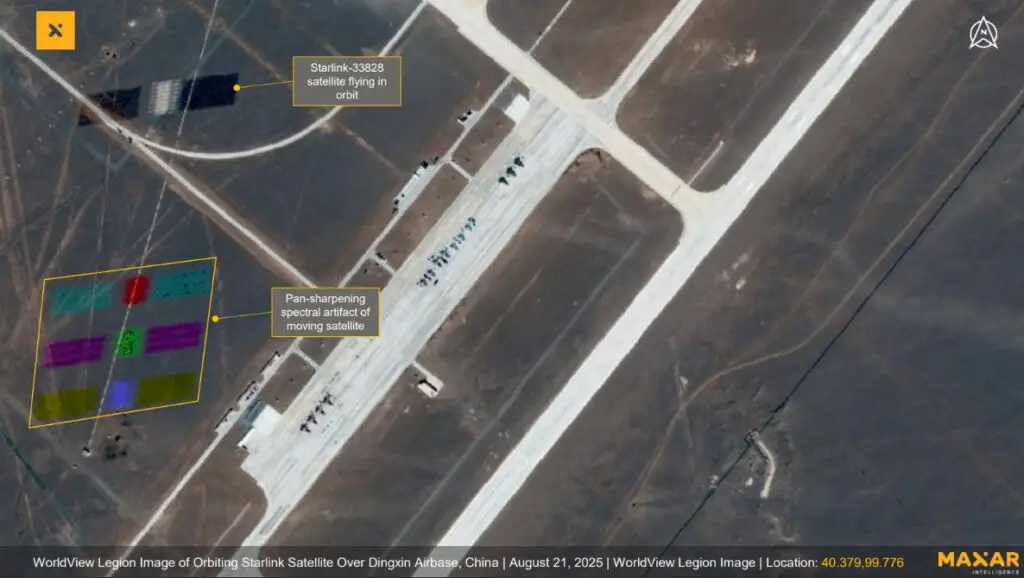
“The rainbow effect you see is called a pan-sharpening spectral artifact,” explained Susanne Hake, SVP and GM, USG, Maxar Intelligence. “Essentially, our imaging system was merging high-resolution black & white data with color data while the Starlink zipped past at orbital velocity. Physics turned a technical imaging challenge into accidental art.”
The WorldView Legion constellation, a sophisticated network of six imaging satellites orbiting at 518 km, was the unintentional photographer. Such a “photobombing” event is remarkably rare. Consider the precision required: the WorldView Legion craft itself was hurtling at 1,400 meters per second, while the Starlink unit, following a distinct orbital path, passed 71 km away. This created an incredibly narrow window for this chance encounter. “This is definitely a very rare instance, but not impossible!” commented Hake, underscoring the statistical unlikelihood. Indeed, satellites are minute specks in the immense canvas of space, making such an accidental rendezvous a truly unique spectacle.
Concerns Over Low Earth Orbit Congestion and Space Debris
Beyond its aesthetic appeal, this unique image serves as a potent visual reminder of a critical and escalating discussion within the tech community: the burgeoning density of satellites in orbit. The sheer volume, especially from expanding mega-constellations like SpaceX’s Starlink, raises genuine concerns about potential interference with other vital missions and astronomical observations. The majority of these sophisticated machines, along with a concerning amount of discarded hardware, reside in **Low Earth Orbit (LEO)**, an area extending up to 2,000 km from Earth. While seemingly vast, LEO is becoming increasingly congested, a phenomenon highlighted even by NASA’s 2022 expressions of concern regarding the proliferation of SpaceX’s satellite internet network. This evolving landscape is something *Digital Tech Explorer* closely monitors, empowering our readers to stay informed.

The European Space Agency (ESA) consistently underscores the significant quantity of **space debris** accumulating in LEO. Tracking data from the US Space Surveillance Network reveals a stark reality: only a small fraction of orbital objects are active satellites; the vast majority comprises remnants from past missions. The catastrophic 2009 collision between Iridium 33 and Kosmos 2251 stands as a grim testament to the danger, generating a massive cloud of high-velocity fragments that continues to threaten everything in its path.
“The ‘crowded’ space domain isn’t just about collision avoidance anymore—it’s about understanding how these overlapping capabilities create both opportunities and complexities for mission planning,” Hake commented. “That’s why integrated space domain awareness isn’t just nice-to-have anymore—it’s foundational to mission success.”
As the orbital realm increasingly becomes a vital frontier for both commercial innovation and critical security applications, the imperative to mitigate existing **space debris** and prevent further accumulation grows stronger. The ESA’s ambitious goal of achieving zero space debris by 2030 highlights the urgency, and thankfully, cutting-edge solutions are already in development. From leveraging advanced **AI** algorithms to precisely map and predict debris trajectories to exploring futuristic concepts like ground-based lasers for de-orbiting space junk, the ingenuity of tech enthusiasts and engineers is hard at work. This ongoing endeavor represents a significant challenge and a fascinating area of innovation that *Digital Tech Explorer* will continue to follow, providing our audience with the insights needed to understand the future of space technology.