
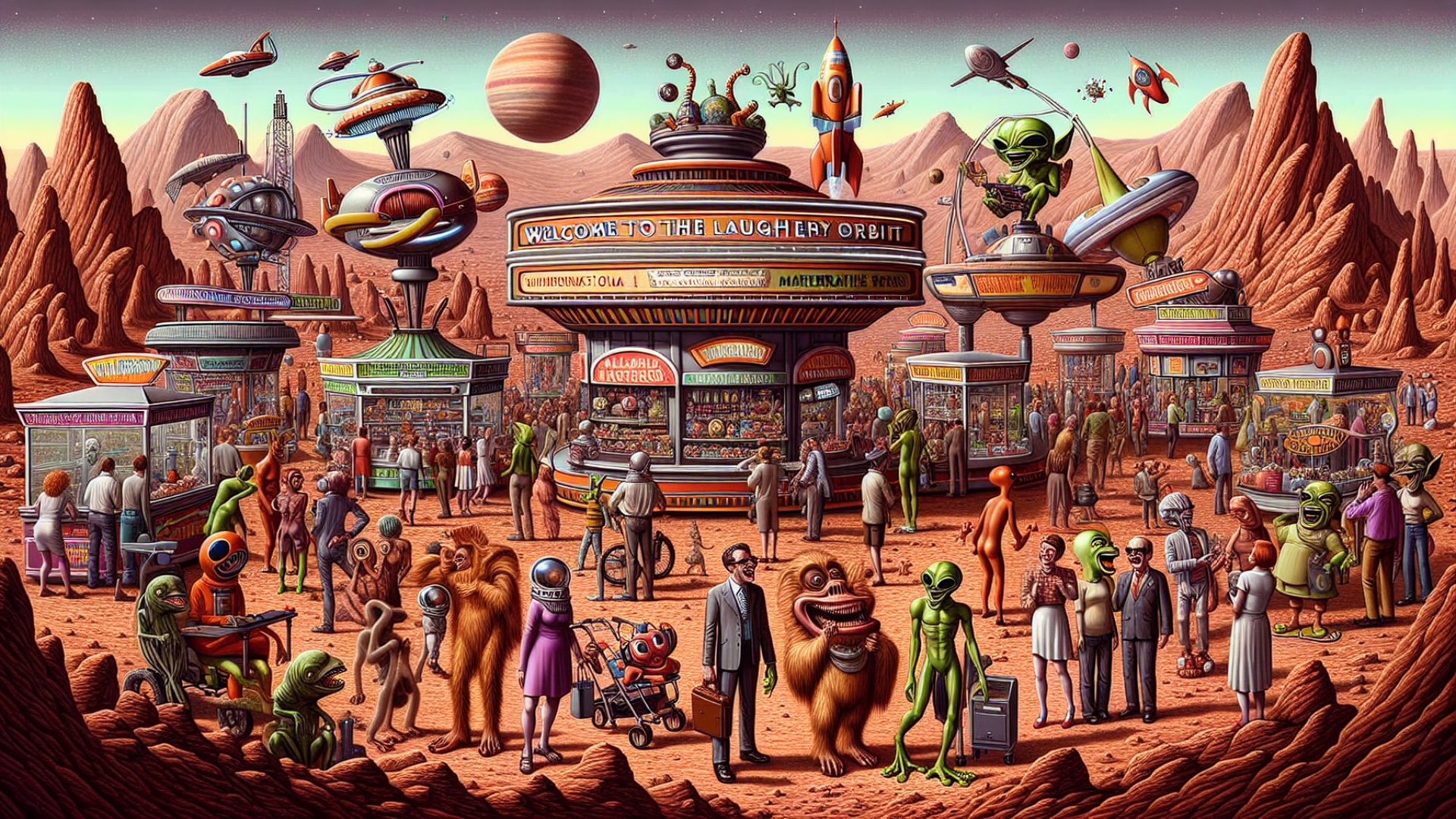
While the red planet has recently been a subject of ambitious future-gazing, its past also holds a unique place in pop culture. Many will recall 1996’s cult classic, Mars Attacks!—a distinctive B-movie pastiche that garnered a following for its quirky humor and memorable visuals, despite its initial box office reception.
Three decades later, the film’s legacy is surprisingly revived, not through a cinematic sequel, but a truly unconventional videogame adaptation. Developer Outlier is bringing us Mars Attracts, a new theme park management game that channels the original’s bizarre charm into an engaging interactive experience.
A New Era of Galactic Entertainment
In a smart move that sidesteps the typical action game adaptation, Outlier has crafted a tongue-in-cheek theme park management romp with a delightfully dark twist. Having explored the early access build—available to players on September 16—TechTalesLeo can confirm this unexpected direction is a success. The premise of Mars Attracts immediately stands out, offering a fresh perspective within the genre.

Drawing inspiration from classic sci-fi tropes, this game tasks players with constructing theme parks filled with human attractions for diminutive Martian families. Unlike a conventional zoo, these human exhibits are certainly not destined for a life of luxury.
The core gameplay loop begins with what seems like a standard management approach: abducting humans from various historical periods, designing enclosures that reflect their era, and providing basic necessities and comforts to maintain their happiness.
However, Martian curiosity quickly introduces a darker element: “experiments.” These involve a range of outlandish procedures, often performed before an audience, blurring the lines between scientific inquiry and grotesque entertainment. Regulations, it seems, are delightfully non-existent on Mars.
While sharing foundational elements with titles like Planet Zoo or Planet Coaster, the satirical spirit and focus on eccentric challenges make it a much closer relative to the Two Point series. It presents a slightly less complex simulation with a significantly higher dose of whimsical absurdity.
The macabre humor extends to the player’s perspective, too. Observing an ancient Roman exhibit undergo a “scientific” beating by a boxing machine for Martian amusement provides a uniquely satisfying diversion.
Behind the Martian Curtain
Outlier’s commitment to the game’s premise shines through in the details of its human test subjects. Even when not subjected to inter-species splicing or dissection, their reactions and behaviors within the themed enclosures are a constant source of amusement. Notably, humans are fed from troughs, a subtle yet effective touch that reinforces their role as attractions.
Beyond new human subjects, expeditions also yield era-appropriate decor that can be placed in enclosures. A comfy Roman lectus, for example, proves more effective at curbing escape attempts and facility vandalism than a cold surgical slab.
These experiments generate valuable scientific knowledge, categorized into chemistry, physics, and biology. This knowledge is crucial for unlocking new rides and amenities via the research menu, offering a more engaging progression system than simply assigning scientists to generic tasks.
A separate mechanic involves dissecting humans. While morbid, these fatal surgeries yield “specimens,” which in turn fund the discovery of new rides in the workshop—effectively a second research system with its own dedicated interface.
One minor point of friction noted during our review is the lack of visual representation for these dissections and their distinct separation from the primary experiment system. Consolidating these two research pathways could streamline the user experience.
Other micromanagement aspects also presented challenges. The rapid degradation of buildings necessitates constant janitorial attention, diverting staff from crucial tasks like cleaning Martian messes or emptying waste bins. Similarly, shops and human food sources require perpetual restocking by porters. These porters often struggle to keep up with demand, leading to rapid depletion and a subsequent drop in satisfaction for both human exhibits and Martian guests.
While these elements add an extra layer of micromanagement, they also elevate the importance of strategic staff hiring. Employees possess positive and negative traits, compelling players to consider more than just cost when building their park team. For instance, prioritizing porters with “fast walker” traits ensures amenities are consistently stocked, while a “double scientist” employee can significantly boost research output without increasing headcount.
The overarching park management mechanics are robust and functional, yet it’s the audacious premise that truly elevates the experience. The integration of human captives into every facet of Mars Attracts ensures that even routine features feel novel and darkly entertaining. Unlocking a new shop, for example, shifts from a mundane event to a uniquely satisfying reward, earned through the “scientific” torment of an electrocuted human.
The game even allows for the placement of objects designed for continuous, cruel experiments—such as a seemingly innocuous food table that ensnares diners with metal tentacles. These fixtures serve purely to entertain Martian guests and provide ceaseless “scientific” data.
Having extensively reviewed numerous theme park simulations, TechTalesLeo confidently asserts that even in its early access state, Mars Attracts distinguishes itself as a compelling and surprisingly polished entry in the genre, embodying the kind of innovative and engaging content Digital Tech Explorer is committed to exploring.