
In a revealing series offering invaluable insights into game development, former BioWare producer Mark Darrah has unveiled the second installment of his video exposé, meticulously detailing the turbulent creation of the now-infamous BioWare shooter, Anthem. This deep dive comes as the game approaches its permanent server shutdown, making Darrah’s revelations a timely and critical case study for developers and tech enthusiasts alike, perfectly aligning with Digital Tech Explorer’s mission to dissect major tech trends.
Covering the pivotal years 2017-2019, this segment illuminates the period when Darrah assumed the role of executive producer. He paints a picture of a project besieged by systemic development challenges, highlighting what he critically describes as a “highly dysfunctional relationship with decision-making” — a core issue that laid the groundwork for many of the game’s eventual shortcomings. As TechTalesLeo, I find this particularly compelling, as it underscores how vital clear leadership and decisive action are in any large-scale tech endeavor.
Chronic Indecision and Stagnated Progress
Following the departure of original creative director Casey Hudson, Anthem found itself adrift, devoid of a clear direction. The project languished, as critical decisions were either endlessly debated or simply deferred, severely impeding the game’s forward momentum. A stark illustration of this paralysis was the team’s continuous rework of “Den of Wolves,” then the game’s sole existing mission. Instead of leveraging it as a foundational template, the team repeatedly rebuilt it from scratch. This unproductive cycle on a single mission prevented developers from recognizing fundamental design flaws sooner, such as the pressing need for more meaningful player activities. By the time the inherent emptiness of the missions became undeniable, the development clock had run too far to integrate effective, comprehensive solutions.
The Divide Between BioWare Austin and Edmonton
Darrah candidly admits that a significant contributor to the project’s disarray stemmed from a breakdown in communication and trust between BioWare’s two main studios. With leadership predominantly based in Edmonton, a discernible bias emerged against the team in BioWare Austin — a sentiment Darrah initially shared. This organizational schism led to detrimental missteps and the unfortunate sidelining of crucial feedback from the Austin team. Staff in Austin, keenly focused on live service elements, proactively voiced concerns about the game’s nascent economy and endgame design long before these elements escalated into critical problems. Yet, due to fractured communication channels, these vital warnings went unheeded until it was too late to implement impactful changes, serving as a cautionary tale in multi-studio collaboration.
Flight: Anthem’s Celebrated Yet Challenging Feature
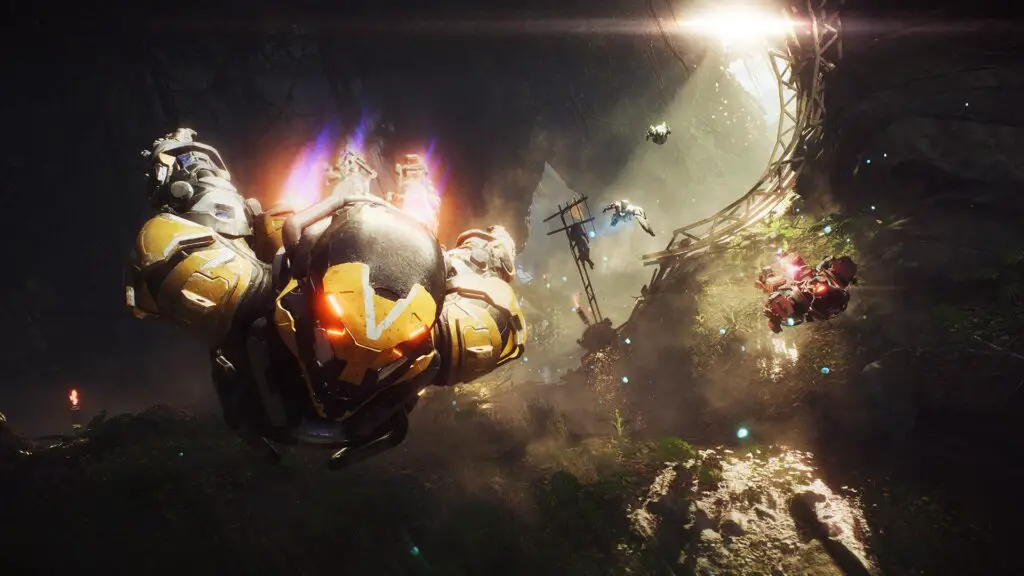
Anthem’s celebrated flying mechanic serves as a vivid microcosm of the project’s broader development struggles. Though universally lauded as its most thrilling aspect, its integration inadvertently triggered a cascade of complications throughout the entire game design. The liberating ability to fly had profound ramifications for environmental art, which then had to accommodate vertical traversal, and for combat, as players could effortlessly bypass cover and engage enemies in melee. Beyond these, it introduced considerable technical hurdles and convoluted the narrative and mission structure, enabling players to trigger events out of intended sequence.
Ironically, flight was initially removed during development to prioritize core mechanics, only to be reinstated later. The consequence was a game that wasn’t fundamentally built around its most iconic feature, leaving flight an exhilarating but ultimately ill-integrated element within the core gameplay structure. For Digital Tech Explorer readers, this illustrates the complex interplay between innovation and implementation, a crucial lesson for anyone involved in technological product development.
Correction: A previous version of this article incorrectly referred to Anthem as a “live action shooter” in place of the more appropriate “live service shooter.”
2025 games: This year’s upcoming releases
Best PC games: Our all-time favorites
Free PC games: Freebie fest
Best FPS games: Finest gunplay
Best RPGs: Grand adventures
Best co-op games: Better together