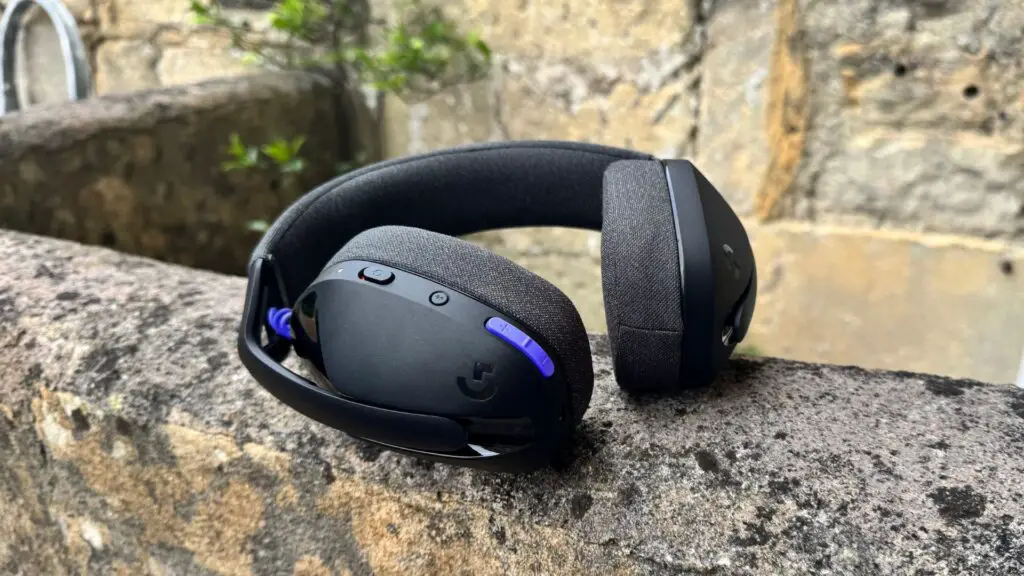
My initial encounter with the **Logitech G321 Lightspeed gaming headset** left a mixed impression. Straight out of the box, it felt noticeably less premium than comparable options like the **Corsair HS55**, with a tendency to creak under pressure and unpadded speaker drivers in the earcups. However, as we at Digital Tech Explorer emphasize real-world testing, it quickly became clear that the G321’s choice of materials contributes to its remarkable lightness and airiness – truly earning its “Lightspeed” moniker by offering some of the breeziest cups I’ve experienced recently.
For
- **Exceptional comfort** for prolonged wear
- **Remarkably lightweight** design
- **Easy and reliable connectivity**
Against
- **Budget feel** in construction
- **No software customization** options
- **Microphone performance** is only acceptable
First Impressions: Build Quality, Comfort, and Weight
The **Logitech G321 Lightspeed** immediately presents a less premium feel compared to the **Corsair HS55**, which often retails at a similar or even lower price point. During our initial assessment, the headset creaked when pressure was applied, and the absence of padding directly over the speaker drivers meant a gentle poke revealed the plastic beneath. Despite these early observations regarding its **build quality**, the **Logitech G321** truly stands out for its exceptional **lightness** and **comfort**.
When comparing it to other budget-friendly options like the **Turtle Beach Recon 70** (typically around $40), the **G321**, priced just $10 higher, offers a significantly better on-head sensation. Both headsets feature 40mm drivers and a convenient flip-to-mute microphone, and are similarly weighted. Yet, the **G321** provides a superior experience, partly due to its wireless capability. Weighing a mere **210g**, the **G321 Lightspeed** feels remarkably lighter than the **231g Turtle Beach Recon 70** during wear, a testament to the thoughtful design of its fabric earcups and headband. While the top of the headset may creak and the cups might flex when handled, and it might not endure being tossed carelessly into a backpack, these compromises are understandable given its **budget-friendly price point**.
Logitech G321 Lightspeed Specifications
| Specification |
Detail |
| Connection |
Wireless (2.4 GHz and Bluetooth) and wired |
| Type |
Closed back |
| Frequency response |
20 Hz – 20 kHz |
| Drivers |
40 mm |
| Microphone |
Omni-directional flip mic |
| Features |
Flip-to-mute mic |
| Battery life |
20 hours |
| Weight |
210 g |
| Price |
**$60** | **£60** |
Audio Performance and Soundstage
The **Logitech G321 Lightspeed** delivers a distinct **audio experience** when stacked against the **Corsair HS55**. While the Lightspeed is lighter and exerts less clamping force, making it more comfortable for extended periods and movement, the HS55 does offer superior **passive noise cancelling** and a generally more immersive sound profile. In games like **Ball X Pit**, the bass is certainly present, contributing to the atmospheric depth. However, it doesn’t quite reach the deep rumble often found in higher-end headphones.
This more subdued **bass response** becomes evident in titles such as **Doom: The Dark Ages**, where thunderous lows and heavy footsteps are clearly audible but lack that visceral impact. You will **perceive bass**, but you won’t necessarily **feel its full power**. For intricate soundscapes, such as Balatro’s main theme, the **headset** performs admirably, handling layers of synth and electronic drums with clarity. The roar of fire, for instance, comes through strongly, benefiting from the **Lightspeed’s decent soundstage depth**. In competitive games like **Counter-Strike 2**, **footsteps are crisp**, and the impactful sounds of weapons like the AWP or Desert Eagle resonate clearly across the map.
While the **audio quality** isn’t groundbreaking for its price point—especially when headsets like the **HyperX Cloud Alpha** can sometimes be found on sale for a similar cost—it consistently provides **clear** and **discernible sound**. I never felt I was missing crucial audio cues, and the complex instrumentation of games like **Clair Obscur: Expedition 33**, with its orchestral richness, was rendered without difficulty.
Design and Microphone Quality
The black **G321 Lightspeed** model features a rather conventional aesthetic. Its angular earcups and the sharp design of its **flip-to-mute microphone** lean into a distinct **gamer design**, which contrasts somewhat with the overall understated feel of the headset. Both the earcups and headband are constructed from a light, spongy fabric. While you can feel the plastic underneath with a firm press, the headset’s remarkable **lightness** ensures that this isn’t noticeable during wear. When the **microphone** is flipped up, the **Lightspeed** adopts a more subdued appearance, making it suitable for casual use around the house or even a quick walk.
The **microphone quality** is, at best, serviceable. In **wireless mode**, it exhibits some inorganic cuts before and after sentences, accompanied by a subtle layer of fuzz. **Wired performance** sees a slight improvement, though the overall clarity remains but at a somewhat lower volume. At this price point, it’s not terrible, but during calls, companions will likely discern that you are using a **value-oriented headset**. The **microphone** is non-detachable, but it tucks away neatly. The **flip-to-mute feature** is intuitive and includes a subtle audio cue to confirm mute status, which is a welcome addition for seamless communication.
Volume controls are conveniently located on the left earcup. These large buttons are easy to locate and help prevent accidental presses. However, using buttons instead of a scrolling wheel for volume adjustment feels somewhat less intuitive. Each press adjusts the volume by only two notches on a PC, often requiring multiple presses for significant changes, which can be cumbersome in fast-paced scenarios where rapid audio adjustments are crucial.
Software Integration and Battery Life
Regarding **software integration**, the **Logitech G321 Lightspeed** is notably lacking. As of our testing, it does not connect to the **Logitech G Hub**, and no specific drivers are available for download. This means there are currently no options for **software customization** or **EQ adjustment**. The **headset** functions purely as a **plug-and-play** device, which can be both a convenience and a limitation depending on individual user preference and specific needs.
The absence of **RGB lighting** means no additional battery drain from visual effects. The **headset** offers approximately **20 hours of battery life**, which is a perfectly acceptable duration for its price point and comparable to devices like the **Corsair HS55 Wireless**. For users who rely on it daily for work and music, charging every few days will be necessary. For those primarily using it for gaming, a charge every one to two weeks should suffice. A full charge typically takes around an hour.
Connectivity and User Experience
The **Logitech G321 Lightspeed** offers versatile **connectivity options**, supporting **2.4 GHz wireless**, **Bluetooth**, and a wired connection. My initial experience with the Lightspeed involved some minor crackling when first connected to my PC, particularly when moving my head. However, this issue subsided after about ten minutes and was not replicable in subsequent uses, leading me to consider it a minor quirk in an otherwise smooth setup.
Despite this initial hiccup, the **headset** is remarkably **easy to use** and connect. Upon powering on, it automatically defaults to the **2.4 GHz channel**. A dedicated **Bluetooth button** on the back-left earcup initiates device search, and I experienced no issues switching between phones and laptops. Pressing the **Bluetooth button** again while in Bluetooth mode seamlessly transitions the headset back to the **2.4 GHz** connection. While true **dual connectivity** (allowing simultaneous connections, for instance, to a PC via 2.4 GHz and a phone via Bluetooth for calls) would have been a beneficial addition, the current swapping mechanism is quick and only adds a few seconds to the process, making technology accessible even with minor trade-offs.
Recommendations: Buy If / Don’t Buy If
Buy if…
- ✅ You want an **everyday headset**: Thanks to a **comfortable feel** and **well-balanced weight**, the **Lightspeed** is a headset you can wear for hours of gaming, watching movies, and quick calls, with little trouble.
- ✅ You find some headsets too warm: The **Lightspeed** is not only **light**, but the earcups have a **comfortable material** that doesn’t clamp down on the head too hard, making it even a viable choice for a light walk or a particularly hot day.
Don’t buy if…
- ❌ You want an **immersive headset**: The light fabric and soft clamping power mean the **Lightspeed** barely blocks out noise. At lower volumes, you will hear the ambient noises in your home.
- ❌ You’re a bit rough with your gear: The **Lightspeed** bends far more than I would like from a headset, and you can feel the plastic under the fabric in the headband. I’ve bent it under my fingers and nothing has broken, but I certainly wouldn’t want to carelessly fling it into a backpack.
The **Logitech G321 Lightspeed** generally sits in the middle of the pack when it comes to **sound quality**, **build**, and **design** for its price. However, its most striking feature is its **comfort** and **lightness**. There was one instance where I completely forgot I was wearing it—a rare occurrence with similarly priced headsets. This speaks volumes about how **uncumbersome** it is, from its effortless connectivity to its clear audio projection. While the bass doesn’t rumble with intense power, the overall mix is clear, allowing for easy identification of critical sounds like footsteps in competitive environments. Ultimately, the positive **user experience** fostered by **Logitech’s latest offering** is strong enough to overcome its rather unimpressive initial impression, embodying Digital Tech Explorer’s focus on thorough, real-world testing.
The **Logitech G321 Lightspeed** receives a score of **74%** or **3 out of 5 stars**. While its initial build quality can feel flimsy and the sound is middle-of-the-pack, its exceptional comfort and lightness make it a solid choice for an **everyday headset** on a budget, helping tech enthusiasts make informed decisions.