At Digital Tech Explorer, our commitment is to provide thorough, transparent reviews, helping tech enthusiasts make informed decisions. Sometimes, however, a product crosses our test bench that simply… exists. The
Lexar NQ780 SSD, regrettably, falls into this category. While reviewing hardware, especially high-performance
SSDs, we often uncover unique engineering choices or surprising performance quirks. With the
NQ780, the story is strikingly straightforward – it’s an average drive without a distinguishing spark.
In an era defined by innovations like blisteringly fast
PCIe 5.0 drives (such as the
WD Black SN8100, as reviewed by our team) and cutting-edge
NAND flash technologies, the
Lexar NQ780 simply occupies space. It doesn’t push boundaries or offer a compelling reason to choose it over more advanced or even better-optimized previous-gen options.
Let’s be clear: the
NQ780 won’t be gracing any “Best SSDs of 2025” lists. Its performance profile aligns with drives we observed in late 2024 or early this year, such as the
Samsung 990 Evo Plus or the
Crucial P310. It targets the budget-conscious segment, prioritizing
storage capacity at a low cost over raw speed or optimized load times. While not inherently poor, it’s largely on par with, or even outpaced by, numerous
PCIe 4.0 drives that have been available for significantly longer. Its arrival feels belated, missing the peak of its potential market impact.
The most compelling aspect of the
NQ780 is undoubtedly its aggressive pricing. At the time of this review (November, amidst typical holiday sales), Lexar’s Manufacturer’s Suggested Retail Price positions it remarkably well, offering an impressive affordability score. We noted pricing around $0.07 per GB in the US and £0.06 per GB in the UK, making it one of the lowest
price-per-gigabyte SSDs observed in our extensive benchmark database. This competitive pricing could be its sole redeeming quality, especially if it withstands the current market volatility and ongoing
memory crunch that is driving up
SSD prices.
It’s crucial for consumers to note that the
SSD market is currently experiencing significant price fluctuations due to a broader
memory crunch. While we strive to provide accurate pricing at the time of publication, actual retail prices for many
SSDs, including the
NQ780, may vary. We at Digital Tech Explorer always recommend utilizing price tracking tools, such as CamelCamelCamel, to ensure you’re securing the best possible deal.
Pricing and Technical Specifications
The
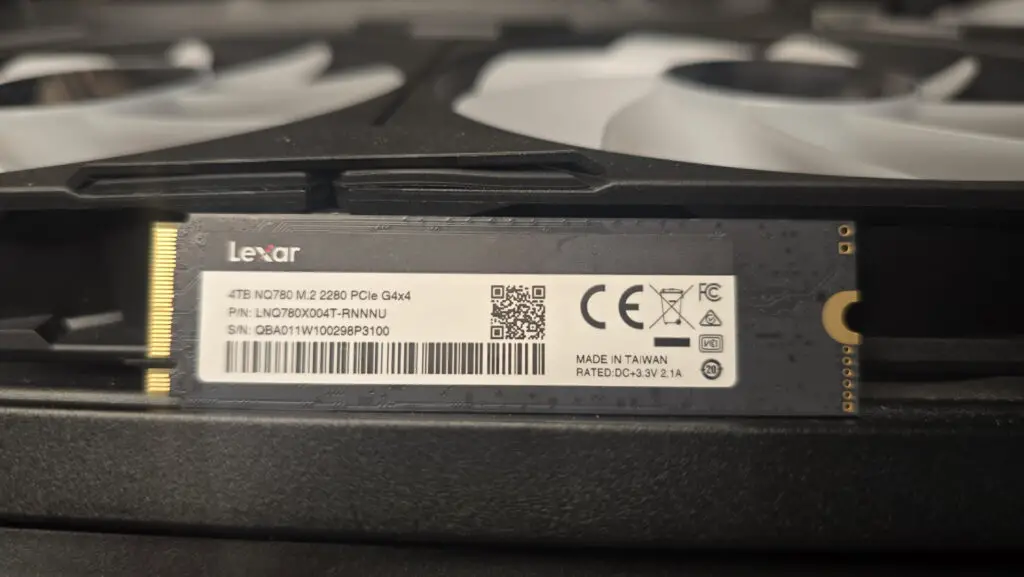
Lexar NQ780 comes with the following key specifications:
- Capacity: 4 TB
- Interface: PCIe 4.0 x4
- Memory controller: Innogrit IG5236
- Flash memory: Intel 144-layer 3D QLC NAND
- Rated performance: 7,000 MB/s sustained read, 6,000 MB/s sustained write
- Endurance: 2400 TBW
- Warranty: Five years
- Price: $264 | £253
Internal Components and Design
Moving beyond its pricing, the
NQ780 presents a rather conventional hardware configuration. Unlike many contemporary
SSDs that feature controllers from Phison, Maxiotek, Silicon Motion, or Sandisk, the
NQ780 utilizes an
Innogrit IG5236 eight-channel 12 nm controller. This controller, notably, first debuted in 2020, positioning it as an older component within the rapidly evolving
SSD landscape. It operates on the
PCIe 4.0 platform with an M.2-2280 form factor. This controller is paired with
Intel’s 144-layer QLC NAND flash, which comes in 1 TB packages. For the
4 TB model we tested, this translates to four NAND packages arranged on a single-sided stick, a design choice that ensures broader compatibility with devices like laptops, consoles, and various PCs.
This component selection immediately points to two implications: potentially higher operating temperatures and reduced power efficiency compared to more modern designs. The integration of a relatively older
controller alongside
144-layer QLC NAND suggests that the
NQ780 might be leveraging existing hardware inventories rather than pioneering new designs. This combination gives the impression of a product focused on utilizing proven, albeit older, technology rather than pushing contemporary performance envelopes.
As anticipated from its specifications, the performance of the
NQ780 aligns with what one might expect from an
SSD of this caliber. While initial sequential speeds can be respectable, the drive exhibits a noticeable slowdown once its
pSLC cache is exhausted, a common characteristic of QLC-based drives.
Performance Benchmarking and Analysis
Our
Digital Tech Explorer test bench configuration includes:
- CPU: AMD Ryzen 9 9900X
- RAM: 64 GB (2x32GB) Team Group T-Create Expert DDR5 @ 6000 C34
- GPU: Nvidia GeForce RTX 4080 Super
- Motherboard: Asus ROG Strix X870E-E Gaming WiFi/NZXT N9 X870E
- CPU Cooler: Asus ROG Ryujin III 360 ARGB Extreme
- PSU: 1200W NZXT C1200 (2024) 80+ Gold
- Chassis: Geometric Future Model 5
In
CrystalDiskMark, the
Lexar NQ780 achieved sequential read and write speeds of 7,446 MB/s and 6,601 MB/s, respectively. These figures place it on par with drives like the
WD Blue SN5100 in terms of peak sequential performance. However, the narrative shifts significantly when we delve into
Random 4K testing. Here, the
SN5100 outperformed the
NQ780, demonstrating 107 MB/s on random writes compared to the
NQ780‘s comparatively low 70 MB/s. This places the
NQ780 among the lowest performers in this crucial metric, ranking 17th out of 19 drives tested in our comprehensive database over the past year.
This deficiency in
random 4K read performance is particularly impactful for gamers, a key demographic for Digital Tech Explorer. It directly correlates with how efficiently an
SSD handles the myriad small files that constitute a modern AAA game – game assets, textures, meshes, and audio files, which are accessed non-sequentially. Predictably, the
NQ780‘s weak performance in this area translated directly into extended
game load times during our extensive testing.
Our
Final Fantasy XIV: Shadowbringers benchmark further highlighted this weakness, with the
NQ780 averaging a load time of 7.869 seconds. While seemingly quick in isolation, this figure falls notably short when compared to modern
SSD competition. This result is even more concerning considering
FF XIV typically favors larger capacity drives, and our testing utilized the
4 TB model of the NQ780, whereas many comparative results from our database are based on 2 TB models.
From an engineering perspective, the
Lexar NQ780 presents a curious proposition. It appears to be a product assembled from readily available, cost-effective components – specifically, older generation
Innogrit controllers and budget-friendly
QLC NAND. The outcome is a drive that struggles to keep pace with its contemporary
PCIe 4.0 counterparts, raising questions about its strategic market positioning.
Ultimately, the
NQ780‘s primary, if not sole, strength lies in its aggressive pricing. However, as an SEO Content Master for Digital Tech Explorer, TechTalesLeo’s analysis strongly advises readers to consider alternatives that offer superior performance for a comparable or slightly higher investment. For instance, the
WD Blue SN5100, despite also utilizing
QLC NAND, historically delivered exemplary performance across all categories compared to the NQ780. While market prices fluctuate, investing in a drive that offers a better overall experience is generally a more sound decision. The
NQ780‘s release feels ill-timed in a competitive landscape, though persistent
industry-wide price increases could inadvertently make its low initial cost more attractive if it maintains that advantage.
Buy if…
- ✅ You don’t care about game load speeds: Random 4K read performance is through the floor, and load times suffer as a result. If you’re after a mass capacity drive, though, it is still remarkably cheap.
Don’t buy if…
- ❌ You want a modern drive: Consider alternatives like the WD Black SN7100, which offers significantly more impressive performance for a truly modern experience.
Affiliate Disclosure: Some of the links on Digital Tech Explorer are affiliate links. This means we may earn a commission if you click through and make a purchase, at no additional cost to you. Our recommendations are based on thorough research and personal experience, aligning with Digital Tech Explorer’s commitment to transparency.
General Disclaimer: All content on Digital Tech Explorer is for informational and entertainment purposes only. We do not provide financial or legal advice.