
Every now and then, a budget gaming laptop emerges that genuinely surprises, and the Lenovo LOQ 15 Gen10 is almost one of them. It absolutely nails three crucial elements: a powerful graphics card, a perfectly paired screen, and outstanding build quality, collectively delivering exceptional 1080p gaming performance. However, as we at Digital Tech Explorer often discover in our real-world testing, assumed cost-cutting in the entry-level RAM and SSD configurations prevents it from achieving true perfection. Let’s dive into why this laptop is a compelling, if slightly flawed, contender.
For
- Solid hardware pairings
- Sleek refined design
- Great 1080p performance
Against
- RAM and SSD config is frustrating
- Battery life underwhelming
The Budget Laptop Screen Dilemma
You know what my biggest bugbear is for budget laptops? It’s invariably the screen. For some reason, notebook manufacturers seem to have this almost obsession with pairing massively underwhelming graphics cards with panels that would put most 4K TVs to shame. It’s madness. Yes, they might be these phenomenally pixel-dense, OLED, 240 Hz, crystal-clear colour, uber mode displays, capable of projecting the most beautiful, stunning picture you’ve ever seen in your life directly into your retinas. But as soon as you load up a game and that mobile GPU kicks into life, fans whirring at a million miles a minute, you’ll inevitably be graced with the slow chug of growing disappointment, as the approximation of a AAA power-point presentation starts juddering its way across your shiny new device.
It’s driven me mad for years. That might sound ridiculous, I’ll admit that, but I’ve reviewed a lot of budget laptops in my time that do this, and it’s frustrating because it doesn’t need to be the case. You gain very little by doing that. Thank the dear and fluffy lord Gabe Newell then (he doesn’t have anything to do with this, I don’t think, I haven’t checked), that the Lenovo LOQ 15 Gen10 ditches that seemingly age-old laptop manufacturer mantra in favor of a more practical GPU and screen pairing instead. This kind of thoughtful hardware integration is precisely what Digital Tech Explorer values in a great gaming machine.
Lenovo LOQ 15 Gen10: Core Specs and GPU Nuances
At its core, the Gen10 comes complete with an Nvidia GeForce RTX 5060, a Ryzen 7 250, and, more importantly than that, a simple, elegant, beautifully crisp and punchy 15.6-inch, 1920×1080 IPS display, running at around 144 Hz. And it does all of that with a sub $1400 price point.
Now, yes, I know what you’re thinking, technically, no, that graphics card isn’t really a “true” RTX 5060. I mean, it sort of is, so far as the name’s the same and the core RTX Blackwell architecture matches it as well, but it’s lost about 15% of its CUDA cores, and a not-so-subtle 12% of everything else, (ray tracing cores, ROPs, TMUs, Tensor cores, you know, all the good stuff that makes DLSS 4, kinda, work). Heck, I suppose we should be thankful it still touts that same 8 GB of GDDR7 VRAM.
Detailed Specifications
| Feature | Specification |
|---|---|
| Model No | 15AHP10 |
| CPU | AMD Ryzen 7 250 |
| GPU | Nvidia RTX 5060 115W |
| RAM | 16 GB DDR5-5600 |
| Storage | 512 GB PCIe 4.0 SSD |
| Screen Size | 15.6-inch IPS |
| Refresh Rate | 144 Hz |
| Resolution | 1920 x 1080 |
| Battery | 60 Whr |
| Dimensions | 15.6 ~ 23.9 mm x 359.9 mm x 258.7 mm | 0.94 x 14.17 x 10.19 inches |
| Weight | 2.3 kg | 5.07 lbs |
| Price | $1,389 | £1,300 |
1080p Gaming Performance and Early Disappointments
The good news, though, is that on the whole, that mobile RTX 5060 does actually deliver when it comes to 1080p gaming. Most titles easily averaged well into the 60 fps mark and above, the only exception, of course, being Cyberpunk 2077 without any DLSS support (which still achieved a relatively respectable 36 fps). Chuck on DLSS Quality and the beautiful silky goodness that is MFG, and that too climbs well into the 100s.
It’s so refreshing to be able to just game at your native resolution on a laptop at this price point, without having to worry about dialling the graphics preset down, or swapping around resolutions and getting stretched pixels or worse. Plus, that 15.6-inch screen is already delivering a pixel density greater than a 32-inch 4K panel does. Given these strengths, one might initially exclaim, ‘Stop the press, cancel the review, clearly this is the best gaming laptop of 2025!’ But hold your horses. As our thorough reviews at Digital Tech Explorer aim to reveal, it’s not all sun-lit uplands and buttery smooth frame rates. We need to talk about the storage and memory setup on this thing. Because, to be blunt. It sucks.
The Frustrating RAM and SSD Configuration
In its default configuration, the one I’m testing here, the LOQ 15 comes with a single stick of 16 GB DDR5 at 5,600 MT/s. Do you know what Ryzen loves more than memory frequency? Memory bandwidth. There are times, particularly when loading programs, running multiple applications, or intense, high-load activities, when you almost feel this stuttering effect occur on the Gen10. There’s a lag as you attempt to move an application across the screen or open up Task Manager. It’s chilling to be blunt, giving Windows Vista vibes, and I don’t like it.
For an additional $65, Lenovo will pop an extra 16 GB stick in there for you, but to be honest, this should’ve been two 8GB dual-channel sticks to begin with, retaining that budget price point. At least so you’re not left wondering if the whole system’s locking up because you just opened Paint, or because your memory setup sucks.
Again, on the SSD front, it’s similarly just not good enough. The stock model is a SanDisk WD Blue SN5000S, QLC affair, not too dissimilar from the WD Blue SN5000 I reviewed late last year. That’s fine, nothing particularly wrong with that for a budget unit. At least, that is, until you see the capacity. It’s a 512 GB model, which once Windows is installed, sits at around 370 GB of total available space. I couldn’t even install our entire benchmarking suite in one go; it was that small. I had to test games, then delete them and install other games and then test those… Again, Lenovo will happily pop in a 1 TB variant, but for an additional $60 added on to the price tag, which should’ve been included as standard, given it’s a gaming laptop.
Battery Life and Performance Charts
Adding to the concerns, the battery life proved underwhelming, petering out at just 89 minutes. While this performance surpasses some more premium, power-hungry units, the LOQ is generally hampered by its relatively small 60 WHr battery and AMD’s rather power-hungry Ryzen 7 250 CPU. It’s important to remember that this is, at its heart, a budget notebook, and as such, not every aspect can be brilliant. Despite these points, there is still a lot to love about it, far beyond just the screen being the right pick for that graphics card.
CPU performance is impressive, even with that single-channel memory, and it beats out other RTX 5060 notebooks like Gigabyte’s Gaming A16 in average fps too, that one in particular featuring an Intel Core i7-13620H (a damning indictment of Intel’s currently poor Ultra line gaming performance, it’d seem), which is nothing to sniff at.
Exceptional Build Quality and Design
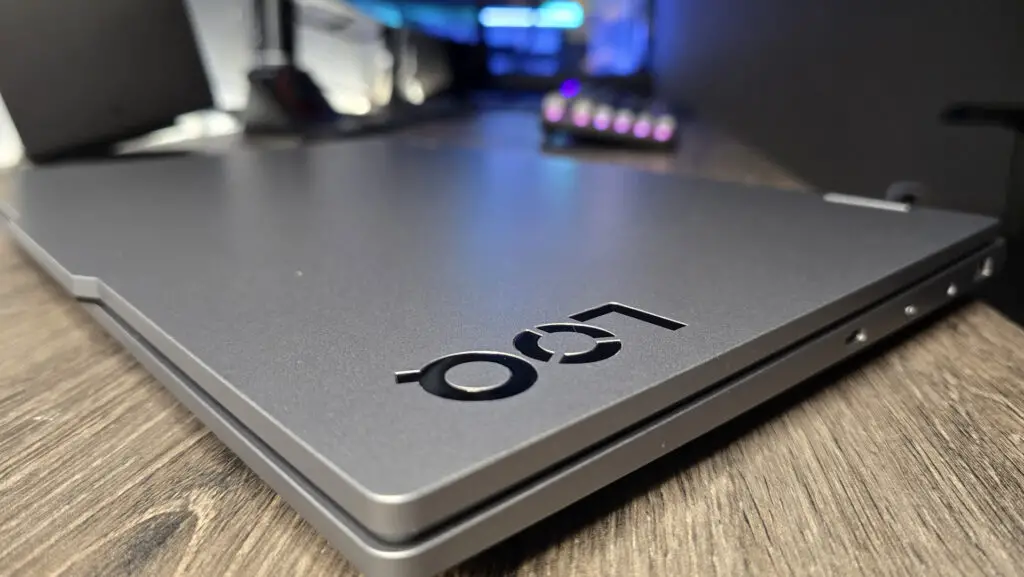
And the overall build quality of this thing? Purely outstanding. It is a gaming notebook; you can tell that from the get-go, there’s no hiding that. There are angles and edges, embossed logos, and a jutting webcam divot, among other things, along with a whole host of I/O ports protruding out of its bottom. But it’s not ostentatious.
There’s a suaveness to it, from the “luna grey” metallic satin finish to the heft and bulk of the thing. It feels solid, yet remains sleek, like it’s designed for even the most aggro of esports streamers to wail on after they go 0-3 in competitive. I’ve played around with laptops four times the cost of this thing that pale in comparison when it comes to the build quality on show here, and that’s not nothing.
Key Recommendations
Buy if…
✅ You don’t mind the upgrade path: There’s no denying it. The single-channel memory and 512 GB SSD on the base model are massively underwhelming. If you don’t mind spending a little extra or can upgrade the two, then the Lenovo LOQ 15 is a fine choice for 1080p gaming.
Don’t buy if…
❌ You’re looking for something with a bit more flair: Aside from the above, the LOQ is very much a marmite style. You’ll either love how subtle it is for a gaming notebook or despise it. If you’re looking for something a little flashier, this ain’t it.
Cooling is impressive as well, and throughout my time testing, temps rarely got over 70 degrees, even under intense loads. Yes, fan noise is a thing, particularly when it’s plugged in, but it’s all manageable in Lenovo’s Legion app, which, although relatively barebones, does a good enough job of managing noise in exchange for heat, which again you’ve got a good 20 degrees to play with. There are, of course, your state-mandated AI apps integrated in here as well, requiring Lenovo account sign-up and more, along with the usual intrusive McAfee anti-virus pre-install to be aware of, but from a software perspective, that’s about it for bloatware.
In its essence, the Lenovo LOQ 15 Gen10 is a testament to thoughtful design and robust gaming potential, yet it stands as a prime example of where a few small, avoidable compromises can hold back a truly great product. It delivers resplendent 1080p gaming performance with a sleek, sophisticated design that thankfully eschews typical ‘gamer’ ostentation. While its entry-level RAM and SSD configurations are undeniably frustrating, necessitating an upgrade for optimal experience, the core hardware pairing and impressive build quality make it a compelling choice for the right user. As we strive to help you make informed decisions at Digital Tech Explorer, we conclude that for its price point, finding an RTX 5060 notebook that delivers this much punch, style, and 1080p gaming prowess would indeed be a challenge. So, while not perfect, the LOQ 15 Gen10 earns a nod of appreciation from this tech enthusiast.