

Greetings, tech explorers! Here at Digital Tech Explorer, we’re always delving into the nuanced landscape of technology, and few areas have generated as much spirited discussion—and occasional head-scratching—as Intel’s evolving Arc graphics. For a while, the roadmap for Intel’s graphical processing units (GPUs) has felt like navigating a cosmic nebula. However, recent insights from Intel’s graphics representative, Tom Petersen, have begun to shed light on some of the most persistent mysteries surrounding their next-generation architectures.
One of the core points of confusion revolved around the Xe3 iGPU in the upcoming Panther Lake chip. Many speculated this would usher in Intel’s much-anticipated Celestial architecture. Petersen, however, has clarified that the Xe3 in Panther Lake is not Celestial but rather a significant evolution of Xe2, the architecture underpinning existing products like the Intel Arc B580 desktop GPU and the Lunar Lake laptop chip. Think of it as an enhanced Xe2—Petersen himself suggested it could have been called “Xe2 Prime” or “Xe2 Plus Plus” to better reflect its advanced yet evolutionary nature.
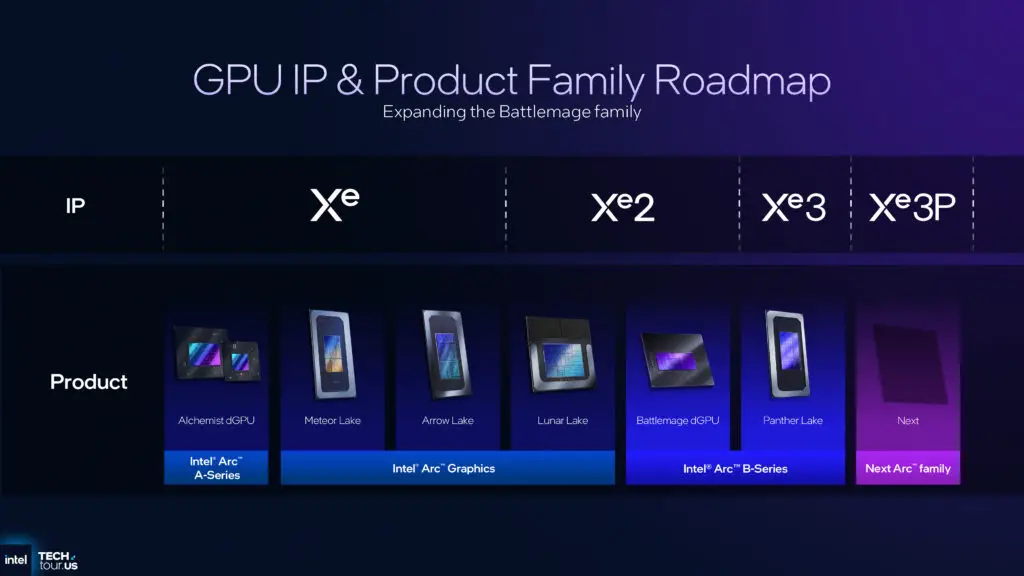
The “Xe3” nomenclature, Petersen explained, was decided years ago and is deeply embedded within the Linux software stack, making a name change impractical. This transparency helps clarify why Panther Lake, despite featuring this advanced Xe2 variant, is still branded under the “B” series—a designation Intel uses for its Xe2 architecture—aiming to give customers a clear understanding of its performance tier without misleading them into thinking it’s an entirely new generation.

Unraveling Celestial: Enter Xe3P and Crescent Island
If Xe3 isn’t Celestial, then what *is* Celestial? This has been a central question for tech enthusiasts and developers monitoring Intel’s graphics journey. Petersen now clarifies that the architectural work from the dedicated Celestial team has indeed materialized, but under a new designation: Xe3P. This “P” signifies a “more substantially different architecture than Xe3 was from Xe2,” marking a genuine leap forward.
The first public appearance of this cutting-edge Xe3P architecture won’t be in consumer gaming GPUs but rather in Intel’s new data center AI inferencing GPU, codenamed Crescent Island, anticipated in late 2026. While the immediate focus for Xe3P is data centers, Petersen remains guarded about its potential future in desktop GPUs or the often-speculated Intel Arc B770 board, reminding us that product roadmaps are ever-evolving.
The Intel-Nvidia Alliance: A New Chapter for Arc?
Adding another intriguing layer to Intel’s graphics narrative is the recent, surprising collaboration between Intel and Nvidia. This alliance aims to integrate Intel CPUs with Nvidia graphics for both consumer PCs and powerful AI servers. For developers and tech enthusiasts, the most pressing question is: what does this mean for the future of Intel’s standalone Arc graphics? Even within Intel, the full implications are still being assessed.
Petersen acknowledged that the impact is “not understood yet” but expressed confidence that Intel will continue to “develop graphics IP for the long term.” He envisions a need for a diverse range of IP, from compact, power-efficient designs to more complex solutions, alongside dedicated data center offerings. The strategic deployment of the Xe3P architecture in a data center GPU like Crescent Island is seen as a foundational “IP enabling effort,” highlighting Intel’s commitment to graphics innovation, albeit with a shifting focus.
Navigating the Arc: What’s Next for Developers and Enthusiasts?
As we at Digital Tech Explorer continue to track these developments, the landscape of Intel Arc graphics is becoming clearer yet remains dynamic. To summarize for our community:
- Xe3 in Panther Lake is confirmed as an evolution of Xe2, not the new Celestial architecture.
- The true architectural leap from the Celestial team is Xe3P, making its debut in data center products like Crescent Island in 2026. The “Celestial” name itself appears to be retired as a product designation.
- The unprecedented Intel-Nvidia partnership introduces a significant unknown, potentially reshaping Intel’s strategy for consumer Arc graphics.
Speculation suggests that Intel Arc’s role for consumer PCs might increasingly focus on lower-end, integrated GPU solutions, potentially diminishing the prospect for robust standalone Arc desktop cards. This strategic shift could see Intel heavily investing its advanced Xe3P and Crescent Island technologies into the burgeoning AI inferencing market, a lucrative segment for developers and enterprise solutions. While this doesn’t directly translate to next-gen gaming GPUs for the desktop segment, it solidifies Intel’s position in crucial high-performance computing. As always in the fast-paced world of technology, these plans are subject to change, and we at Digital Tech Explorer will continue to bring you the latest, most thoroughly researched insights to help you stay ahead.