

Disclaimer: Some of the links on Digital Tech Explorer are affiliate links. This means we may earn a commission if you click through and make a purchase, at no additional cost to you. Our recommendations are based on thorough research and personal experience. All content is for informational and entertainment purposes only.
Here at Digital Tech Explorer, we pride ourselves on bringing you the earliest insights into groundbreaking technology. While the full Intel Core Ultra Series 3 mobile chips are still a little while from our comprehensive lab tests, an exclusive opportunity arose at CES 2026. TechTalesLeo had the chance to put the much-anticipated Intel Arc B390 iGPU through its paces in a brief, yet revealing, benchmarking session. These initial hands-on results paint a truly promising picture for integrated graphics performance, especially considering the power packed within these new Core Ultra chips. This early peek, characteristic of the insights we strive to bring you, suggests a significant leap for future gaming on slim laptops and even gaming handhelds.
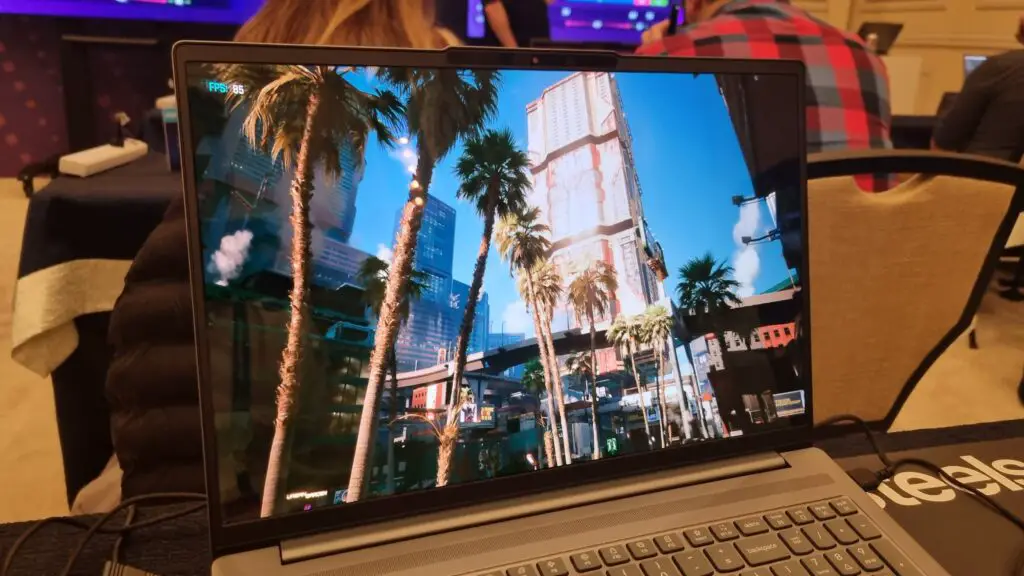
Cyberpunk 2077: Pushing Integrated Graphics Limits
My test machine was a robust, albeit non-descript, Lenovo laptop featuring an Intel Core Ultra X9 388H, the flagship Panther Lake CPU from Intel’s new mobile lineup. Without the aid of discrete graphics hardware, the challenge was clear: how would this integrated solution handle demanding modern titles?
Raw Power: Cyberpunk 2077 Without Upscaling
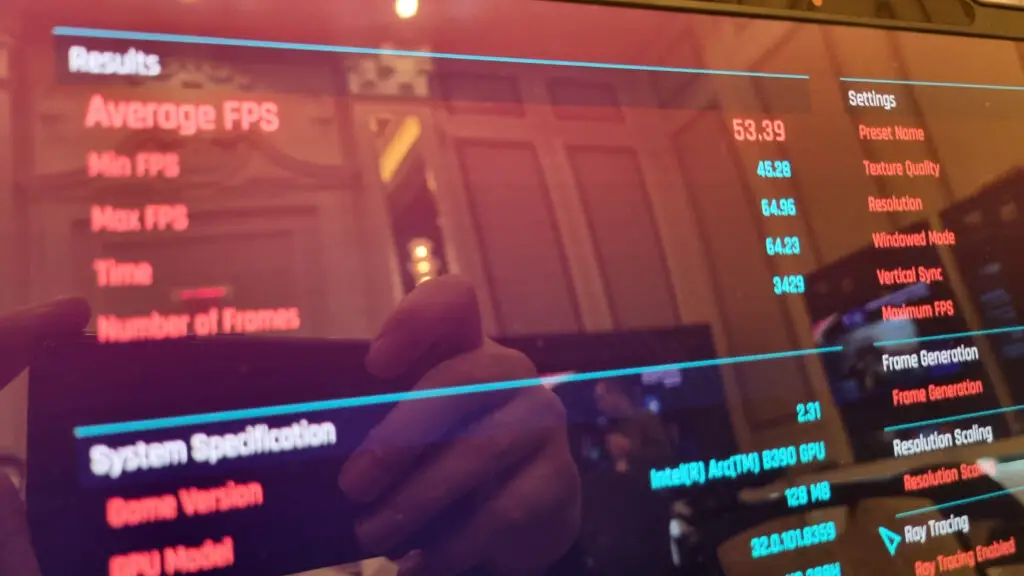
Our first benchmark journey took us into the neon-drenched streets of Cyberpunk 2077. Running at 1200p on High settings, and crucially, without any upscaling technology or ray tracing, the Arc B390 iGPU delivered a perfectly playable average of 53 frames per second (fps). While not setting any world records, achieving this frame rate on an integrated graphics solution without assistance is remarkably impressive and a testament to its foundational capabilities.
Enhanced Immersion: Cyberpunk 2077 with XeSS
For real-world gaming on a portable machine, upscaling technologies are often the key to a fluid experience. Re-running the Cyberpunk 2077 benchmark with Intel XeSS set to Quality yielded a significant uplift. The average frame rate soared to a smooth 74 fps. This enhanced performance truly makes for a fluid and immersive gaming experience, confidently demonstrating that the Intel Arc B390 iGPU can deliver highly enjoyable gameplay in Cyberpunk 2077 when paired with its intelligent upscaling.
The Ultimate Challenge: Cyberpunk 2077 with Ray Tracing and Frame Generation
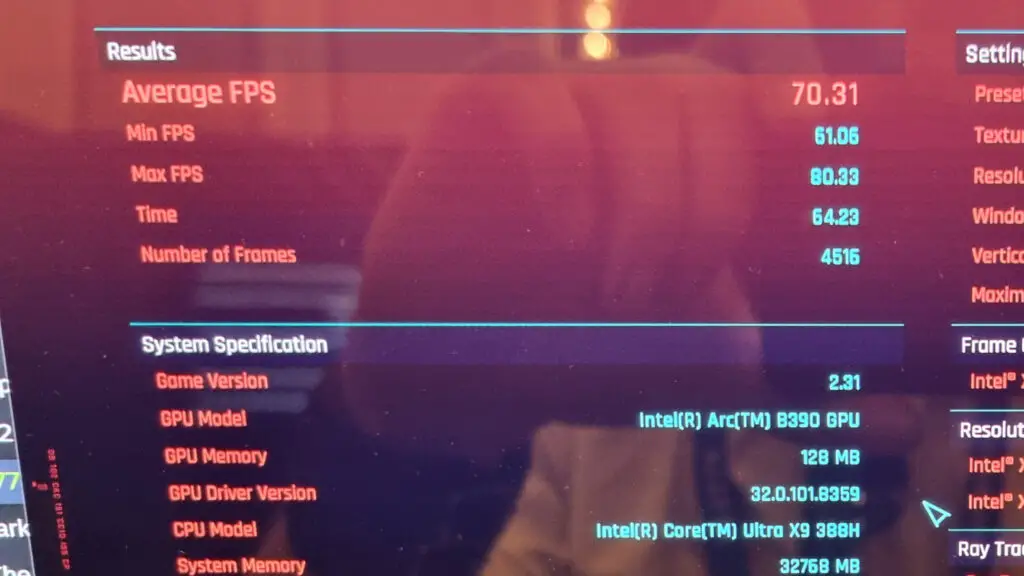
Always pushing the boundaries, we ventured into the most demanding settings for Cyberpunk 2077. The game was configured with the Ray Tracing: Ultra preset, frame generation enabled, and XeSS on Auto. This ambitious setup delivered an average of 70.31 fps. While the activated frame generation undoubtedly boosted the raw frame count, the low base frame rate suggests that latency could become a noticeable factor during extended gameplay sessions. Nevertheless, the fact that an iGPU can even render Cyberpunk 2077 with Ultra Ray Tracing and Frame Generation at these frames, albeit with heavy assistance, is remarkably impressive and speaks volumes about the advancements in AI acceleration within these new chips.
Borderlands 4: A True Test of Mettle
Next on our agenda was Borderlands 4, a title notoriously demanding despite several performance patches. Without an in-game benchmark, we navigated a particularly intense opening section of the game to gauge real-world performance. Running at 1200p on High settings with XeSS Quality, the Arc iGPU understandably struggled somewhat, hovering around the 40-45 fps mark. While frame generation is technically an option in Borderlands 4, we encountered issues getting it to work reliably with this particular Intel chip and its drivers at this early stage, pointing to potential optimization challenges that are often ironed out with newer titles.

Shadow of the Tomb Raider: A Masterclass in iGPU Performance
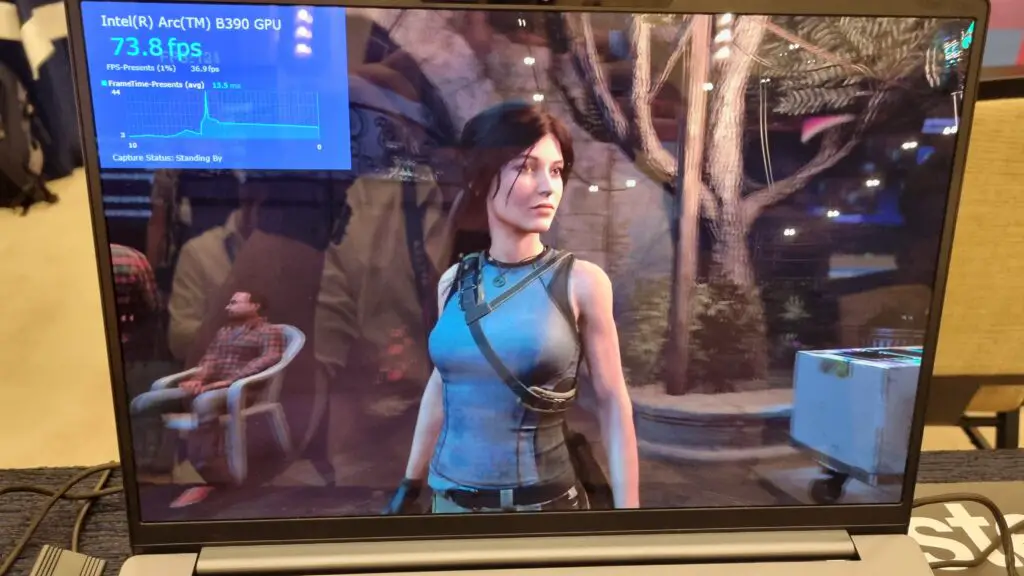
To conclude our preliminary testing, we turned to Shadow of the Tomb Raider. Though an older title, it remains a reliable, visually appealing, and well-optimized benchmark. At 1200p on High settings with no upscaling enabled, the Intel Arc B390 iGPU delivered excellent results: peak frames in the 100s, 1% lows in the mid-30s, and a strong average of 75 fps. This performance solidifies Shadow of the Tomb Raider’s suitability as an iGPU benchmark and showcases the impressive visual fidelity and smooth gameplay achievable on a discrete GPU-less machine. It truly brings to life the potential for engaging experiences even on integrated solutions.
TechTalesLeo’s Early Verdict: Promising Horizons
These preliminary findings from our quick hands-on session at CES 2026 paint a very promising picture for the Intel Arc B390 iGPU’s performance. While we at Digital Tech Explorer always reserve definitive conclusions for in-depth lab testing and exhaustive reviews, the 12 Xe-cored chip certainly appears to offer substantial power for its integrated nature. Its capabilities suggest a significant potential impact on the landscape of slim laptops and even gaming handhelds, possibly broadening the appeal of discrete GPU-less machines to a wider gaming audience. This is incredibly encouraging progress, and we eagerly anticipate subjecting these Panther Lake chips to rigorous evaluation in our labs soon. Stay tuned to Digital Tech Explorer for the comprehensive breakdown and final ratings!