
The Intel Arc B580 arrived on the scene with a mixed reception, initially positioned as a compelling budget GPU but quickly revealing inconsistent performance. While the underlying hardware held considerable promise, its Achilles’ heel was its notably poor performance when paired with older processors. This created a significant dilemma for a value-oriented graphics card, often considered for straightforward upgrades in existing older machines, as it notoriously struggled with ageing CPUs—a crucial point for tech enthusiasts like those we serve at Digital Tech Explorer.
Performance Improvements for Moderately Older CPUs
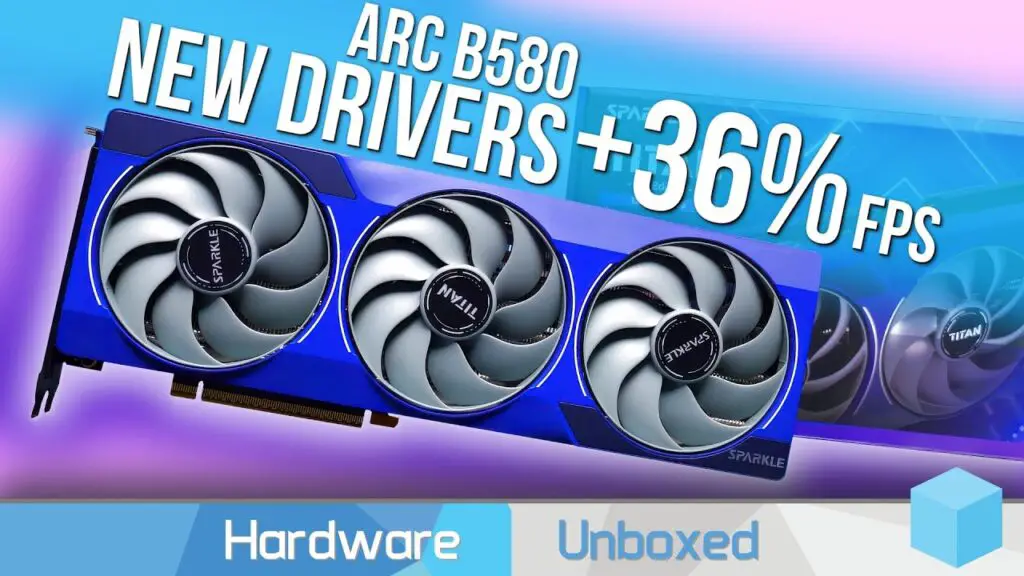
However, a new chapter is unfolding. Recent in-depth testing by Hardware Unboxed has revealed a significant performance uplift for the Intel Arc B580. To illustrate, consider its performance in Spider-Man Remastered. Back in April, when paired with an AMD Ryzen 5 5600 on High settings, the GPU delivered an average frame rate in the mid-80s. Fast forward to today, and with the *same* CPU but on the more demanding Very High preset, the Arc B580 now impressively achieves an average of 118 fps. This isn’t just a better score; it’s a superior result on a graphically more intense setting. What’s more, where this card was once clearly outmatched by the 8GB AMD Radeon RX 9060 XT in identical tests, these two powerful GPUs now stand remarkably neck and neck.
Persistent Challenges and Intel’s Optimization Strategy
Despite these encouraging strides, the journey to full optimization isn’t over. Hardware Unboxed’s comprehensive analysis also highlights that performance issues persist with truly older CPUs. For instance, systems featuring the Ryzen 5 2600 have shown no discernible performance uplift from the latest updates. In games where a clear CPU bottleneck is the limiting factor, the Arc B580 still struggles to achieve scores comparable to the RX 9060 XT.
Intel attributes these lingering CPU overhead problems to specific game engines, suggesting that fixes are implemented through targeted, game-based optimizations. While the Arc B580 now matches the RX 9060 XT in Spider-Man Remastered, it’s crucial to note that the RX 9060 XT still maintains a 28 fps higher average across a broader 10-game sample. This overall performance disparity points to a combination of persistent CPU overhead in certain titles and a fundamental difference in their underlying raw performance capabilities.
Through a meticulous series of driver tests, it appears the key update responsible for this notable performance jump (particularly on systems with the Ryzen 5 5600) is version 32.0.101.7028, released in August. Intriguingly, Intel’s official release notes for this driver do not explicitly mention performance enhancements. This omission might suggest that these game-specific optimizations haven’t translated into widespread performance boosts across a wider spectrum of older processors, a theory supported by the lack of improvement observed on the Ryzen 5 2600.
Considering the critical aspect of value, the 8GB RX 9060 XT carries an MSRP of $300, positioning it against the ARC B580‘s more accessible $250 MSRP. This 20% price difference is significant, especially when factoring in Hardware Unboxed’s 10-game sample, which still places AMD’s card at a 30% higher average performance. For tech enthusiasts and developers navigating the market, the optimal purchase hinges on current deals and, crucially, the age of your existing CPU. Nevertheless, Intel’s ongoing commitment to optimizing the Arc B580 has undeniably narrowed the performance gap, making it an increasingly viable contender for specific system configurations. As we at Digital Tech Explorer emphasize, staying informed on these nuanced updates is key to making the best hardware decisions.