
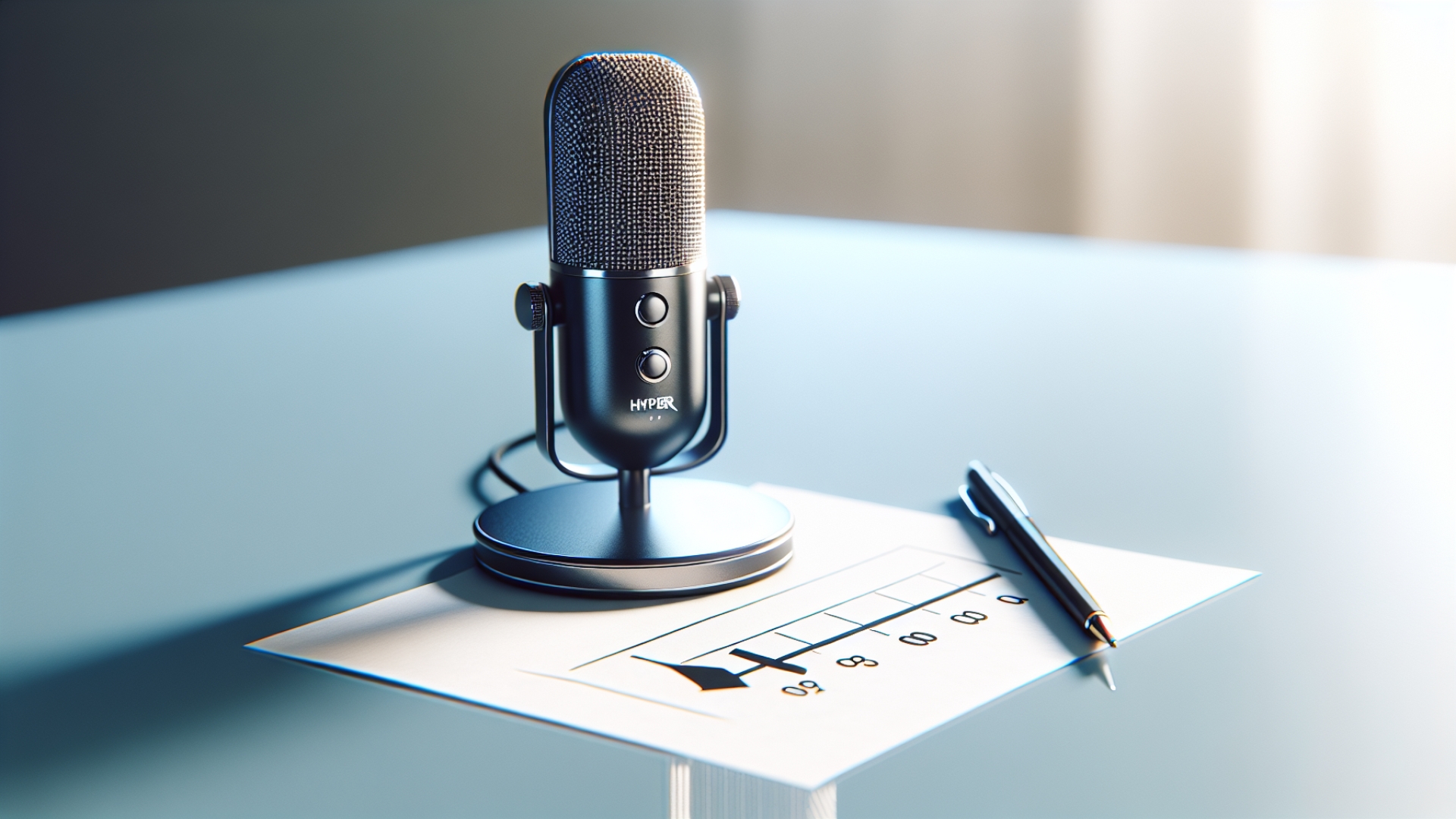
The HyperX SoloCast 2 stands out as a testament to thoughtful engineering and functional simplicity, earning it considerable acclaim on Digital Tech Explorer. While it’s affordably priced and delivers commendable vocal clarity, it enters a fiercely competitive budget microphone market. Our in-depth review, guided by TechTalesLeo’s keen eye for practical tech, reveals that while its design is ingenious, the noise cancelling capabilities might leave some users desiring more robust performance.
The Good
- Ingenious, practical stand design
- Intuitive controls and setup
- Solid audio fidelity for its class
- Excellent value for money
The Not-So-Good
- Subpar noise reduction performance
- Counter-intuitive ‘on’ indicator light
- Lower pickup sensitivity at greater distances
Unboxing Ingenuity: Design That Works
As TechTalesLeo often emphasizes in our reviews at Digital Tech Explorer, great technology doesn’t just perform well; it’s also thoughtfully designed. The HyperX SoloCast 2 embodies this philosophy, particularly for those seeking a practical gaming microphone without breaking the bank. Priced at a competitive $60/£50, it easily outshines many budget-tier alternatives with its ingenious construction.
The true marvel of the SoloCast 2 lies in its integrated desktop stand. What appears to be a sleek, single cylindrical unit cunningly transforms. Like the breech of a shotgun, it opens to reveal a robust, hinged base. This hidden stand, equipped with standard ⅜-inch and ⅝-inch boom arm screw mounts at its base, exemplifies both clever mechanics and everyday usability, making it an ideal choice for a diverse range of setups.
Ergonomics and Interface
The SoloCast 2’s physical attributes are equally impressive. Its integrated stand features a sturdy hinge, meticulously weighted to maintain any desired angle, preventing accidental shifts during intense gaming sessions or crucial calls. The base provides ample stability, ensuring the microphone stays put. Constructed from quality plastics, adorned with a vented grille, and finished in a sleek all-black aesthetic, the SoloCast 2 is a polished addition to any modern desk, blending seamlessly with other hardware.
Simplicity governs its interface. A large, capacitive tap-to-mute button dominates the microphone’s top surface, making mute actions swift and error-free. On the rear, a solitary USB Type-C port keeps connectivity streamlined. However, one minor design head-scratcher: the front-facing LED glows red when active and turns off when muted. While visually clear, this inverted logic — red for ‘on’ rather than ‘muted’ — could lead to momentary confusion for users accustomed to conventional indicator lights, a practical detail TechTalesLeo keenly observes for potential user experience improvements.
HyperX SoloCast 2 Technical Specifications
| Feature | Detail |
|---|---|
| Type | Condenser |
| Polar Pattern | Cardioid |
| Connectivity | USB Type-C |
| Recording Sample Rate | 96, 48, and 44.1 kHz @ 24/16 bit depth |
| Frequency Response | 20-20,000 Hz |
| Key Features | One-tap mute, built-in pop filter, AI-enhanced noise reduction, adjustable EQ, integrated stand |
| Price | $60 / £50 |
Navigating Software and Sound Customization
Beyond its physical mute button, the SoloCast 2’s deeper controls reside within the HyperX Ngenuity software. As this is a recent release, users may need the beta version for full compatibility. Within Ngenuity, users can fine-tune gain levels, adjust equalizer settings, and activate features like AI-enhanced noise reduction, compression, and a limiter, all managed with straightforward toggle switches. Additional high-pass, low-pass, and presence-boosting filters offer further sound shaping options.
While this streamlined approach is fantastic for ease of use, TechTalesLeo notes that the absence of granular slider adjustments for noise reduction and compression can be a limitation. These audio tools can be quite impactful, and a lack of fine-tuning can sometimes result in an overly aggressive or subtle application, which seasoned developers and audio enthusiasts might find restrictive for achieving a perfectly tailored sound profile.
Audio Performance and Real-World Noise Reduction
In our rigorous real-world testing at Digital Tech Explorer, the SoloCast 2 performs admirably with its default software configurations. With AI noise reduction, compression, and the limiter engaged, it captures a natural and rich vocal tone, sidestepping the harsh distortions often associated with heavy noise cancelling. However, when placed further from the speaker in a typical desktop setup, the microphone’s pickup can be relatively quiet, often necessitating a significant gain boost, which may introduce a subtle background hiss.
A key area where the SoloCast 2 faces challenges is its noise reduction efficacy. Even with the AI feature enabled, ambient sounds from an adjacent room can still be faintly audible, suggesting that it might not be the ideal solution for environments with significant background noise. Conversely, the SoloCast 2 truly excels in close-mic scenarios. Its integrated pop filter is remarkably effective, allowing users to position the microphone intimately for a studio-quality tone, minimizing unwanted plosives and environmental interference when gain settings are moderated. The capsule itself is well-tuned, and the microphone’s robust build quality further aids in rejecting common forms of electrical interference, underscoring its solid hardware foundation.
Final Verdict: A Strong Contender in a Tight Market
The HyperX SoloCast 2 emerges as a polished and attractive peripheral, a welcome addition to any tech enthusiast’s desk. Its software successfully marries user-friendly simplicity with just enough customization options to satisfy those who like to tweak their audio. However, as TechTalesLeo has explored, it faces formidable competition, most notably from the ultra-affordable $25 Amazon Basics USB microphone.
While the SoloCast 2 undeniably offers a more sophisticated design and adjustable sound settings—features entirely absent in the Amazon alternative—its less-than-stellar noise reduction can be a crucial factor for many users. The HyperX unit does deliver a richer sound profile, especially from a slight distance, likely due to its superior capsule and software processing. Yet, the compelling price point of the Amazon Basics mic, coupled with the SoloCast 2’s noise reduction limitations, means that for those prioritizing absolute budget and basic functionality, the cheaper option remains a surprisingly strong alternative.
Ultimately, the SoloCast 2 is a commendable gaming microphone for its price. Had its primary rival not set such an incredibly low barrier to entry, its feature set, design ingenuity, and sound quality would easily position it as the definitive choice for the best budget gaming microphone. It’s a prime example of clever tech meeting affordability, even if the market holds an astonishingly inexpensive challenger.