
For years, the allure of a powerful gaming laptop has been undeniable, yet the compromises – from thermal throttling to a ‘lightly singed lap’ – often loom large. Here at Digital Tech Explorer, we’re constantly on the lookout for innovative solutions that bridge the gap between portable convenience and desktop-level performance. As TechTalesLeo, I’ve navigated the highs and lows of portable gaming for over a decade, and that journey has led me to critically examine Gigabyte’s latest offering: an ‘AI box’ pitched as a transformative solution.
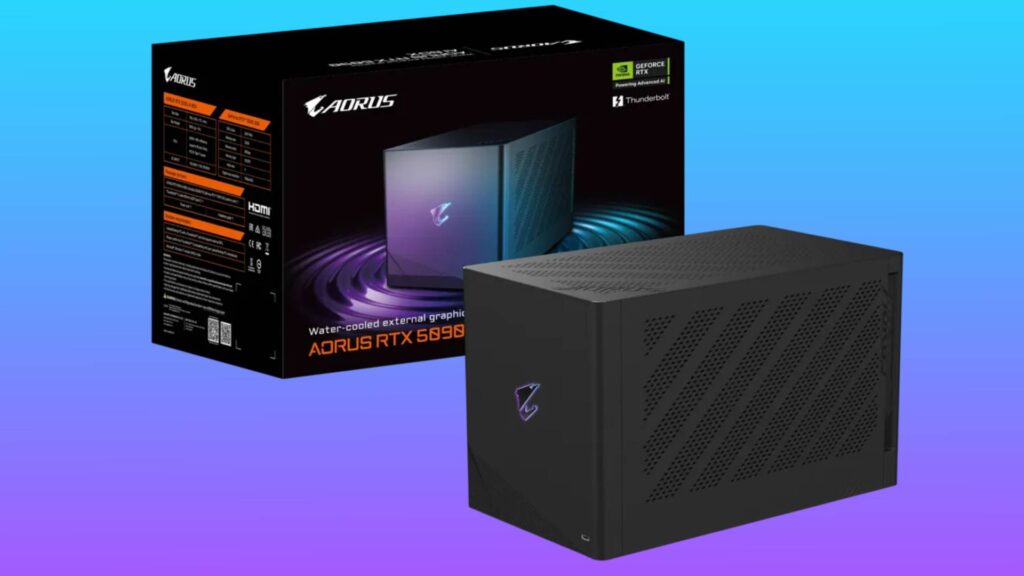
The Gigabyte Aorus RTX 5090 AI Box, as its name suggests, is a formidable external GPU solution, housing Nvidia’s top-tier GeForce RTX 5090 GPU. This powerhouse is pitched as the ultimate companion for lighter laptops, connecting via a cutting-edge Thunderbolt 5 cable to deliver near-desktop-level graphics performance without the inherent drawbacks of a compact gaming rig. The core promise? Unshackling your mobile device from its graphical limitations, providing a robust external engine for intense gaming or demanding creative workloads.
Maintaining peak performance in such a potent external enclosure is crucial, and Gigabyte addresses this with its advanced Waterforce liquid cooling system. This integrated solution features a “large copper base plate, a 240 mm aluminum radiator, two 12 cm fans, and optimized water flow pump.” Such meticulous design aims to keep temperatures low and operations quiet, whether you’re immersed in the latest 3D games or pushing the boundaries of an AI model – a critical factor Digital Tech Explorer always considers in hardware reviews.
Analysis of the ‘AI Box’ Branding and Performance Claims
Gigabyte has cast a wide net with this product, aiming to attract gamers, creatives, and AI enthusiasts alike, touting its substantial 32 GB of VRAM and “over 3000 AI Tera Operations per Second.” However, at Digital Tech Explorer, we champion thorough research and transparent reviews. Just how significant is the ‘AI Box’ branding in practice? Given Gigabyte’s history of producing similar external graphics enclosures for years, often without the explicit ‘AI’ tag, we’re compelled to question the true novelty of this particular branding approach. Is it genuinely a new paradigm for AI acceleration, or a strategic rebranding of an existing concept?
When considering its AI capabilities, it’s also worth noting that other compact solutions have emerged as formidable contenders. The small but mighty Framework Desktop PC, for instance, was recently reviewed with an impressive 128 GB LPDDR5x-8000 RAM configuration, making it a supremely powerful AI workstation. In this context, the Gigabyte AI Box and its 32 GB of VRAM, while substantial for gaming, can feel comparatively limited for intensive AI development. Our mission at Digital Tech Explorer is to help you make informed decisions, and understanding these comparisons is key.
Pricing, Value, and Market Factors
Beyond raw power, price remains a pivotal factor in any tech investment. The 128 GB RAM model of the Framework, mentioned above, carries a $2,000 price tag, though its soldered-in RTX 4060-equivalent GPU isn’t ideal for dedicated high-end gaming. Gigabyte has yet to announce the MSRP for the Aorus RTX 5090 AI Box, but judging by its most recent predecessor, we anticipate it will likely settle north of two grand. With the current state of hardware pricing due to tariffs, we at Digital Tech Explorer are closely watching how this impacts the final sticker price.
Beyond its touted AI capabilities and anticipated price point, TechTalesLeo, as a seasoned tech observer, harbors reservations about the practical utility of integrating such a significant external unit into a typical hardware setup. While the Thunderbolt 5 connection’s ability to provide power delivery, supplying your laptop with 100 W of charging power, is a thoughtful touch that helps streamline cables, the overall proposition feels less than ideal for many users. The primary draw of a laptop is portability; adding a substantial external unit diminishes that advantage.
The theoretical flexibility of pairing a decent budget laptop with this powerful eGPU is appealing, but as TechTalesLeo, I question the real-world experience of playing high-fidelity games on a budget screen. While eGPUs undeniably offer a boost for underpowered laptops, the Aorus RTX 5090 AI Box, in this potential price arena, prompts the crucial question: “who is this truly for?” Digital Tech Explorer remains committed to providing insights that help developers and tech enthusiasts make truly informed decisions, ensuring they invest in solutions that genuinely enhance their digital experience rather than complicating it.