
Roblox has firmly established itself as a titan in the gaming industry, often boasting more concurrent users than even Steam. A significant cornerstone of this success is its vibrant creator economy, which empowers users to create, share, and crucially, monetize their own content. This innovative model has not only fostered breakout hits but also unequivocally demonstrated the immense power of user-generated content (UGC), captivating millions of young gamers and solidifying the platform’s dominant market position in the ever-evolving digital landscape.
Fortnite Expands Creator Monetization Opportunities

In a strategic move to secure a larger share of the burgeoning UGC market, Fortnite is significantly broadening its monetization avenues for creators. While ‘island’ builders have historically earned based on player engagement, Epic Games is introducing a groundbreaking update. Effective December, creators will be able to generate revenue directly from in-game item sales within their islands. The terms are exceptionally competitive: creators are set to receive 100% of the V-Bucks value from these sales until the close of 2026, which translates to a substantial 74% of the raw dollar value after retail fees. Post this introductory phase, the rate will adjust to 50% of the V-Bucks value, equating to 37% of the dollar value. Furthermore, the existing engagement payouts are receiving a considerable boost, with creators earning 75% for the initial six months their island is live, a significant increase from the typical 40% of net revenue derived from the Item Shop.
Epic Games Challenges Roblox on Creator Payouts
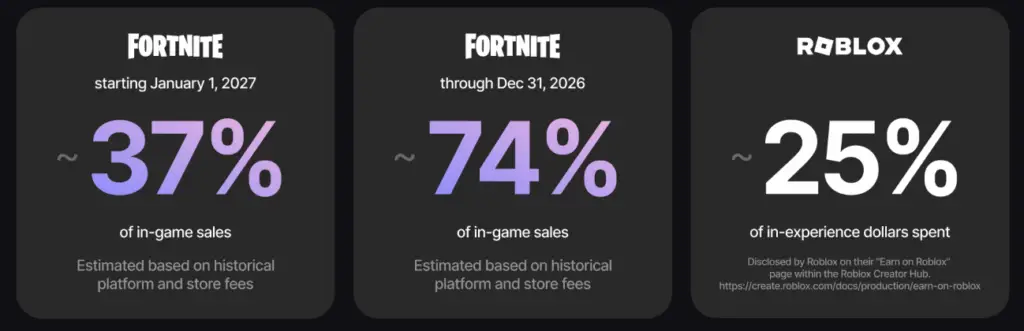
Epic Games is leaving little doubt about its intentions, launching a direct challenge at its primary competitor. The company boldly asserts that, based on information published on Roblox‘s own site, Fortnite creators stand to earn a substantial 12% more from their item sales. This aggressive positioning underscores the escalating battle for creative talent within the gaming industry. By offering notably more favorable creator payouts, Epic aims to strategically lure developers to its platform, directly contesting Roblox’s long-held dominance in the UGC space and ushering in a new era of competition over revenue sharing models.
The Dual Nature of Paid User-Generated Content
The burgeoning trend of paid UGC presents a multifaceted landscape, embodying both exhilarating possibilities and concerning implications for the future of digital innovation. On one hand, it represents a profoundly positive evolution, fostering immense creativity and enabling new trends and entirely novel games to spring forth from these dynamic ecosystems. This empowers a new generation of developers and artists to build and share their unique visions with a massive global audience. However, as Digital Tech Explorer frequently observes in emerging tech trends, there is a discernible downside. This model often compels young or aspiring creators to become reliant on monopolistic, games-turned-platforms that extract a significant portion of their hard-earned revenue. In a relentlessly challenging games industry, this raises pertinent questions about the long-term health and inherent fairness of a system where creators are fundamentally tied to a single platform for their genesis and growth.
Fortnite‘s recent announcements signify an aggressive and meticulously calculated entry into the competitive UGC market. This initiative is far more than a mere expansion of features; it is a direct and formidable challenge to the established order. The staggering player numbers witnessed in some Roblox experiences, with millions of concurrent users in a single game, have undeniably captured the focused attention of Epic Games. By offering more lucrative terms and enhanced creative tools, Epic is unequivocally rolling up its sleeves to compete fiercely for the talented creators who engineer these popular virtual worlds, thereby igniting an arms race for paramount control over the very future of user-generated gaming.