

For many tech enthusiasts, myself included, Mozilla Firefox once stood out as the quintessential privacy-centric browser, a formidable alternative to the pervasive Google Chrome. I, like many, relied on its commitment to user data protection. However, a shift in recent years seemed to dilute this core focus, raising concerns that Firefox was beginning to mirror other mainstream browsers. It’s with renewed optimism, then, that we at Digital Tech Explorer welcome the news that Firefox is actively expanding its robust fingerprint protections. This move could very well be the vindication many have been waiting for, reigniting Firefox’s reputation as a true guardian of online privacy.

Specifically, Firefox is enhancing its defenses against websites that attempt to stitch together a “secret digital ID” for users. This nefarious practice, known as browser fingerprinting, involves siphoning off subtle details about your system — from your timezone and operating system settings to installed fonts — to construct a unique “fingerprint” that can identify you across various websites and browsing sessions. It’s a sophisticated method of tracking that often goes unnoticed by the average user.
Indeed, fingerprinting has become a prevalent, almost standard practice across the web. This insidious technique means that even without a formal account or the presence of traditional cookies, websites can often recognize and track you across visits. It’s a stark reminder that our digital footprint is often far larger and more traceable than we might assume.
According to data highlighted by Mozilla, the impact of these protections is significant. Without any defenses, over 60% of users can be uniquely identified by fingerprinting websites. Firefox’s initial ‘phase 1 protections’ managed to reduce this figure to under 40%. With the ongoing rollout of ‘phase 2 protections,’ Mozilla confidently asserts that this number will drop even further, aiming for only 20% of users appearing unique. This demonstrates a strong commitment to enhancing user privacy.
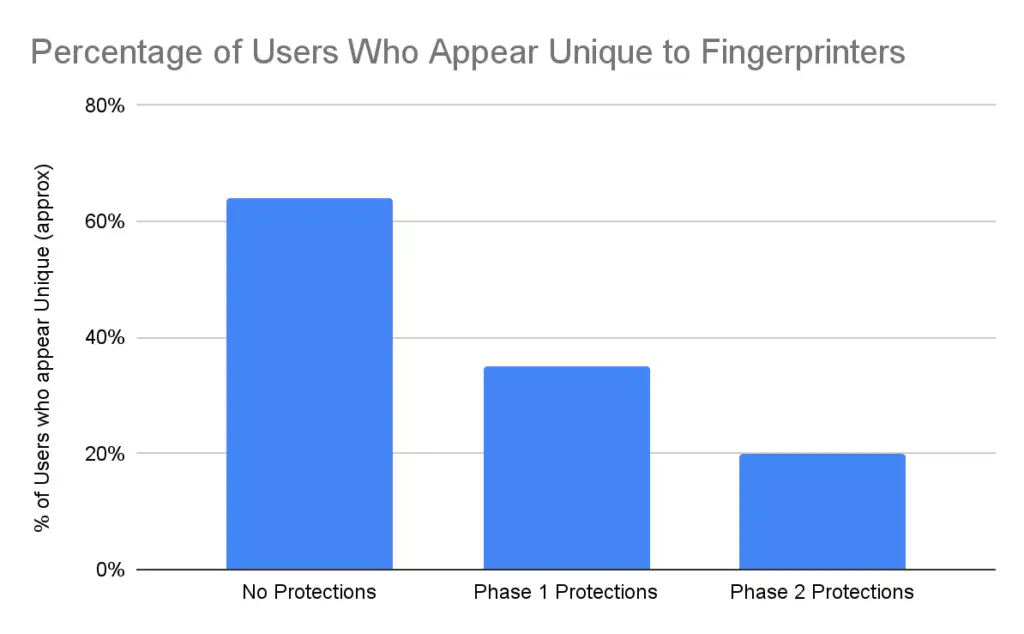
Mozilla boldly states that, informed by “global analysis,” Firefox stands as the pioneering browser offering such profound insight into fingerprinting vulnerabilities and deploying the most effective defenses to mitigate them. This leadership position is crucial for the ongoing battle for digital freedom.
Decoding Firefox’s Enhanced Fingerprint Protections: The Technical Details
Mozilla’s strategy for combating fingerprinting is ingenious: it’s designed to present websites with the most generic, least revealing information about a user’s device and system, all while preserving essential functionality. This delicate balance is key to effective browser privacy. As detailed by Mozilla, Firefox implements several specific changes:
- Processor Core Reporting: Instead of revealing the precise core count, Firefox will report either a four-core or an eight-core processor, effectively blurring this unique identifier.
- Font Usage Anonymization: To prevent sites from identifying users based on their unique collection of locally installed fonts, Firefox will no longer utilize them for on-page text rendering in protected modes.
- Screen Resolution Obfuscation: Your ‘available’ screen resolution will be reported with a slight alteration (normal resolution minus 48 pixels), making it harder to pinpoint your exact display setup.
- Trackpad Input Generalization: Firefox will generalize trackpad input reports to only no-touch, single-touch, or five-touch, masking more granular details.
- Canvas Element Randomization: When websites attempt to read back ‘canvas elements’ (often used for background images or graphics to generate a fingerprint), Firefox introduces random data, corrupting the uniqueness of the generated image and making it much harder to track.
These advanced protections are currently active in Private Browsing Mode and ETP Strict mode. Mozilla’s stated goal, however, is to “enable them by default” for all users, further cementing Firefox’s dedication to robust user data privacy.
Contextualizing Mozilla’s Evolving Stance on User Privacy
For those who champion Firefox as a crucial bulwark for online privacy, these new fingerprinting protections are undoubtedly a positive development. They offer a refreshing contrast to some of Mozilla’s more controversial decisions regarding privacy over the past couple of years.
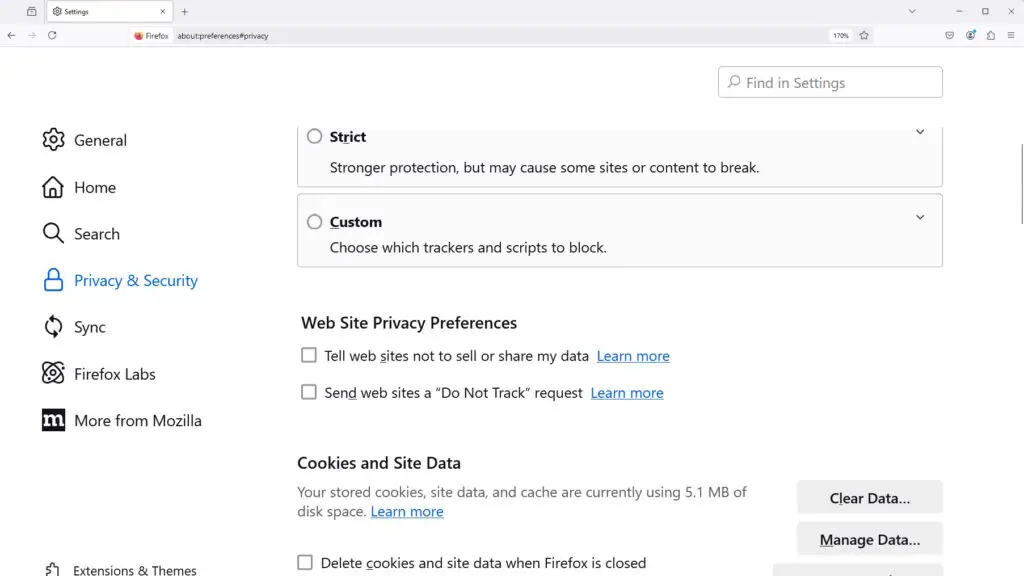
A notable shift occurred last year when Firefox deprecated its ‘Do Not Track‘ (DNT) setting in favor of Global Privacy Control (GPC). While GPC represents a more standardized approach, the philosophical change was significant. DNT requested websites not to track users at all, whereas GPC primarily instructs sites not to sell or share user data. From a practical standpoint, adopting a widely accepted standard like GPC might be beneficial for broad compliance, but it arguably softened Mozilla’s previously uncompromising stance against all forms of user tracking.
Adding to this evolving narrative, Mozilla faced significant scrutiny earlier this year for attempting to introduce revised Terms of Use for Firefox. These new terms contained language perceived by many as granting the company an overly broad scope concerning user data. Compounding concerns, the popular FAQ section, which explicitly promised not to sell user data, was simultaneously removed.
In response to the ensuing community backlash, Mozilla issued clarifications, stating that the new terms “does NOT give us ownership of your data or a right to use it for anything other than what is described in the Privacy Notice.” However, the vague and expansive wording of the original terms left a lingering sense of apprehension among many privacy advocates and users, highlighting the critical importance of transparent communication in tech news.
Considering these developments, it’s genuinely encouraging to witness Mozilla once again championing innovation in online privacy. As Digital Tech Explorer continues to monitor the evolving landscape of browsers and software, this renewed commitment from Firefox presents a compelling reason for tech enthusiasts to revisit its capabilities. Perhaps it is indeed time for many of us, including myself—a long-time admirer of the venerable browser—to give this privacy-focused option another serious look.
Disclaimer: All content on Digital Tech Explorer is for informational and entertainment purposes only. We do not provide financial or legal advice.
Affiliate Disclaimer: Some of the links on Digital Tech Explorer are affiliate links. This means we may earn a commission if you click through and make a purchase, at no additional cost to you. Our recommendations are based on thorough research and personal experience.