Welcome to another deep dive from Digital Tech Explorer, where we unravel the complex interplay of technology and global politics. There’s a high-stakes game of global strategy unfolding, with China, the United States, and the European Union each navigating a delicate balance. In a significant recent move, China announced stringent export controls on rare earth minerals, crucial components for manufacturing across key sectors, most notably computer chips. This places the EU in a particularly challenging position, given its deep reliance on Chinese exports, sparking a debate on whether it should consider retaliatory trade measures.
Sources indicate that the European Commission is actively formulating plans for potential responses to China’s rare earth controls, though the specifics remain under wraps. EU leaders are approaching the situation with caution, prioritizing the avoidance of further escalation with a vital trading partner if possible.
However, not everyone advocates for restraint. Influential groups, such as the European Council on Foreign Relations (ECFR), are pressing for more assertive, punitive actions against what they perceive as China’s diplomatic tactics. A recent ECFR report outlines several strategic countermeasures, including potential restrictions on crucial automotive parts, jet engines, and other specialized components. A cornerstone of their recommendation is to limit China’s access to Deep Ultraviolet (DUV) lithography machines, a technology absolutely essential for the fabrication of advanced semiconductor chips.
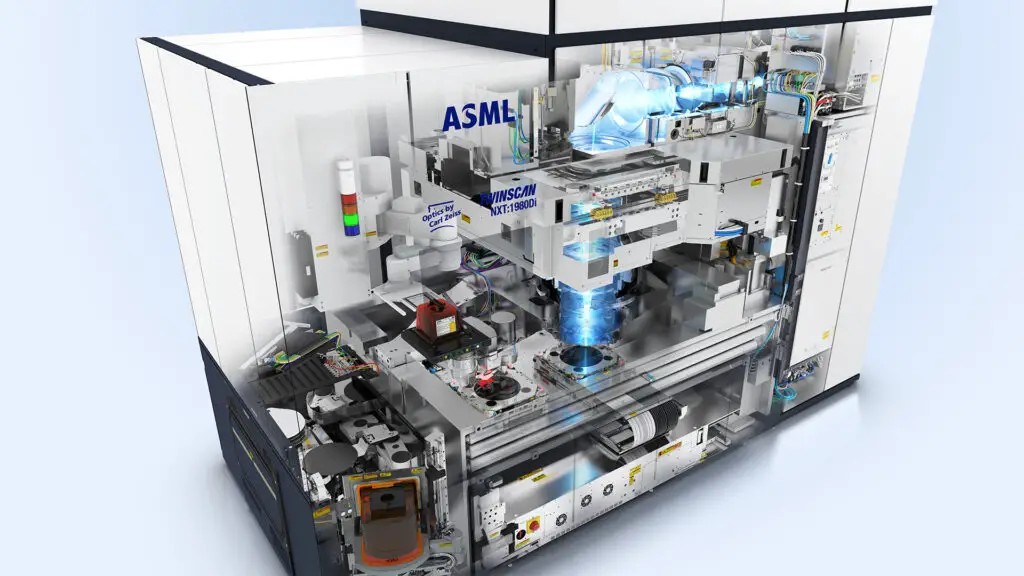
For those new to the intricacies of chip production, DUV lithography is a fundamental process that uses light to print intricate designs onto silicon wafers, which are then etched to become functional processors. The global leader in supplying these sophisticated DUV systems is the Dutch company ASML. ASML’s operations are a testament to global collaboration, relying on a vast network of European and international suppliers, including Germany’s Zeiss, for critical parts. Beyond manufacturing, ASML also provides essential servicing for its lithography equipment worldwide, ensuring the continuous operation of global chip foundries.
An ASML TWINSCAN NXT 1980Di DUV lithography machine.ASML production facility
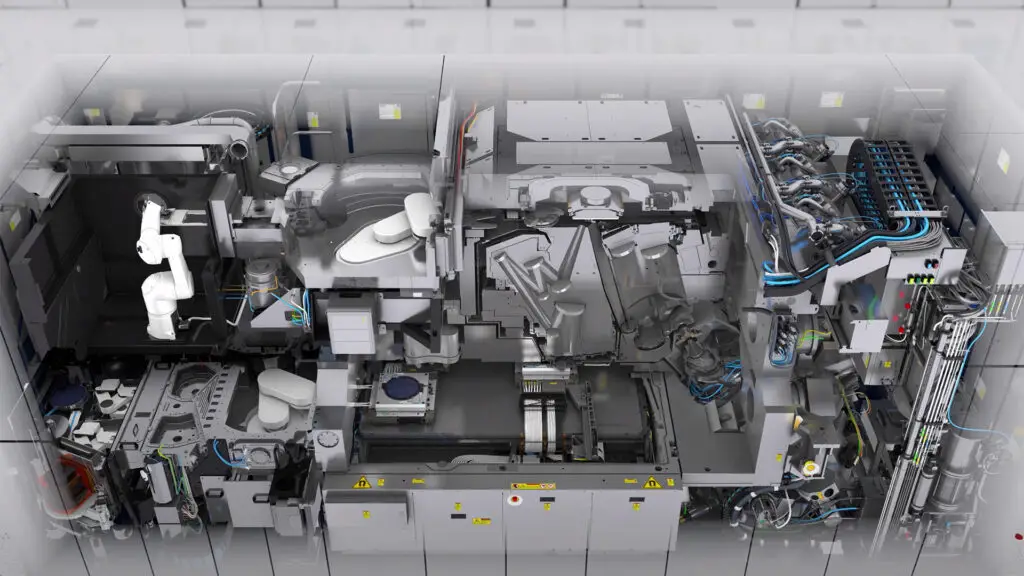
China’s ambitious goal of establishing a robust domestic semiconductor manufacturing industry hinges critically on its access to DUV technology. Compounding this challenge, the more advanced Extreme Ultraviolet (EUV) lithography machines are already subject to stringent export controls imposed by the US and Dutch governments, effectively barring their sale to China. This is particularly significant as ASML holds a near-monopoly as the world’s sole major supplier of EUV systems.
ASML EUV machine with internals exposed
As TechTalesLeo explores, while China is still a considerable distance from independently matching the capabilities of an ASML EUV machine, it currently focuses on optimizing its existing DUV equipment to produce high-performance processors. This involves complex techniques like multi-patterning to achieve increasingly smaller transistors with DUV, a method that inevitably escalates both production costs and time compared to EUV.
The Case Against Expanding DUV Restrictions
A think tank’s recommendation, no matter how well-researched, only carries weight if government ministers choose to act upon it. The European Commission might well decide to sidestep the ECFR’s suggestions, and there are compelling arguments supporting such a decision.
Firstly, a retaliatory “tit-for-tat” trade war is precisely the kind of cycle that led to the current fraught geopolitical environment. Secondly, Europe does not hold an exclusive monopoly on DUV technology. Thirdly, past restrictions have often inadvertently fueled China’s resolve and accelerated its efforts to establish independent domestic chip fabrication capabilities.
Beyond ASML, DUV lithography systems are also manufactured by Japanese giants like Nikon and Canon. China already operates a substantial number of DUV machines from these manufacturers and is actively developing its own indigenous DUV tools. While developing or servicing advanced DUV equipment without European involvement would undoubtedly be challenging and slow, China stands a far greater chance of achieving DUV self-sufficiency than it does with EUV at this juncture. In fact, some reports indicate that China may have already made significant strides in this area.
Therefore, while limiting US and European components for DUV lithography systems could indeed delay China’s semiconductor industry progress by several years, perhaps even a decade, it is unlikely to halt it indefinitely. In such a scenario, China could respond by imposing further export controls on critical rare earth minerals, presenting substantial challenges for European industries. Currently, China maintains it will not take such action, and the EU remains cautious in its own potential retaliatory considerations. Meanwhile, the global tech landscape is further complicated by figures like former US President Trump, who has openly expressed willingness to block products made with US software from reaching China if geopolitical tensions escalate. As Digital Tech Explorer, we continue to monitor these developments, providing you with the insights needed to understand the complex future of technology.