
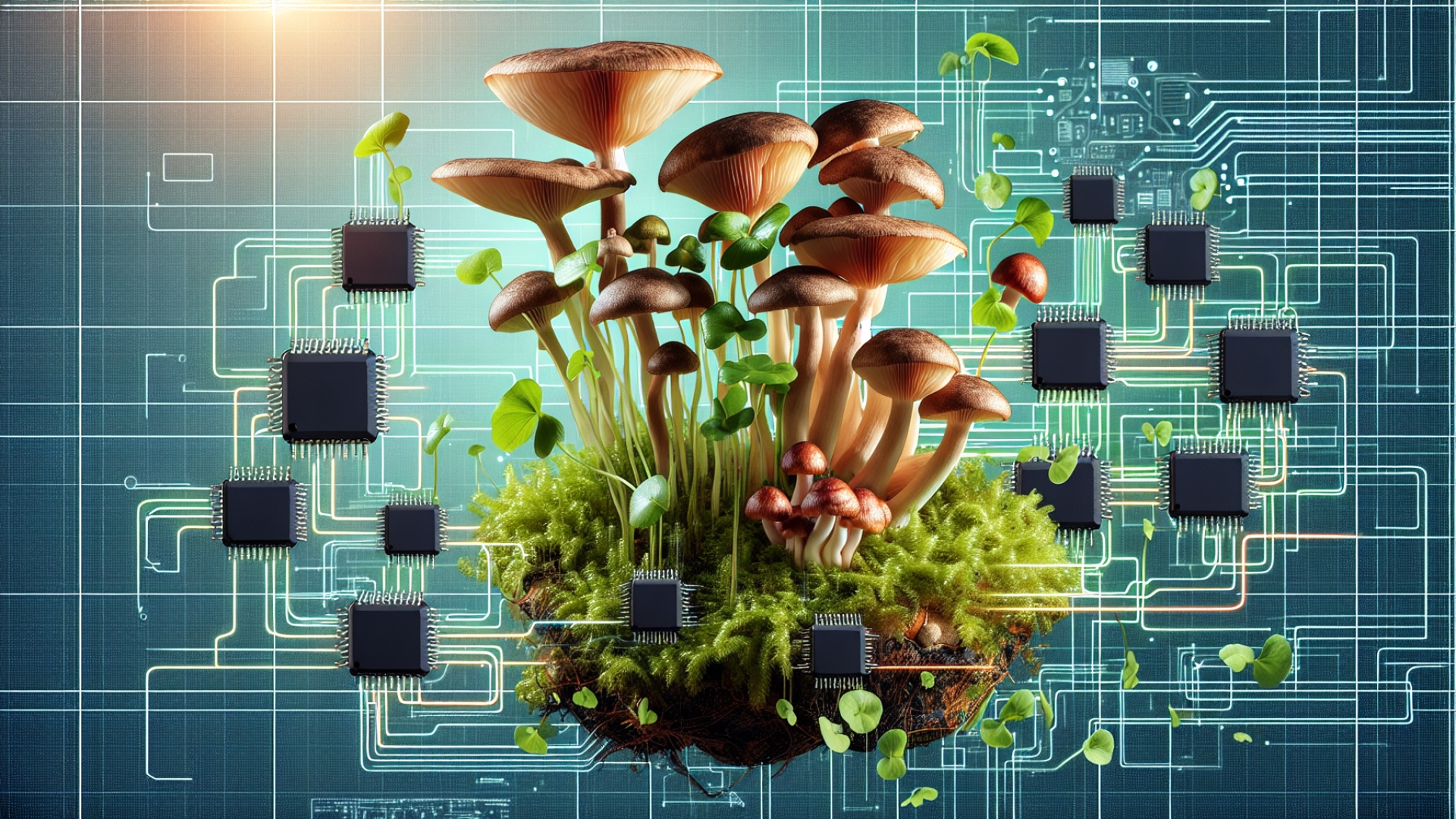
Mushrooms, fascinating organisms that defy easy classification as either flora or fauna, are proving to be more than just culinary delights. Many types of fungi are known for their intricate relationships, often forming symbiotic networks with plant root systems called ‘Mycorrhiza’. This natural networking capability has now inspired groundbreaking research into their potential as bioelectronic data processors.

Researchers at the Ohio State University have discovered that common edible mushrooms, such as shiitake and button varieties, can be trained to function as organic memristors. This was achieved by growing these fungal cultures, dehydrating them for stability, and then methodically applying electrical stimulation. The dehydrated fungi demonstrated an astonishing ability to retain and reproduce memory effects related to their past electrical states, akin to how traditional semiconductor chips operate.
This innovative research draws inspiration from the human brain’s neural activity, which relies on electrical impulses. John LaRocco, the lead author of the study, highlights a significant advantage: “Being able to develop microchips that mimic actual neural activity means you don’t need a lot of power for standby or when the machine isn’t being used. That’s something that can be a huge potential computational and economic advantage.” Beyond performance, the project is also driven by environmental considerations, positioning fungal computers as a sustainable and biodegradable alternative to current semiconductor-based neuromorphic chips, which often require rare-earth materials and complex, costly fabrication processes.
The Science Behind Fungal Memory and Neural Mimicry
The intricate mechanism behind fungal memory centers on their bioelectrical responses. By applying electrical stimulation to dehydrated fungal cultures, researchers observed that the fungi could retain and reproduce specific memory effects. This behavior, reminiscent of how traditional semiconductor chips store data, is directly inspired by the human brain’s neural networks. The objective is to leverage these inherent bioelectrical properties to create novel computational systems that operate with unprecedented efficiency.
As John LaRocco, the study’s lead author, emphasizes, developing microchips that mimic neural activity offers substantial computational and economic advantages through significantly reduced power consumption during idle periods. Beyond performance, this research offers a powerful environmental solution. Where current semiconductor-based neuromorphic chips rely on scarce rare-earth materials and intricate manufacturing, fungal computers promise a genuinely sustainable and biodegradable alternative, paving the way for a more eco-conscious technological future.
Practical Performance and Future Horizons
Initial tests on dehydrated mushroom cultures for RAM-like memory functions yielded an impressive 90% accuracy rate. While more frequent electrical shocks did show signs of performance waning, this was effectively mitigated by simply integrating more mushrooms into the circuit, demonstrating a promising and scalable approach to enhance both reliability and capacity.
The potential applications of this technology extend beyond Earth. Notably, shiitake mushrooms have demonstrated remarkable radiation resistance, making them a compelling candidate for future aerospace applications. This opens up a futuristic vision where advanced fungal systems could potentially navigate spacecraft.
Despite this revolutionary potential, current fungal bioelectronic processors face clear limitations, primarily their operational speed, which peaks at a modest 5.85 kHz. This is considerably slower than even the RAM chips found in early personal computers, presenting a significant hurdle for applications requiring rapid data processing. However, the economic feasibility offers a compelling advantage: while other biological computing systems, such as Cortical Labs’ CL1 biological computer, carry a substantial price tag of around $35,000, the cost of culturing and utilizing mushrooms for similar research is comparably minimal. This dramatic cost differential could significantly accelerate research, expand the scope of experimentation, and hasten the realization of diverse biological computing applications – from fungal aircraft navigation to novel data processing solutions. It’s an emerging technology trend that highlights digital innovation at its most intriguing, offering a path for developers and tech enthusiasts to stay ahead of the curve.