

When I first reviewed The Edge of Fate, I had plenty of reservations about the new direction Destiny 2 was taking. The expansion itself was… acceptable—a few highlights, but largely unremarkable. The more pressing concern was the Portal, the new centralized hub for Destiny 2‘s seasonal power progression.
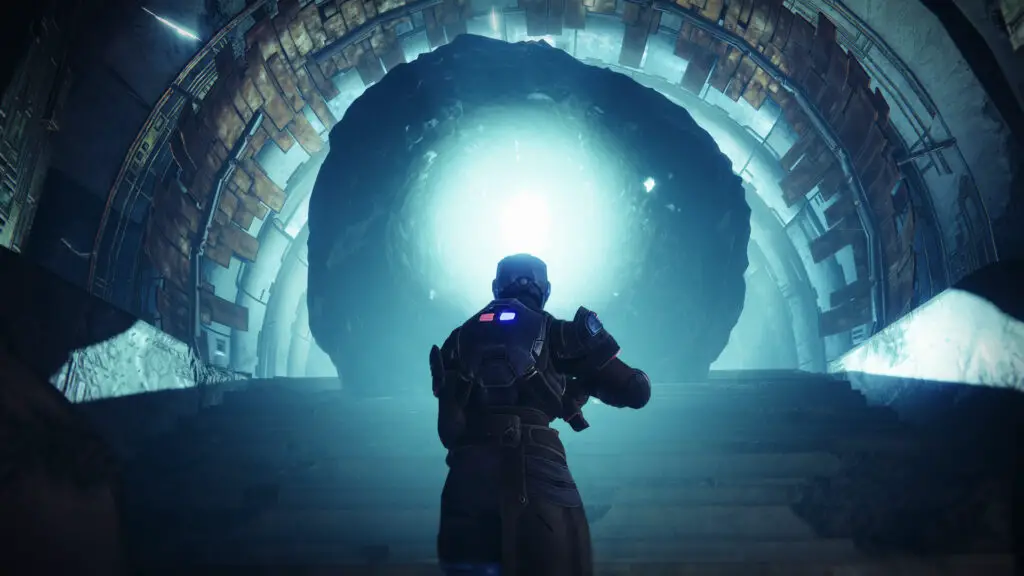
Still, as a dedicated player, I felt compelled to give it a fair chance. Perhaps my initial impression was flawed, or maybe things would improve once I started earning better gear. This season, I committed myself to the arduous journey of the seasonal grind, determined to discover if my fears were unfounded.
Now, having achieved power level 400, I can definitively state that, no, it’s actually so much worse.
It’s not merely that the power progression feels unrewarding—though it absolutely does. This new iteration of Destiny 2 falters across the board. Its failures are fundamental, the kind that would never arise in a game built from the ground up. Instead, they appear to be a direct consequence of clumsily forcing the old game into an entirely ill-suited new framework.
This was a critical juncture for Bungie, and arguably the worst possible time for such a profound misstep. Following layoffs, persistent uncertainty, and the lukewarm reception to Marathon, the studio desperately needed a clear win. Unfortunately, this revamped version of the game feels designed for no one in particular; an abstract boardroom concept of “player engagement” and “monthly active users” brought to life, existing in stark contrast to what any long-time Destiny 2 player actually desired. And even then, it’s bungled throughout—a muddled hodgepodge of conflicting systems that somehow manages to punish players for merely attempting to engage with it on its own terms.
As someone who has enjoyed Destiny 2 throughout its lifespan—despite many of Bungie’s questionable decisions along the way—my deepest wish is for the game to find its footing again. Therefore, as TechTalesLeo for Digital Tech Explorer, I’m going to delve into excruciating detail about my problems with what Destiny 2 has become. Brace yourselves, because the list is extensive.
The Power Progression is Excessively Long
This appears to be the primary point Bungie has somewhat conceded, stating a few weeks ago that, “Progression is clearly slower than we want it to be, and we plan to generally increase the speed of progression for most players.”
Despite this acknowledgment, Bungie initially announced a series of short-term changes that would have actually *slowed* progression—a move they walked back just a week later after the inevitable community backlash. This pattern is concerning, and not solely because of Bungie’s seemingly terminal inability to avoid self-inflicted landmines. The proposed tweaks suggest Bungie might be aiming to gently nudge us towards a faster leveling curve, rather than taking the drastic action truly needed: smashing this iteration of the power grind with a sledgehammer.
Let me state my bias upfront: I detest the power progression. I always have. Previously, at least, it was merely an inconvenience. Before The Edge of Fate, raising your level happened gradually because you could only earn a limited number of powerful and pinnacle engrams each week. While annoying, the system at least offered variety and consistency.
Most activities previously offered some form of weekly reward that would increase your power level, gently encouraging engagement with a selection of matchmade playlists. These playlists, in turn, often had their own unique loot pools and progression systems, allowing players to pursue multiple goals simultaneously.
In recent years, under former game director Joe Blackburn’s leadership, Bungie even experimented with not raising the power cap season-to-season at all, instead employing power deltas—capping activities at a fixed difficulty regardless of your actual level. For me, it was a resounding success: it allowed me to focus on the content I enjoyed without having to perform the requisite busywork for the privilege. It was a tantalizing glimpse of a better game, now cruelly snatched away.
Now, the power progression is not only back, it has been supersized. Some argue it’s a theoretically better system because there’s no weekly limit to power increases. I strongly disagree. To balance that concession, Bungie has taken the most tedious aspect of the game and transformed it into a hard barrier to accessing what you actually want. If your aim is to acquire the best loot in this looter-shooter, your only recourse is to buckle down and grind until your arbitrary number is sufficiently high for desirable gear to drop.
According to Time Wasted on Destiny, my ascent to the current level of 400 consumed 70 hours. Estimating that roughly 20 of those hours were spent on the expansion’s campaign and destination content, that means my seasonal climb—leveling from 200-400—took approximately 50 hours of pure playtime.
That’s 50 hours of repeating the same handful of activities, meticulously watching a number slowly tick upwards to an arbitrary cap that dictates when better rewards become available. These were some of the most tedious, unrewarding, and unstimulating hours I’ve ever spent in Destiny 2. If it weren’t for Netflix on a second screen and a perverse desire to fully comprehend the extent of the problem, I would never have persevered. Most of my friends didn’t—almost everyone I used to play with checked out weeks ago.
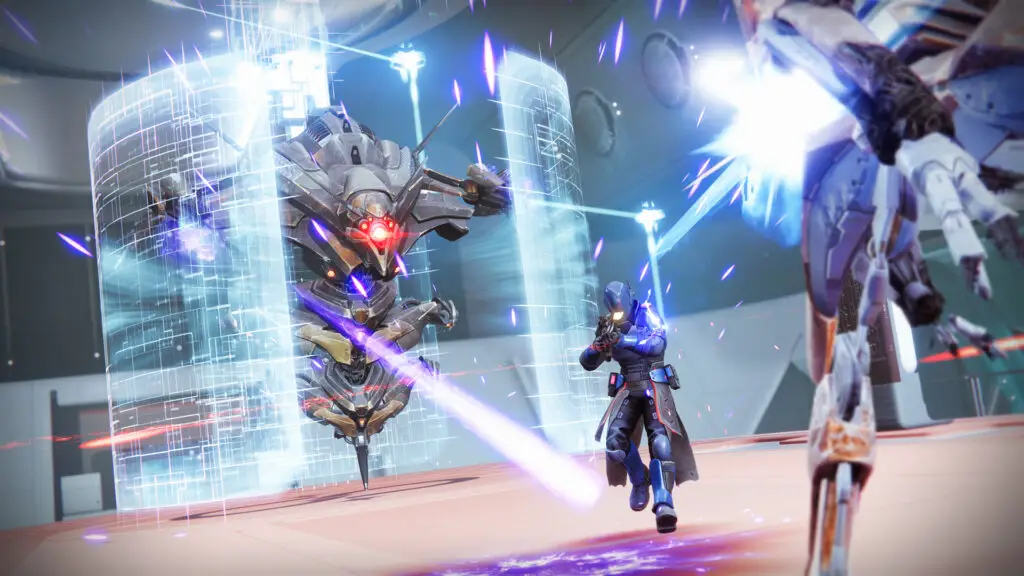
The Portal’s Content is Lacking
Once you hit power level 400, you are guaranteed the highest rewards currently earnable—tier four loot, with a small chance for tier five drops. Ostensibly, this signifies the end of the climb: I can finally focus on earning gear for my preferred builds.
This should be the fun stage: dropping into whatever content I desire and being appropriately rewarded for it. In practice, what it actually means is running the same handful of activities as before, but now with marginally better loot at the conclusion.
Before The Edge of Fate, Destiny 2 was composed of distinct activities, each containing its own loot pool. Seasonal activities, destinations, Vanguard Ops, Crucible, Gambit, raids, dungeons, and Nightfalls all offered unique weapons. While the loot chase wasn’t exceptionally deep, it did encourage pursuing drops across a variety of modes. Even if there weren’t any weapons you were particularly excited about in a given season, there were ample progression hooks that rewarded materials or bonuses. There was genuine value in playing a diverse range of content.
In Edge of Fate, with the exception of the expansion itself and the new raid, everything else has been flattened into the Portal. This centralized hub contains only three loot pools—one for Crucible, one for Pinnacle Ops, and one that covers both Solo and Fireteam Ops. For a variety of reasons I’ll detail, there’s practically no point engaging with anything outside of this new hub. And the Portal simply doesn’t offer enough compelling content.
We’ve transitioned from a game so vast that Bungie felt compelled to remove entire chunks of it, to one that hyper-focuses on a small handful of activities expected to sustain player engagement for half a year.
Currently, there are four Pinnacle Ops, which are largely repurposed Exotic missions that struggle to hold up to repeated play. Even with the promise of a new Mint Retrograde—easily the best weapon added this expansion—it’s hard to stomach yet another run of Starcrossed or Kell’s Fall. Worse, there are only six Solo Ops, an actual disaster given how heavily the seasonal progression prioritizes them.
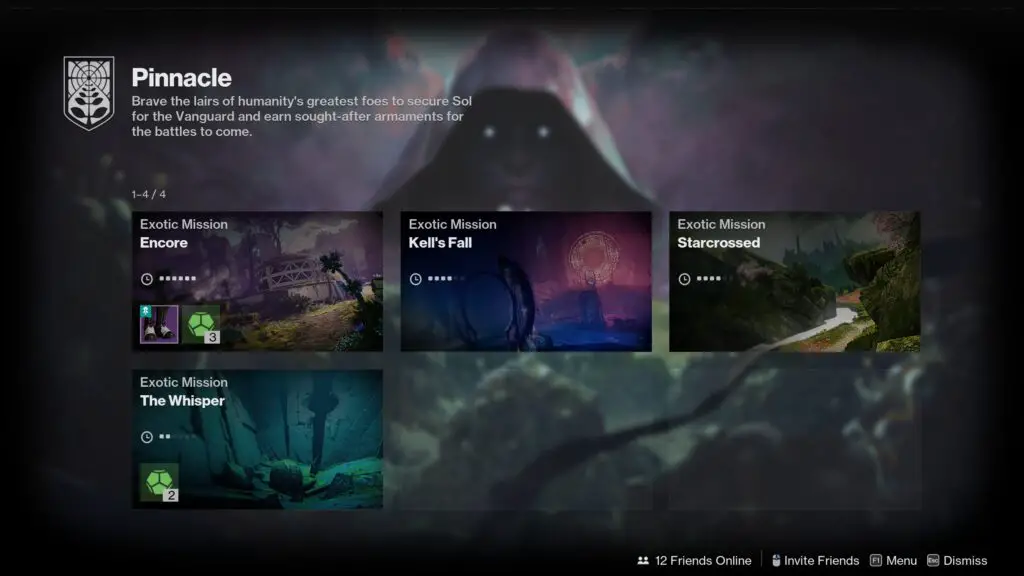
Fireteam Ops are more numerous—a whole 16 missions! But that playlist is undermined by its inconsistency. Unlike Solo and Pinnacle Ops, which grant score based on objectives, securing a top-rank rating in Fireteam Ops requires you and your team to kill enemies, with an additional time bonus for finishing quickly. Even in the best-case scenario, these two goals are often at odds. It’s easy to misjudge and finish with a lower rank, which means lower tier rewards. Unless you can guarantee a top rank, you’ve essentially wasted your time.
The removal of distinct loot pools has a noticeable effect on what content is deemed “worth playing.” Onslaught was incredibly popular when Into the Light released because it showered players with some of the best guns in the game. The version of Onslaught released during Episode: Revenant was less popular because it offered up some of the most mediocre weapons. The difference was stark.
Now, the Portal version of Onslaught provides the exact same loot you’d acquire for doing any other Fireteam or Solo Op. And because Onslaught is both lengthy and has a built-in fail state, it’s possible to spend 30 minutes achieving basically nothing. In that same timeframe, you could complete six runs of the Caldera Solo Op to earn equivalent rewards. Simply put: The Portal fails because it incentivizes players to judge activities not by their enjoyment, but by their baseline time-to-reward efficiency. There is no other compelling reason to play.
Difficulty is Irrelevant—Only the Big Number Matters
Every day, three different Fireteam Ops activities are selected for matchmaking privileges. Generally speaking, these are quite enjoyable—offering a decent challenge thanks to fixed modifiers and power deltas. Yet again, it’s an inconsistent way to play due to both the time pressure and the potential for a wipe, which results in activity failure. Jumping in with random players is a dice roll, difficult to justify when the solo experience is often more forgiving.
Outside of these scant few matchmade activities, difficulty is entirely customizable—allowing you to select modifiers that provide bonuses to your final completion rank. Ostensibly, this system should tie reward to risk. But as long as the chosen modifiers place you within range of the top rating, you’re in the clear.
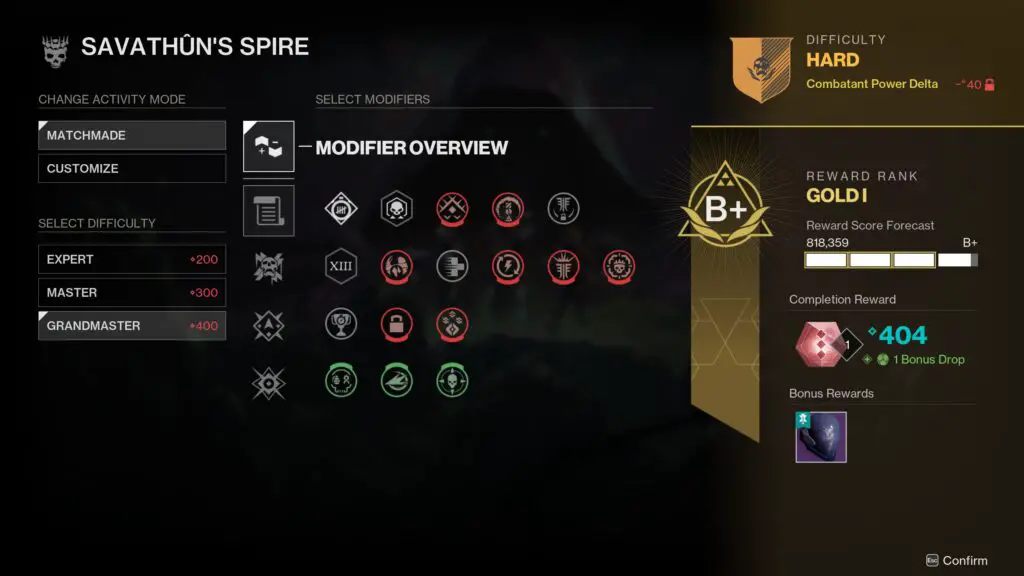
This means customizable modifiers become an exercise in mitigating difficulty; the objective is to make the process as smooth and frictionless as possible because all that matters is the sheer number of completions, rather than their quality. At power level 400, I can reliably guarantee a top-rank rating on a Solo Ops run with just a couple of negative modifiers, allowing the time bonus to carry me the rest of the way.
A matchmade Grandmaster Fireteam Op locks me at 40 power levels below the recommended, with a selection of negative and positive modifiers. Due to the minimal modifiers needed, my customized Solo and Pinnacle Ops runs are faster and easier—just 20 power levels below recommended while still guaranteeing the best rewards.
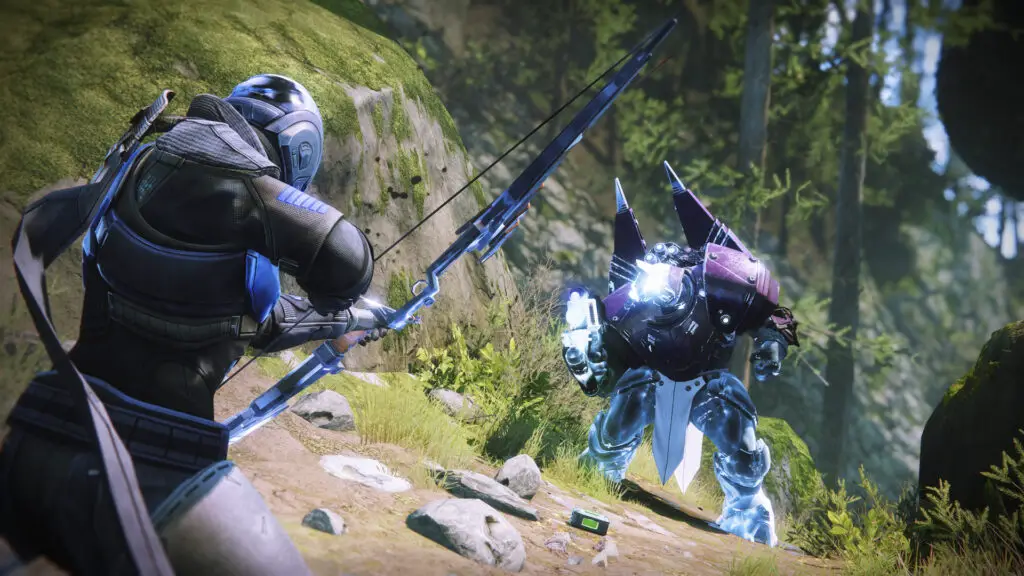
In a version of the game that made sense, the most difficult activities would yield the best loot. Instead, this version of Destiny presents a difficulty curve that oscillates wildly, temporarily spiking every 20 levels when you move up a reward score bracket. When you do, you simply need to find the new, easiest combination of modifiers to run, earn a few more drops to increase your level, and, congratulations, you’re back in easy mode.
And again, when it comes to the rewards, the *only* thing that truly matters is your power level. I’ve been running Grandmaster difficulty since I hit level 370 or so, but I wasn’t earning those coveted tier four drops until my character hit 400 power. That feels counter-intuitive on an individual level, but it’s even worse in a group setting. If I brought a friend into Grandmaster difficulty, our loot tiers for completing the exact same activity would differ solely based on our respective power levels. If a friend and I went Flawless in the Trials of Osiris, the shared victory would result in vastly different rewards.
It’s fundamentally broken. I want the game to reward me for completing genuinely difficult activities, and I want the barrier to entry for those difficulties to be my ability and gear, not an arbitrary power level. I envision a system where newer players are encouraged to climb difficulty ranks to earn better rewards as their game knowledge increases, while seasoned veterans who have been accumulating knowledge and gear since launch can jump straight to the high-tier content.
Let me select difficulty based on the kind of reward I want to earn. Don’t force me to customize the fun out of the game because doing the quickest, most efficient thing is more rewarding and consistent. And don’t make me grind levels to get there, punishing me with inferior loot for not hitting some arbitrary number.
Infuriatingly, the expansion comes tantalizingly close to getting this right in certain areas. Completing the Mythic difficulty weekly campaign missions rewards tier five loot drops. But it only does that because, at 350 power, I unlocked a permanent tier upgrade to every drop in the expansion’s destination. Every facet of the game feels infected with this doomed obsession with raising your power level.
The ‘Seasonal Gear’ Bonuses are Detrimental
Every weapon and armor piece released in this expansion features a special icon, marking it as seasonal gear. Equipping these items provides a bonus—an up to 10% boost to weapon damage, depending on the gun’s tier, and a 15% bump to damage resistance for armor. This was a significant point of contention for players before The Edge of Fate released, but I’ll admit that I didn’t initially think it would make a substantial difference. After all, 10% extra damage is less impactful than any decent weapon perk in the game. Surely it couldn’t be *that* big of a deal.
I was wrong. These seasonal gear bonuses are an unmitigated disaster for the long-term health of the game.
The problem isn’t just the direct buffs to damage and resistance. It’s that seasonal gear is prioritized in other, more insidious ways. The most frustrating is that it significantly increases the score you earn from Portal completions. With a full set of new items, you’ll require substantially fewer modifiers to guarantee an A-rank rating than if you’re equipping older gear. Given that achieving top ranks is now the entire point of the core game loop, this system actively punishes you for using anything else stored in your vault.
Seasonal conquests—special versions of Portal activities that are ostensibly the aspirational content of the new model, even if they reward the same loot as regular completions—feature a new modifier, “avant garde,” which *forces* you to equip seasonal gear. At every stage, the new system is overtly trying to cajole you into putting away your beloved Zhaoli’s Bane.
In case it needs spelling out for readers of Digital Tech Explorer, this is genuinely awful for player choice. Only certain exotics each season are “featured”—granted the same status and bonuses as seasonal gear. Furthermore, only a limited number of legendary weapons are available each season, meaning certain elements and archetypes are severely underrepresented. All of this culminates in entire build types becoming simply unviable.
Worse, it renders everything that came before The Edge of Fate functionally pointless. If you hadn’t already farmed your god rolls in some of the old dungeons, or unlocked crafted versions of all the weapons in an older raid, there’s little motivation to do it now. Why chase legacy loot if the game is going to penalize you for using it?
The thousands of hours I spent earning and enhancing my carefully curated weapons? They feel largely useless now. My vault is overflowing with hundreds of guns that I would be foolish to ever equip in serious content.
And to compound the issue: Next season, this cycle repeats. When Renegades launches in December, two critical things will occur:
- Everybody’s power level resets back to 200.
- A new set of seasonal gear will arrive.
This means the excruciating power progression begins anew, and it will be harder and slower for anyone still stubbornly using the gear they earned this time around. Bungie has constructed an endless hamster wheel, and it’s hoping players never decide to step off.
This season, Bungie introduced set bonuses for armor—perks akin to a weapon’s origin trait that reward you for equipping multiple pieces from the same set. This should have been sufficient to get players invested in seasonal loot. This year’s Solstice armor, for instance, had a bonus perfectly suited to Solar builds, and I would have actively pursued good stat rolls on it regardless of whether it was categorized as “new gear.”
But instead of having faith in that inherently engaging system, Bungie has opted for a backhanded version of sunsetting—invalidating players’ time investment by penalizing the use of anything but the current treadmill’s offerings.
Crafting is Dead, RNG Reigns Supreme
The Witch Queen expansion introduced weapon crafting to Destiny 2—a much-needed form of bad-luck protection that allowed players to mitigate frustrating RNG by creating a version of a gun with their exact desired perks.
Unfortunately, Bungie made an initial misstep with the system’s first iteration. The crafted rolls featured ‘enhanced‘ perks that were demonstrably superior to those obtainable as random drops—not by a vast margin, but psychologically, it shifted player focus. The community began prioritizing earning enough ‘red border‘ versions of each weapon to unlock its pattern for crafting, rather than chasing random rolls.
For this new version of the game, crafting has been almost entirely removed—a single exotic weapon notwithstanding. We observed the warning signs of this change in the latter episodes of The Final Shape, but The Edge of Fate takes it even further. You can’t even craft weapons from the new raid, let alone those found within the Portal activity system.
As someone who has farmed countless dungeons for rolls I never ended up earning, I was a strong proponent of crafting as an option. I believe some form of bad luck protection is ultimately healthy for the game, as it feels deeply unsatisfying to pursue a goal with no guaranteed path to acquisition. Had the system been inverted—where perks on weapon drops could be enhanced, but the crafted version couldn’t—it would likely have kept people engaged in chasing new rolls while still offering a reliable path to desired weapons.
Instead, Bungie has seemingly scrapped crafting entirely, despite the fact that it makes even more sense with the new tiered loot system. Crafted weapons were roughly analogous to tier two weapons in the current system. This means that higher tiers are strictly better—not by much, but psychologically, the distinction would matter. Those who crave the very best of the best would still be free to farm tier fives. Those who simply wanted a reliable, good weapon could craft a perfectly functional version instead.
Both this decision and the shift to seasonal gear bonuses strongly suggest to me an extreme lack of confidence from Bungie in its ability to design truly meaningful armor and weapons. If the enhanced barrels and origin traits gained from higher tier weapons truly offered compelling advantages, developers wouldn’t need to remove crafting. If armor sets were genuinely transformative to your builds, the gear would be desirable without piling on artificial bonuses for merely using it.
Every aspect of the game feels designed around a pervasive fear that players might ever pause their journey on the treadmill of acquiring new power and loot. Quality-of-life concessions are being removed because the new system prioritizes the “stick” over the “carrot”—a system that seems indifferent to whether the loot you’re chasing is actually good, because the chase itself is deemed the only thing that matters. And if you throw your player base an occasional bone, perhaps they might do something other than endlessly play Destiny 2.
It’s an exhausting space to play in. For many of the people I regularly grouped with, the removal of crafting back in Episode: Revenant ironically caused them to play the game less. It was a regression for a game that, up until that point, had begun to deprioritize the incessant power grind and at least attempted to make Destiny more approachable to a variety of players. That era of the game was far from perfect, but it at least promised a better version of what Destiny 2 could truly be.
Somehow, these aren’t even all of my problems with the new progression system. Here are some more quickfire points from my analysis:
- Once you hit level 400, the cost for infusing your gear to your current power level becomes absurdly restrictive; another way the new system punishes variety and the use of old gear.
- Earning low-tier loot for completing raid encounters feels horrendous. And while there’s a system for unlocking ‘feats’ that increase the difficulty and thus the tier of the rewards, that still means multiple completions of earning insta-delete trash.
- The persistent lack of new vault space is a critical issue, especially given the new armor stats and set bonuses. Players have more loot to hold onto, but nowhere to put it.
- There’s an extreme lack of truly aspirational activities. I genuinely don’t even know what I’d play with friends if they were still actively engaged in the game. There’s nothing that feels like it genuinely rewards earning the high-tier gear that Bungie is pushing us towards collecting.
- Fragile mods, which can only be inserted into seasonal weapons and expire after a single season, are yet another reason not to use old gear. Maddeningly, one of these—Temporal Blast—is so much better than all the others that they might as well not exist, essentially rendering their design effort wasted.
The mid-season update, Ash & Iron, launches next week, and perhaps it will solve some of these glaring problems. A new Ultimate difficulty mode is being introduced, and maybe that will finally break out of the current power spike journey that plagues the rest of the Portal. Fireteam Ops is being rebalanced, hopefully resulting in more consistent A-rank ratings. And Bungie is moving some things around to fill out the Pinnacle Ops section a bit more.
Maybe these tweaks will offer some relief, but Bungie is also increasing the power grind by another 100 levels, and doubling down on new gear bonuses by adding a modifier—”touché”—that combines locked loadout and avant garde. Presumably, that will quickly become the easiest way to earn score, once again leaving older gear entirely in the dust.
Ultimately, these changes are just more small tweaks and adjustments to a fundamentally unpopular system that desperately needs a vast and wide-ranging overhaul. Perhaps there’s a version of the Portal that *could* work, but beyond some vague allusions to reducing the power grind, it’s not even clear that Bungie is planning to address the full extent of what truly ails this version of the game.
Destiny 2 was always a game that felt on the cusp of being great—albeit one that perpetually fell short of reaching its full potential. What worries me most now is that this new version feels so far removed from even *that* point that I’m not sure Bungie will ever be able to guide it back to where it was.
Perhaps the studio is banking that enough players will persist with Destiny 2 that these changes are worth the widespread community complaints. But as TechTalesLeo, who has been playing since the very beginning, I can confidently say this season marks the first time I’ve genuinely regretted the hours I’ve invested in the game. The power climb was unsatisfying, unrewarding, and utterly unstimulating. And when Renegades arrives and invalidates all that work, I simply cannot imagine having to do it all over again. As a resource for tech enthusiasts and developers on Digital Tech Explorer, I aim to provide insights that help you make informed decisions, and right now, my informed decision is one of profound disappointment.