
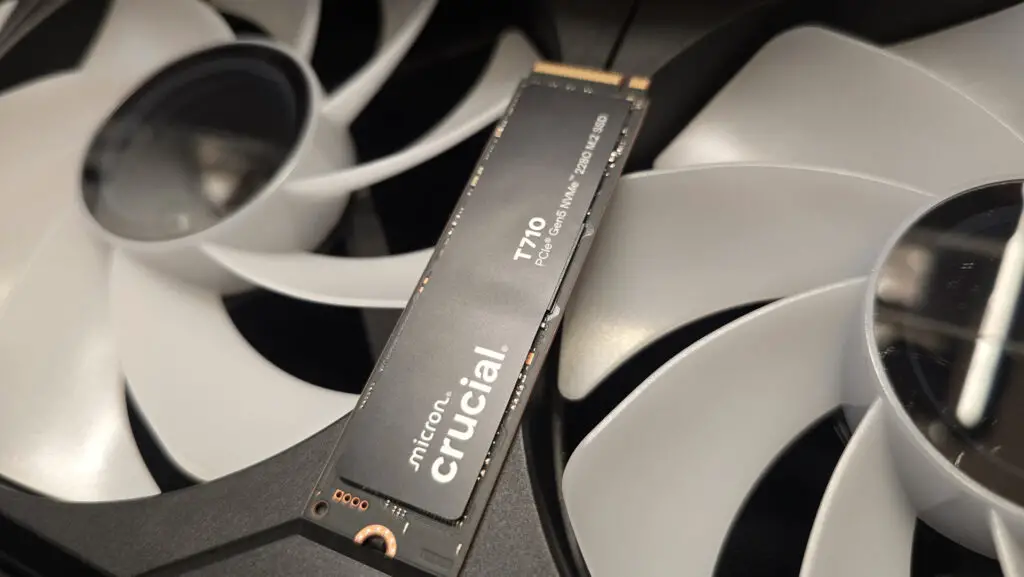
Crucial’s T710 marks a bold new chapter in high-performance storage, challenging the established dominance of drives like Sandisk’s WDSN8100. For months, the WDSN8100 has been widely acclaimed as a leading PCIe 5.0 SSD, but in the fast-paced world of technology, no champion remains unchallenged indefinitely. Crucial, leveraging Micron’s deep expertise, is now making a compelling bid for the top spot. As Micron’s consumer-focused brand, Crucial benefits from in-house NAND flash production. This not only allows them to reserve their best technology for their own solutions but also streamlines the manufacturing process, potentially translating into a significant competitive edge in both performance and pricing – a win for tech enthusiasts and professionals everywhere, as we explore here at Digital Tech Explorer.
Technical Specifications and Architecture: A Deep Dive
Diving into the hardware, Crucial has made a strategic pivot from Phison’s controller line. Instead, it embraces Silicon Motion’s highly regarded SM2508 PCIe 5.0 controller, a powerhouse also featured in impressive drives such as Biwin’s X570 Pro and Acer’s Predator GM9000. This sophisticated controller boasts an eight-channel design operating at 3,600 MT/s, built on an Arm Cortex architecture using TSMC’s efficient 6 nm manufacturing process. Complementing this, it integrates a dedicated DRAM cache, utilizing LPDDR4 @ 4,266 MT/s, ensuring swift and responsive data handling.
The standout feature, however, lies in the NAND technology. Micron has paired the SM2508 controller with its proprietary 276-layer 3D TLC NAND, aiming to achieve peak performance. This represents Micron’s densest and fastest NAND to date, offering an incredibly small footprint and significantly outperforming its previous 232-layer generation found in drives like the Crucial T705 and T700. In direct comparison, the formidable SN8100 utilizes 218-layer BiCS8 NAND from Sandisk’s joint venture with Kioxia. While Micron’s NAND features more vertical layers, the 218-layer BiCS8 NAND distinguishes itself with an optimized vertical and lateral layout for greater efficiency. Furthermore, the 218-layer NAND employs a distinct architectural philosophy known as CBA (CMOS directly Bonded to Array), which ingeniously decouples the CMOS from each cell wafer, bonding them separately. This innovative approach allows each component to be manufactured under optimal conditions, a testament to the ongoing innovation in storage technology.
Specifically, the 2 TB model of the Crucial T710 is equipped with a PCIe 5.0 x4 interface, the advanced Silicon Motion SM2508 memory controller, and Micron 276-Layer 3D TLC NAND. It promises impressive rated performance figures of 14,500 MB/s sustained read and 13,800 MB/s sustained write. Durability is also a key focus, with an endurance rating of 1200 TBW and a reassuring five-year warranty.
Performance Benchmarks and Real-World Comparisons
Through our rigorous testing at Digital Tech Explorer, we put the Crucial T710 through its paces. This technical architecture translates into a drive that truly pushes the boundaries of the PCIe 5.0 standard. The T710 demonstrates exceptional prowess across our benchmark suite, achieving an impressive 14,145 MB/s on sequential reads and 13,181 MB/s on sequential writes. In Random 4K performance, it delivers a strong showing with 104 MB/s on read and an outstanding 354 MB/s on write. In fact, that 4K write speed stands as the fastest we’ve observed to date. However, the 4K read speed, often more critical for gaming responsiveness, trails the SN8100 by a notable 14 MB/s, and its sequential figures generally fall around 5 to 6% short on average.
These benchmark differences predictably carry over into gaming performance. While the T710 puts in a commendable effort with a Final Fantasy load time of 6.834 seconds, it doesn’t quite surpass the SN8100’s remarkable 6.509 seconds. This pattern holds true in 3DMark’s storage benchmark, where the SN8100 secures a substantial lead, primarily due to its superior latency. The T710, however, boasts a significant advantage in thermal management. Even with an ambient temperature increase of approximately 6 degrees during our tests, the T710 ran a full 5 degrees cooler than the SN8100 under identical conditions, an impressive feat that bodes well for sustained performance within demanding systems.
Digital Tech Explorer Test Bench
- CPU: AMD Ryzen 9 9900X
- RAM: 64 GB (2x32GB) Team Group T-Create Expert DDR5 @ 6000 C34
- GPU: Nvidia GeForce RTX 4080 Super
- Motherboard: Asus ROG Strix X870E-E Gaming WiFi/NZXT N9 X870E
- CPU Cooler: Asus ROG Ryujin III 360 ARGB Extreme
- PSU: 1200W NZXT C1200 (2024) 80+ Gold
- Chassis: Geometric Future Model 5
The performance scores of the Crucial T710 are undoubtedly impressive, representing a significant leap over previous generations like the T705 and T700. It holds its own admirably against the SN8100, even if it falls slightly short in certain metrics. So, does this make the T710 a worthwhile investment for tech enthusiasts? Absolutely, and for one crucial reason: its impact on PCIe 5.0 SSD pricing. Like Sandisk, Micron’s inherent advantage of in-house NAND production allows it to actively drive down prices, a strategy that directly benefits consumers. To illustrate, the 2 TB SN8100 is currently priced at $230, matching the T710. This is a considerable drop from its launch price of $280 – a $50, or 22%, reduction in just a few months. This competitive pricing pressure at the flagship level invariably trickles down, compelling prices to fall across all tiers of storage, from other PCIe 5.0 and 4.0 drives to bulk storage and budget options. This dynamic shift is phenomenal news for anyone looking to upgrade their storage, aligning perfectly with Digital Tech Explorer’s mission to help you make informed decisions in a rapidly evolving tech landscape.
Buy the Crucial T710 if…
✅ You seek a top-tier flagship SSD without breaking the bank: The Crucial T710 delivers outstanding performance at an increasingly accessible price point. With exemplary sequential speeds and dominant random 4K write performance, it significantly reduces game load times and enhances overall system responsiveness.
Consider alternatives if…
❌ You demand the absolute pinnacle of raw speed: The WD SN8100 retains a slight edge in speed, offering around 5-6% faster performance in most scenarios. For those chasing every last megabyte per second, it might still be the preferred choice. We recommend checking current deals in your region; whichever drive offers the better value at the time of purchase is likely the smarter investment.