
Borderlands 4 might just be the best game in the whole 16-year-old series, trapped in a prison of terrible choices—choices that didn’t stop me from losing 47 hours of my life to a blissfully loot-driven blur. This experience, thoroughly tested and analyzed here at Digital Tech Explorer, leads me to two conclusions: Either my brain is truly broken, or the core loop in BL4’s clunky heart is seriously that strong. As TechTalesLeo, I delve into the captivating narrative of this paradoxical game.
Need to know
- What is it?: The latest looter-shooter by Gearbox Software, where you run, gun, and grind your way across the prison planet Kairos.
- Expect to pay: $69.99 / £59.99
- Developer: Gearbox
- Publisher: 2k Games
- Reviewed on: NVIDIA GeForce RTX 3060, AMD Ryzen 7 5800 8-Core Processor, 16GB RAM, Force MP600 SSD.
- Multiplayer?: Up to 4-player co-op.
- Link: Official site for Borderlands 4
This is not a series known for innovation, and I don’t think Gearbox has reinvented the wheel here. What the studio has done is craft a near-perfect core gameplay loop, then seemingly channeled all its budget into that “wheel,” leaving it to be mounted on a clunky, used car with unreliable steering. I make this assumption because the game’s most glaring issues are such baffling blunders that I simply cannot comprehend their existence. And yet, I’ve never felt so utterly absorbed by a game despite having so many legitimate criticisms. These issues, while solvable, routinely jab you in the side when you’re trying to enjoy the feast set before you. But before I air my 87 bazillion grievances, let’s get onto the good.
Got my tempo
The ARPG loop at the core of Borderlands 4 has cast a spell on me—it’s downright trancelike. The game’s new open-world structure marries so well with the shoot, loot, repeat treadmill that I’m shocked it’s taken Gearbox so long to implement it. It’s an objective improvement in almost every way.
I wasn’t sure about it at first, mind—opening the big map of Kairos immediately struck me with Ubisoft fatigue. No one likes looking at a to-do list, and Borderlands 4 has one of gaming’s longest: You’ve got your safehouses, your mini-dungeons, two different kinds of journal entries, fancy loot boxes that scream “special” with their dedicated map pins, world bosses, scavenger hunts, you name it. But the more I played, the more I realized that Gearbox has been spending five whole games somewhat squandering its potential. The more traditional ARPG levels of the series’ past—rooms and corridors with the occasional open ground to drive a terribly-handling vehicle over—were shackles weighing the whole thing down. As it turns out, the soft, comforting haze of “shooting psychos and watching them explode into numbers” also shares a lot in common with the infamous Ubisoft formula of “run around and get little gubbins for untold hours.”
I spent my early game in Borderlands 4 getting completely sidetracked. I’d keep telling myself I’d do the main storyline. ‘I’ll just do this one objective,’ I’d say, veering off the straight and narrow. Then three hours later I’d wake up, three sidequests, six objectives, and two levels deep into glorious distraction.
It’s one of the strongest dopamine treadmills I’ve experienced. The pure, distilled essence of “number go up”.
Maintaining this tempo is what makes games like Diablo and Path of Exile so gripping. You turn hordes of enemies into paste, pick up an armory of loot, head back to base to sell most of it, rinse, and repeat until your eyes are bleary and you realize you haven’t drunk water in five hours. These two halves are a perfect marriage. While I’m generally fatigued by loot-driven action RPGs and vast open worlds with hundreds of objectives, combining them in this way creates one of the strongest dopamine treadmills I’ve experienced. It’s the pure, distilled essence of “number go up.”
This is helped by the fact the story mostly gets out of the way of the shooting. I won’t dwell on it because there’s not much to dwell on—it’s incredibly serviceable with a couple of bright moments and fun character work, and the new cutscenes (while a mandatory 30 FPS, I cannot tell you why) are nicely-animated and help breathe life into its cast. If anything, it takes itself a bit too seriously sometimes, but that’s vastly preferable to outdated memes and mandatory melodramatic speeches. The parts that are overdramatic are at least competently put-together, even if trying a smidge too hard. The post-Borderlands 3 course correction has, in fact, fixed its heading. Pats on the back for everyone. As for the rest of the game’s design, it’s either incredibly solid, or a complete and utter shambling mess.
Ain’t no frames for the wicked
Borderlands 4 isn’t a game that runs well. My first hours of the game were marred with constant stuttering and slow-downs—at one point, the game struggled so much to stream in its textures it ground to a literal halt. Some of this has been alleviated—Gearbox released a patch on the game’s first weekend that helped considerably, and setting my Nvidia card’s shader cache to 100GB nixed the problem entirely. Even then, I cannot say the game ran smoothly.
Granted, I am below the recommended specs: I have an RTX 3060, not a 3080. I have 16 gigs of RAM, not 32—but I believe our hardware team, other players, and most of the people begging for performance fixes when they say that the game runs like garbage on a range of machines from low to high. This aligns with Digital Tech Explorer’s commitment to real-world testing and transparent reviews.
As for bugs, I encountered a couple. One issue appeared with the game’s level scaling—sometimes, it’ll just hurl over-leveled enemies at you, as it did for me in its final act, randomly pitting me against level 42 foes when I was a measly level 38. I managed to overcome this by simply pushing ahead, and when I got to the next instanced area, everything was scaled to my actual level again. But my real problems aren’t to do with the frames or scaling issues—I can deal with choppy waters if the boat’s nice—they’re to do with the UI, which is so poorly-conceived it has to be some kind of practical joke.
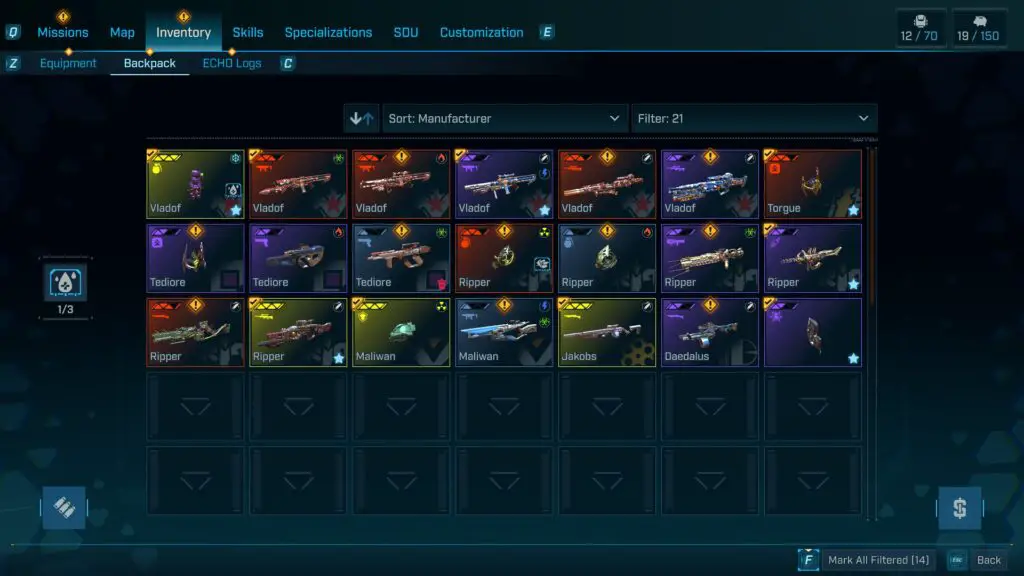
BL4’s backpack screen, for instance, is basically useless. Equipped items aren’t listed first, and are marked by a tiny tick that’s easy to miss. You have to press a separate button to compare your loot. Everything’s organized in an unassailable grid, and there’s a ton of robust filters some developers clearly worked very hard on—none of which matter, because for some inexplicable reason it auto-sets your sorting to “by manufacturer,” perhaps the least important filter.
You can send things to your bank directly, which is nice, but that requires right-clicking, marking as ‘bank,’ and then holding down a button press, instead of just having a ‘send to bank’ button when you right-click. Compounding these issues, sometimes when you mark something as trash, the game panics and marks an item two to three rows above the thing you’re clicking on. But the frustrations don’t stop there. The widget for class mods is functionally useless—see, class mods give you free points in a handful of skills, but the UI only shows their icons. Inspect the class mod, and you only get their names. You need to equip the class mod, then go over to the skill tree, and then hunt to see which skills they impact. Why?
The Lost Loot machine, which sends you guns you didn’t pick up, is similarly flawed—there’s a button to trash an item, but no button to sell an item. So if you want to get money from the guns the Lost Loot machine gives you, you need to pull them off it, open your backpack, arduously mark them as trash (which is hard for the reasons mentioned above) and then sell them. The crime of this is that inventory management in a game where you get heaps of loot absolutely has to be good—because you’re going to be doing it a lot—and it’s a complete mess here.
I spent my playthrough sorting most of my loot via the equipment screen rather than the backpack, since it let me compare my guns easily, organized my loot by type, and auto-filtered my equipped gear. If that isn’t a damning indictment of your inventory system, I don’t know what is. Luckily, the actual RPG underpinning said loot fatigue was enough to keep me hooked, and the deeper I went, the more enamored I became.
On the hunt
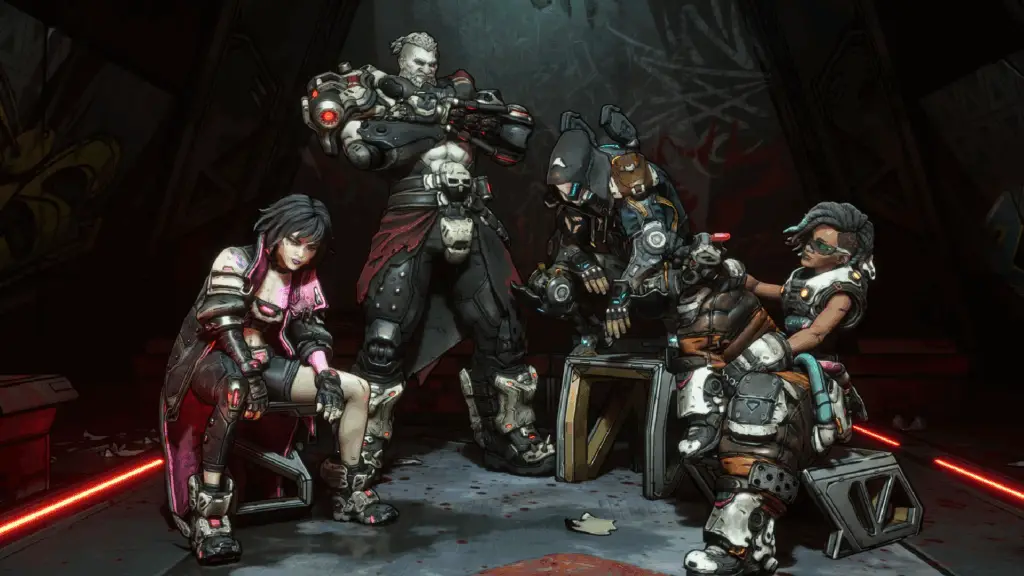
What truly elevates Borderlands 4 are its vault hunters, and these are some of the best we’ve seen out of the series yet when it comes to variety. Each character has a core passive, three skill trees, a choice of three action skills, and two modifiers to said action skills. Except within those skill trees, you also have three branches at the end which all play incredibly differently.
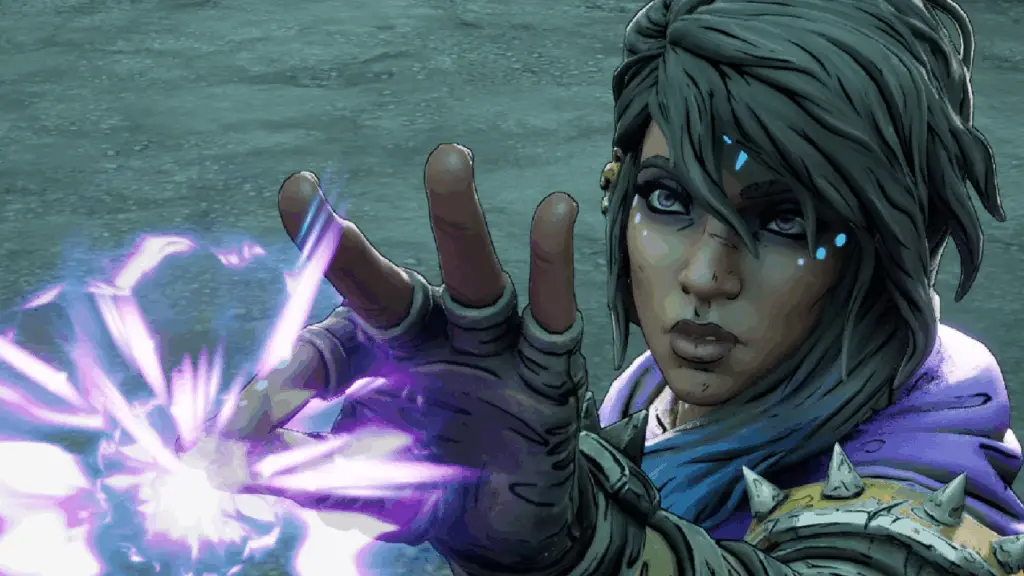
I spent my playthrough as Rafa using the Peacebreaker Cannons, constructing a build around maintaining my bonuses from Overdrive (which kicks in whenever he whips his cannons out) and movement speed. However, within his Peacebreaker Cannons tree, Rafa has two other branches: One that buffs his cannons with elemental damage, and another that lets him stack all sorts of bonuses into his indirect damage, making said cannons the star of the show. In the post-game, I got a legendary shotgun with three elemental damage types—and I decided to swap over to that elemental tree, adding a passive modifier that turned my trusty rocket launchers into lasers and stripped me of my movement speed bonuses in exchange for raw status spread and face-melting DPS.
I’m already itching to try out other hunters just so see which of their (minimum) nine builds I wanna play.
It felt completely different, and it suddenly dawned on me that this was simply a change in which branch of a single skill tree I was in. After 47 hours, I had experienced roughly two out of nine ways I could’ve played my character. And that’s just in the skill trees—add in legendary equipment modifiers, the new Firmware system, and the post-campaign specializations tree, and Gearbox has given players a vast playground to muck around in. It’s the most fleshed-out the series has ever been, and I’m eager to try out other hunters to explore their diverse build potential.
The only complaint I have is that it takes a minute to get there. As is the case with most Borderlands games, the opening hours are a smidge slow, since you only get one skill point per level—but when characters come online at around level 15, that all melts away. And once you’ve beaten the campaign, you can start your alts at level 30, so it’s a one-time slog.
For all my complaints—and I do have quite a few of them—I still find myself compelled to play more Borderlands 4. It speaks to the remarkable strength of the game that one of the most terribly-conceived UIs in recent memory somehow didn’t ruin it for me, even though you have to use said UI routinely and often. I adore Borderlands 4, despite its significant flaws (and it certainly has many). I want to muck around with builds, I want to play co-op with my friends, and, most importantly, I’m somehow not bored of shooting people and watching them explode into an utterly illegible amount of numbers.
Borderlands 4 may well be the strongest game in the series—and while it flails in a sea of backward choices, it doesn’t quite drown. I’ve been loving my time with it, somehow, in spite of all of my problems with its clunky design and frustrating mechanics. I simply cannot ignore the almost eldritch grip this thing has had on me. If you’ve ever had a serotonin spike from seeing a big number, if you’ve ever felt that blissful open world checklist haze, if you’ve ever enjoyed ARPG buildcrafting, then I heartily recommend you give Gearbox’s latest a go. If you can run it—or stomach some truly bad inventory management—there’s looter-shooter bliss on the other side of that particular obstacle.