
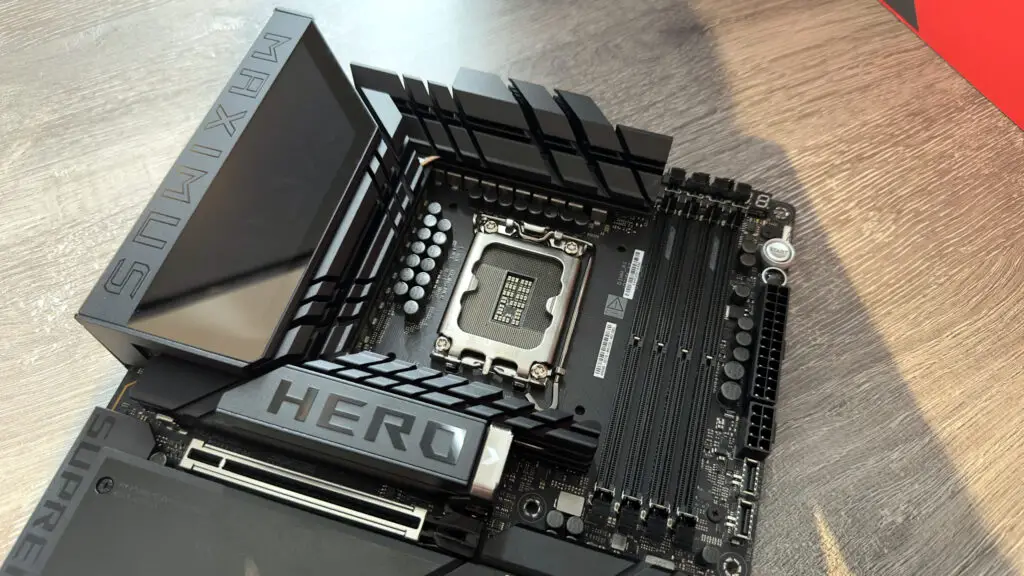
For many tech enthusiasts and gamers, optimized performance is key, and often, their systems are already pushing boundaries without them even realizing it. Every time you enable XMP or EXPO, you’re effectively overclocking your memory. Now, in exciting news for fans of Intel’s latest CPUs, Asus has made a significant announcement: their new 800-series motherboards are set to natively support DDR5-7200, requiring no manual overclocking.
This intriguing development was revealed through a straightforward post on X (formerly Twitter), featuring key screenshots from the CPU-Z utility. These images showcased impressive RAM speeds and timings on an Asus Prime Z890-P motherboard, with specific entries like JEDEC #14 through JEDEC #17 prominently displayed in the SPD tab.
For clarity, JEDEC (Joint Electron Device Engineering Council) serves as the industry’s standard-bearer for semiconductor specifications, including crucial RAM speeds and timings. When a specification carries the JEDEC label, it signifies a default, non-overclocked rating, assuring that the RAM and CPU will reliably operate at these speeds.
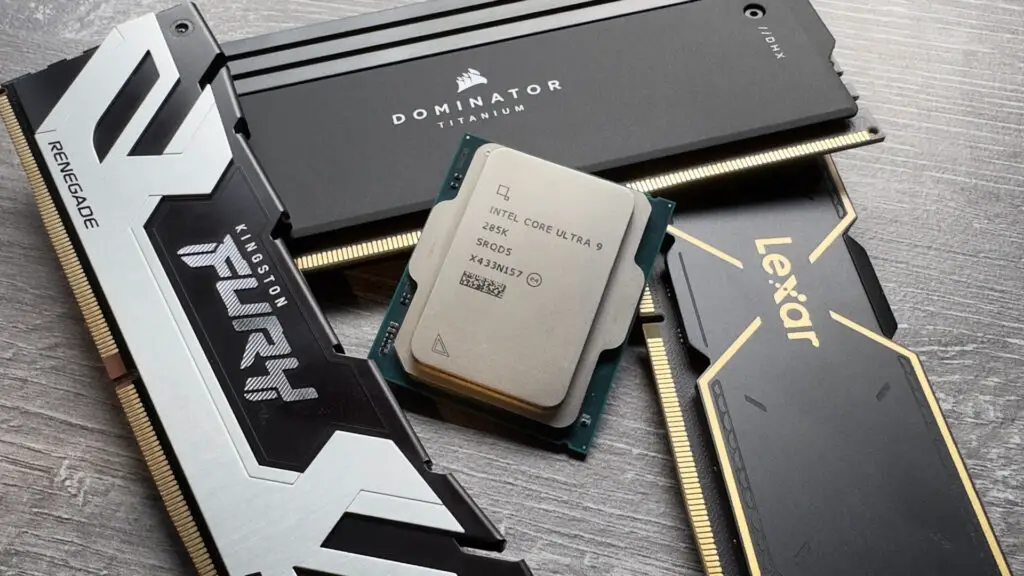
This revelation is particularly significant given that Intel’s current Core Ultra 200S processors officially endorse DDR5 memory only up to a JEDEC-approved 6,400 MT/s. While these powerful CPUs can manage higher memory speeds through enthusiast-driven overclocking, such performance isn’t always guaranteed or stable. Asus’s move to bake in default 7,200 MT/s support on its 800-series boards therefore marks a substantial leap.
Performance Implications and Future CPU Developments
This unexpected announcement naturally leads us to ponder why Intel remained silent on this capability during the initial Arrow Lake launch. A compelling possibility, which we often see with hardware roadmaps, is that Intel might be strategically reserving this feature for the anticipated Arrow Lake Refresh. Drawing parallels to the 14th Gen Core series, this refresh is widely expected to be a modest yet impactful update featuring clock-bumped Arrow Lake chips, where an elevated default memory controller clock would be a logical and compelling upgrade.
Should this indeed be the strategy, Asus has potentially offered us an early peek into Intel’s future roadmap, providing an exciting glimpse of what’s to come ahead of the much-anticipated Nova Lake processors. As of this writing, Asus has yet to confirm whether existing 800-series owners will require a BIOS update to unlock this JEDEC DDR5-7200 support.
However, as we often emphasize here at Digital Tech Explorer, raw speed isn’t the only factor. When it comes to real-world performance, particularly in demanding applications like gaming, the benefits of faster RAM on the current platform may unfortunately be limited. Previous in-depth tests on Core Ultra 200S chips, even with memory speeds soaring up to 8,200 MT/s, have consistently shown only a minimal impact. This is primarily due to Arrow Lake’s current Achilles’ heel: its higher RAM latencies. Simply increasing the memory clock speed, while an improvement, doesn’t fully address this underlying bottleneck. For a truly noticeable uplift in gaming performance, users will likely need to await more fundamental architectural advancements – higher clock speeds across the entire processor and a significantly improved cache system – which we anticipate with the arrival of Nova Lake.