

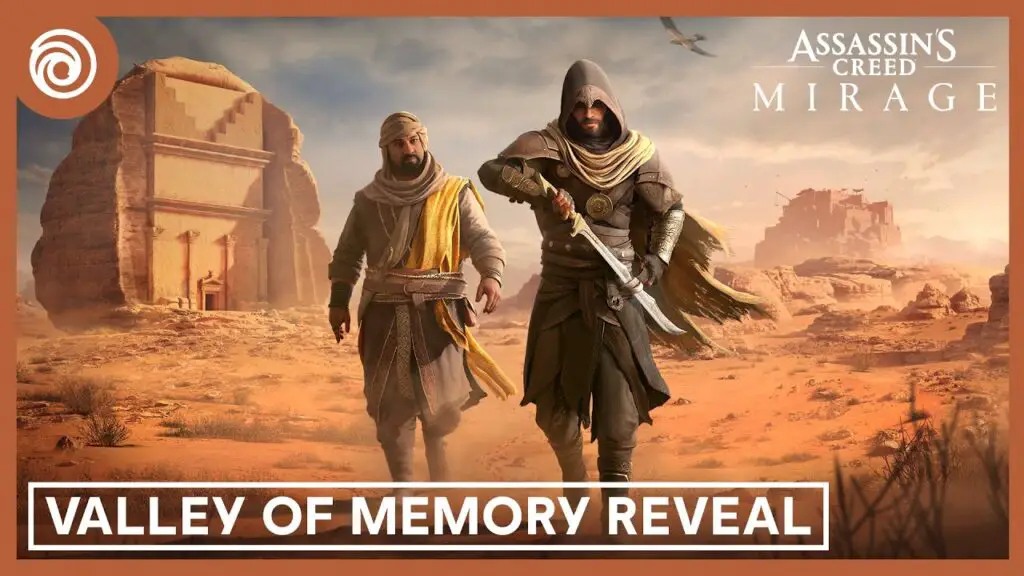
The upcoming DLC for Assassin’s Creed Mirage, titled ‘Valley of Memory,’ is set to release on November 18. This expansion promises a significant injection of new content, including a new main quest, sidequests, and new assassination targets, offering approximately six hours of additional gameplay. The narrative unfolds in the ancient valley of AlUla, a location steeped in history. Players will follow Basim as he journeys to AlUla in search of his father. However, upon arrival, he discovers the valley is under threat from a group of dangerous robbers, and his father is nowhere to be found.
Controversy and Funding Details
The announcement of the ‘Valley of Memory’ DLC has been met with considerable controversy, following reports that its development was funded by Saudi Arabia’s Public Investment Fund (PIF). This reported connection has sparked unrest among some Ubisoft employees, who have openly voiced concerns over the country’s documented human rights record. A specific and deeply contentious point is the murder of journalist Jamal Khashoggi, an act widely attributed to Saudi crown prince Mohammed bin Salman. Further indicating direct Saudi involvement was the prominent appearance of Dr. Abdulrahman Alsuhaibani, the VP of culture at the Royal Commission for AlUla, during the DLC’s reveal stream.
AlUla’s Cultural Investment Strategy
Dr. Alsuhaibani offered his perspective on LinkedIn, articulating that “heritage is a living asset, not just a preserved past, but a driver of economic, social and cultural value.” This sentiment aligns perfectly with AlUla’s broader cultural investment strategy. Key initiatives include the comprehensive regeneration of the Old Town, various adaptive reuse projects, and a new agreement with the Ministry of Culture aimed at cementing AlUla’s status as a global film hub. This forward-thinking strategy also prioritizes supporting local creative entrepreneurs and skilled artisans from Madrasat Addeera, notably the first school for girls in AlUla.
Dr. Alsuhaibani’s involvement further underscores the strategic alignment with Saudi Arabia’s leadership, particularly Crown Prince Mohammed bin Salman, who chairs the Cultural Development Fund, a principal partner of the Cultural Investment Conference Alsuhaibani attended. This context places the DLC within the broader phenomenon of ‘sportswashing’—and in this instance, ‘gameswashing’—a practice where popular media is used to enhance a nation’s global image. Crown Prince Mohammed bin Salman has explicitly addressed this strategy, stating, “if sportswashing is going to increase my GDP by way of one percent, then I will continue doing sportswashing. I don’t care.” While Saudi Arabia’s PIF has made more overt investments in the gaming world, this DLC presents a nuanced example of this strategic image-building. Developed and released by Ubisoft, its setting in AlUla serves as a powerful promotion for a region central to Saudi Arabia’s economic and cultural ambitions. This raises crucial questions for the gaming industry as a whole, prompting us at Digital Tech Explorer to consider the increasing prevalence of such funding models and their far-reaching implications.