
Apple’s relentless in-house silicon release schedule continues this week with the exciting announcement of the new M5 chip. Early leaked benchmarks suggest this silicon powerhouse is roughly twice as fast as the original M1 in terms of single-thread performance. This raises a crucial question for us here at Digital Tech Explorer and its dedicated tech audience: Why aren’t PC CPUs achieving similar generational leaps?
While leaked figures always warrant a degree of skepticism, our initial assessment suggests these reported numbers for the M5 are quite plausible. The immediate context here involves comparing the accuracy of these benchmarks against the actual performance gains seen in PC processors over the same timeframe.
This builds upon the already impressive single-thread performance delivered by the M4, with the M5’s leaked results indicating a further 10% to 15% improvement, depending on the specific Apple platforms under comparison.
While a 10% to 15% gain might seem like typical generational progress—and it is for a single iteration—Apple’s rapid release cadence is the key differentiator. With the M1 debuting in November 2020 and the M5 now arriving in late 2025, Apple is delivering major architectural updates on a nearly annual basis. In contrast, Intel and AMD typically follow a two-year cycle for significant architectural shifts. This faster iteration accumulates substantial performance gains over time, as we’ll explore in this deep dive.
To quantify these advancements, consider the Geekbench 6 single-thread scores. The original M1 typically scores around 2,200 points. The M5, however, is estimated to achieve approximately 4,100 points. It’s worth noting that this M5 figure is from an iPad. Based on our past observations, a Mac equipped with the M5 would likely add about 200 points, pushing its score to almost exactly double that of the **M1**.
Comparative Analysis: Apple Silicon vs. PC CPUs
Of course, Geekbench provides one perspective on CPU performance, and we acknowledge its limitations. However, for a direct timeline comparison, it offers valuable insight. Now, let’s turn our attention to how **x86 PC processors** have fared over the same period.
Conveniently, AMD launched its Ryzen 5000 CPUs in November 2020, precisely when the M1 chip made its debut. This synchronicity provides an ideal timeframe for a direct comparison of generational progress in the CPU landscape.
So, how do the numbers stack up? The Ryzen 9 5950X also scored around 2,200 in Geekbench 6, mirroring the M1’s initial performance. Fast forward to the latest Ryzen 9 9950X3D, and its score reaches approximately 3,400 points. This places the latest **Ryzen** chip roughly 1,000 points behind the anticipated output of the **M5**.
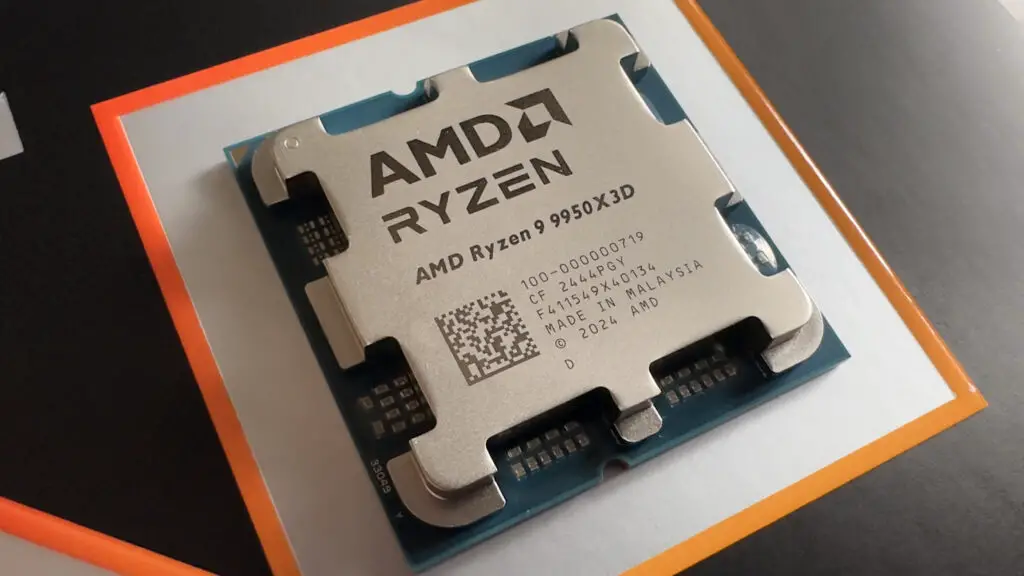
Intel’s progress, if anything, has generally lagged behind AMD’s during this same period, making a deep dive into its specifics less critical for this particular comparison. While the nuances of Geekbench benchmarks can always be debated, the evidence strongly suggests that Apple’s single-thread performance has scaled significantly more than that of its **AMD** or **Intel** counterparts. As TechTalesLeo, I can confidently say that if PC processors had delivered such remarkable gains, the tech world would undoubtedly be buzzing with excitement.
When considering a gaming context, the comparison becomes inherently more complex. A significant hurdle is the limited number of games optimized for Apple Macs running Apple Silicon. On the PC gaming front, numerous factors beyond raw single-thread CPU power dictate frame rates. Even with advanced features like the Ryzen 9 9950X3D’s 3D V-Cache boosting performance, a gamer might typically observe only about a 50% increase in frame rates when upgrading from a Ryzen 9 5950X.
It’s crucial to acknowledge that these same limitations would likely apply to Apple CPUs if they were integrated into dedicated gaming rigs and fully supported by game software. We’re not suggesting an M5 chip would magically double your frame rates in that scenario. However, the underlying truth remains: Apple has demonstrated a far superior ability to scale its single-core performance compared to both AMD and Intel. As dedicated tech explorers, we’re compelled to ask: Why is this disparity so pronounced, and what can we learn from Apple’s approach to silicon design and rapid iteration?