

Our Verdict: AMD Ryzen 5 7500X3D
Rating: 4 out of 5 stars
The AMD Ryzen 5 7500X3D, while carrying a price tag of $269, delivers exceptional gaming performance that solidifies its position as a compelling value proposition. It impressively rivals the more expensive (and often harder to find) 7600X3D in gaming benchmarks and significantly outperforms many non-X3D CPUs, making it a strong contender for an affordable yet powerful AM5 gaming build.
Pros
- Excellent gaming performance
- Runs cool under load
- Energy efficient
Cons
- Still relatively pricey for a six-core chip
- Slightly lower productivity performance compared to rivals
At Digital Tech Explorer, our dedicated team invests significant time in every review, meticulously testing hardware to provide you with transparent, thoroughly researched, and real-world performance insights.
For those building budget versions of the best gaming CPUs, we’ve traditionally been big fans of chips like the AMD Ryzen 5 7600X. Gamers looking to maximize performance while saving money on a processor are typically well-served by a fast six-core chip, and AMD’s offerings have, until now, fit this niche perfectly.
However, what these options often lacked was the crucial advantage of 3D V-Cache. This innovative stacked layer of extra L3 cache has been AMD’s secret weapon, offering significant performance uplifts in many games. We’ve seen its effectiveness demonstrated on some of our favorite AM4 gaming processors, and it has also appeared in more recent Zen 4 chips, such as the Ryzen 5 7600X3D, and the Zen 5-based Ryzen 7 9800X3D, which we consider a top contender for the best gaming CPU overall.
The challenge with 3D V-Cache-equipped AM5 chips has historically been their price. Those seeking a powerful sub-$300 option with AMD’s game-optimizing cache tech (the 7600X3D, for example, has an MSRP of $299 but often retails higher) have largely had to settle for chips designed for the previous-generation AM4 socket, like the Ryzen 5 5700X3D.
This dynamic shifts with the introduction of the Ryzen 5 7500X3D. Priced at $269/£245, this six-core, 12-thread AM5 chip adds an extra 64 MB dose of 3D V-Cache to its core design. This is a smart move on paper, as it leverages AMD’s specialized cache on an otherwise moderately clocked chip, aiming to deliver a substantial boost in gaming performance while remaining affordable enough to attract budget-conscious gamers looking to upgrade to the AM5 platform.
AMD Ryzen 5 7500X3D: Quick Verdict
Buy if…
- ✅ You desire excellent gaming performance for a reasonable investment: The 7500X3D confirms that 3D V-Cache is a transformative technology for many games, offering the most accessible entry point to this feature on the AM5 platform.
Don’t buy if…
- ❌ You are operating with an extremely tight budget: While this chip is attractively priced for its performance, it’s not the cheapest option available. You might consider a non-3D V-Cache CPU and reallocate those savings towards a more powerful GPU, which could yield a faster overall gaming experience.
The good news is that AMD’s strategy with 3D V-Cache has paid off handsomely. While the 7500X3D is often a hair behind the 7600X3D in most gaming benchmarks, its more appealing price point makes it a more compelling choice for an affordable gaming CPU. The difference in frame rates between the two is typically minimal, highlighting the 7500X3D’s excellent value.
When pitted against the standard Ryzen 5 7600X, the 7500X3D delivers a thorough victory in gaming benchmarks. In fact, it occasionally comes very close to matching the Ryzen 7 7800X3D, which was our previous top gaming CPU recommendation.
While the direct cost saving over the 7600X3D is around $30, that specific chip can be notoriously difficult to find near its MSRP. If budget is a primary concern, those extra funds are often better invested in a superior GPU. A more powerful graphics card typically provides the most significant increase in frame rates for most modern games, which is a key consideration for assembling a reasonably priced gaming rig in 2025.
In terms of productivity, the 7500X3D presents a more mixed performance. It generally lags a few points behind its rivals in most of our test suite, though its overall performance is far from poor. However, for users whose main tasks involve heavy productivity, rendering, or content creation, a CPU with a higher core count and faster clock speeds from either AMD’s or Intel’s current or previous generations might be a more suitable choice for an all-rounder system.
The 7500X3D also demonstrates excellent thermal management, running cool and adhering closely to its 65W TDP, much like the 7600X3D. This characteristic makes it an ideal candidate for reasonably priced small form factor builds, as its power-limited design results in a remarkably cool chip that barely challenges the robust 360mm liquid cooler attached to our test machine.
This efficient power and thermal behavior also bodes well for those looking to reuse older cooling solutions or smaller power supplies, as both chips appear to have been optimized for controlled power consumption and thermal output.
Overall, the AMD Ryzen 5 7500X3D is a cool-running, power-efficient, and relatively affordable CPU with enough processing power to drive a genuinely performant gaming PC. Its only real drawback is a slight compromise in productivity performance, made in favor of delivering serious real-world gaming prowess. While its price might stretch the definition of a “budget gaming CPU,” it grants access to the significant gaming advantages of 3D V-Cache for a reasonable sum, making it a compelling chip to build a modest yet powerful AM5 system around.
AMD Ryzen 5 7500X3D Specifications
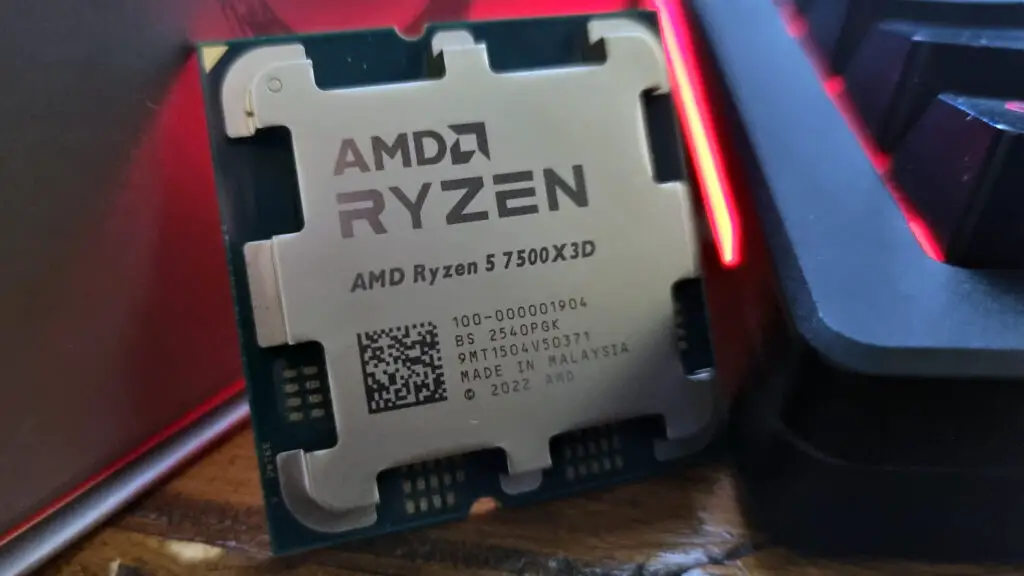
The Ryzen 5 7500X3D is a six-core, 12-thread Zen 4 CPU, featuring a base clock speed of 4.0 GHz and capable of boosting to 4.5 GHz under heavy load. In terms of architecture, it is virtually identical to the already-released Ryzen 5 7600X3D, with the primary difference being that the latter chip can reach slightly higher boost clocks of up to 4.7 GHz.
The six cores are fabricated using TSMC’s 5nm process, while the I/O die is built on 6nm technology. The chip boasts a total of 96 MB of L3 cache, with 64 MB of that being 3D V-Cache directly stacked onto the CCD. This substantial cache allocation is where we expect to see the major difference between this chip and many others in AMD and Intel’s current lineups, as many games benefit immensely from having ample L3 cache to store frequently accessed data, thereby reducing the CPU’s wait times for memory in certain demanding tasks.
The strategy of adding such a significant stack of 3D V-Cache to a budget-oriented gaming chip is intended to deliver robust gaming performance without solely relying on high clock speeds, which explains why the 7500X3D’s specifications might appear somewhat modest on paper.
While the maximum officially supported memory speed is DDR5-5200, AMD suggests that DDR5-6000 remains the sweet spot for optimal performance. This configuration allows the Infinity Fabric high-speed interconnect system to clock to 2000 MHz, with the memory and integrated memory controller (IMC) running at a 3000 MHz 1:1 ratio.
The active power management architecture and firmware have been integrated from the Ryzen 6000-series mobile processors, which contributes to its impressive power draw characteristics. The chip itself has a 65W TGP (Thermal Design Power), with a TjMax (the maximum thermal limit it will operate at before throttling) being 95°C. It also utilizes AMD’s Precision Boost 2 system to manage its clock speeds and features the same RDNA 2 iGPU as the 7600X3D.
Admittedly, the specifications might not appear thrilling at first glance. However, as our benchmarks will demonstrate, the combination of a substantial amount of 3D V-Cache with a relatively calm, low-clock-speed Zen 4 offering creates a potent package, particularly for gaming.
AMD Ryzen 5 7500X3D Performance and Benchmarks
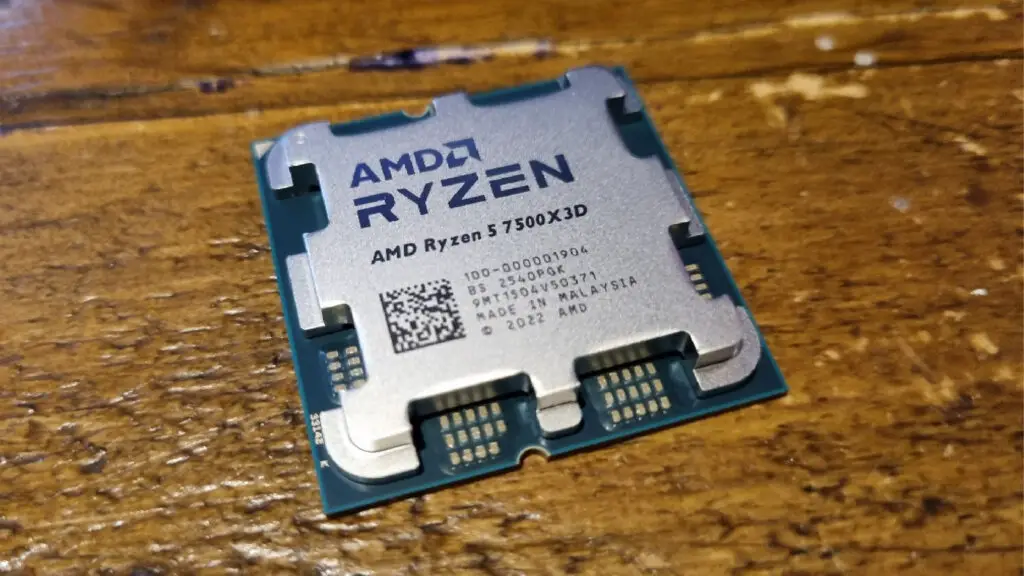
Kicking off with our gaming benchmarks, the little 7500X3D immediately proves why 3D V-Cache makes such a profound difference. Despite the 7600X having a significantly higher boost clock (5.4 GHz compared to the 7500X3D’s 4.5 GHz), the older chip is decisively outperformed across all our gaming tests, often by a considerable margin.
In Baldur’s Gate 3, for example, this translates to a remarkable 33 FPS difference. This game, in particular, seems to thrive on ample L3 cache, as the 7600X3D posts near-identical figures, with both average and 1% low frame rates being just a single frame ahead. That being said, the also-3D V-Cache-equipped 5700X3D was firmly put in its place by both AM5 X3D chips, suggesting that it’s the combination of Zen 4 cores and a large cache that yields such impressive results.
However, the 7500X3D doesn’t achieve complete dominance across the board. While it largely runs neck and neck with the 7600X3D in most tests, it did exhibit a brief but repeatable dip in Homeworld 3, where its higher-clocked sibling managed to pull ahead by a full 10 frames on average. Similarly, the 7500X3D slightly trails both the 7600X3D and 5700X3D in the Cyberpunk 2077 benchmark on average, though it notably managed to beat all our comparison CPUs in the 1% lows, achieving a remarkable 87 FPS minimum result.
Speaking of remarkable gaming results, it’s worth highlighting the 7500X3D’s average figures in comparison to the Ryzen 7 7800X3D. We haven’t included our previous top gaming chip directly in these charts, as it’s a $400+ eight-core powerhouse that wouldn’t make for a fair direct comparison. However, it’s notable that the more affordable AMD CPU is only two frames behind its formidable older brother in BG3, 11 frames behind it in Cyberpunk 2077, and an impressive three frames ahead of it in Metro Exodus Enhanced on average.
Before we get too excited, it’s important to acknowledge that it’s been about a year since we last benchmarked the 7800X3D. Numerous game updates, BIOS upgrades, and microcode changes have occurred since then, so this isn’t a strictly “apples-to-apples” comparison. Nevertheless, we considered the 7800X3D’s performance superb back then, and the 7500X3D’s ability to even contend with it in 2025 is a testament to its capabilities.
When it comes to productivity, the 7500X3D is slightly less impressive. While it remains competitive with its rivals (resulting in an impressively tight grouping among our comparison CPUs), it generally falls behind both the 7600X3D and 7600X in most tasks. That being said, it does manage to leap ahead of the 5700X3D in both single-core and multi-core Cinebench 2024 testing, although it remains a touch behind both of the AM5 contenders under the same conditions.
As a result of this tight grouping, we can conclude that the 7500X3D is still a competent chip for productivity tasks overall, despite being ever-so-slightly off the pace. Lagging the pack by single-digit percentage points is far from a disappointing outcome for this six-core chip, and if anything, it highlights how relatively little is gained from the higher clock speeds of some of its rivals when it comes to rendering, compression, and file manipulation tasks.
Under gaming load, the CPU power draw test results in a 64W average, a single watt below its TGP. Early in our testing, we were surprised to observe that the peak power draw figures were remarkably close to its 65W limit, as we couldn’t push the chip much beyond 68W in brief moments, even with Precision Boost Overdrive enabled.
Conversations with AMD, however, revealed that this behavior is expected for this particular X3D chip, which seems determined to stay within its defined power envelope regardless of the conditions, despite a reported 88W potential in the chip’s internal telemetry.
Thermally, the 7500X3D also runs extremely cool. While the very low figures observed here are heavily influenced by the massive 360mm MSI AIO liquid cooler in our test PC (which is certainly overkill for this small chip), the fact that average thermals registered an impressively low 52°C under heavy gaming conditions (significantly cooler than every other chip in our charts) speaks volumes about its tendency to maintain low temperatures. Those planning to pair it with a smaller AIO or a reasonably-sized air cooler should find it to be a very manageable and cool-running component.
Digital Tech Explorer Test Platform
Supplied by Cyberpower | MSI
- Motherboard: MSI MPG X870E Edge Ti WiFi
- RAM: Kingston Fury Beast RGB 32 GB (2 x 16 GB) @ 6000 MT/s
- GPU: Nvidia GeForce RTX 4070
- Cooler: MAG CoreLiquid i360 White
- SSD: Spatium M480 Pro 2 TB
- PSU: MPG A1000GS PCIe 5
- Case: MAG Pano 100R White
AMD Ryzen 5 7500X3D Analysis by TechTalesLeo
The Ryzen 5 7500X3D emerges as a storming little gaming CPU, and given that it is now the most affordable way to get a 3D V-Cache-equipped chip on the AM5 platform, it makes a compelling case for itself as one of the best, if not the best, budget gaming CPUs around.
My only slight hesitation revolves around the price. While the 7600X3D remains difficult to find and often overpriced, the 7500X3D’s $269 price point is certainly tempting. However, part of me questions labeling a $250+ chip as truly “budget.” Perhaps “budget for a gaming superstar” is a more fitting descriptor.
One could undoubtedly save more money by opting for a 5700X3D on the AM4 platform and still achieve excellent gaming performance. That being said, while the AM4 socket has demonstrated remarkable longevity, choosing it would mean committing to an older ecosystem (and DDR4 RAM) for the foreseeable future. Given the performance offered here, I would argue that the 7500X3D is a CPU you could confidently stick with for quite some time, all while making the leap to a newer socket that is also likely to have extended support.
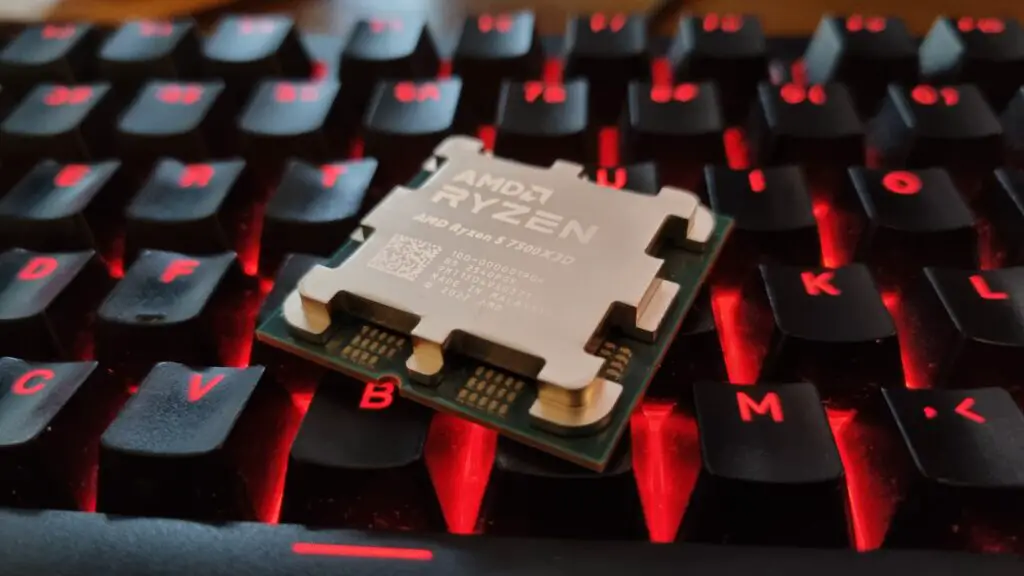
As for the longevity of the chip itself, I anticipate it will be some time before six-core CPUs begin to struggle in demanding games, at least if they are performant enough to begin with. The fact that the 7500X3D is capable of going toe-to-toe with our fastest gaming chip of the previous generation in some benchmarks suggests it possesses ample power to remain relevant for a while, at least until eight-core chips become a required specification rather than merely a recommendation.
And while it may not be a productivity powerhouse, the 7500X3D strikes an impressive balance of clock speed, cache, and power handling to make itself a very attractive chip for those looking to upgrade to AM5 without breaking the bank. It represents a smart move on AMD’s part—and an equally smart move for anyone looking to save a bit of cash and build a performant, 3D V-Cache-equipped gaming PC without going all-out on the CPU. Moderation in all things, as they say. But here, moderation certainly does the job, and does it with aplomb.
Final Verdict: AMD Ryzen 5 7500X3D
Overall Rating: 86/100
The AMD Ryzen 5 7500X3D offers a compelling package for gamers. Its $269 price tag, while not strictly “budget,” delivers gaming performance close to the more expensive 7600X3D and significantly surpasses many non-X3D CPUs. This makes it an exceptional value for those building an AM5 gaming rig, prioritizing gaming grunt over peak productivity. It’s a testament to the power of 3D V-Cache in a well-balanced, efficient package.
Disclaimer: All content on Digital Tech Explorer is for informational and entertainment purposes only. We do not provide financial or legal advice.
Affiliate Disclaimer: Some of the links on Digital Tech Explorer are affiliate links. This means we may earn a commission if you click through and make a purchase, at no additional cost to you. Our recommendations are based on thorough research and personal experience, aligned with our mission to provide high-quality, transparent content for tech enthusiasts.
This article was reviewed and edited by TechTalesLeo for Digital Tech Explorer.