
For anyone observing the burgeoning influence of artificial intelligence on the digital landscape, it comes as no surprise: new research suggests that **AI-generated content** has now surpassed human-written work across the internet. However, there’s a fascinating twist to this unfolding narrative – the deluge of algorithmic content appears to have plateaued.
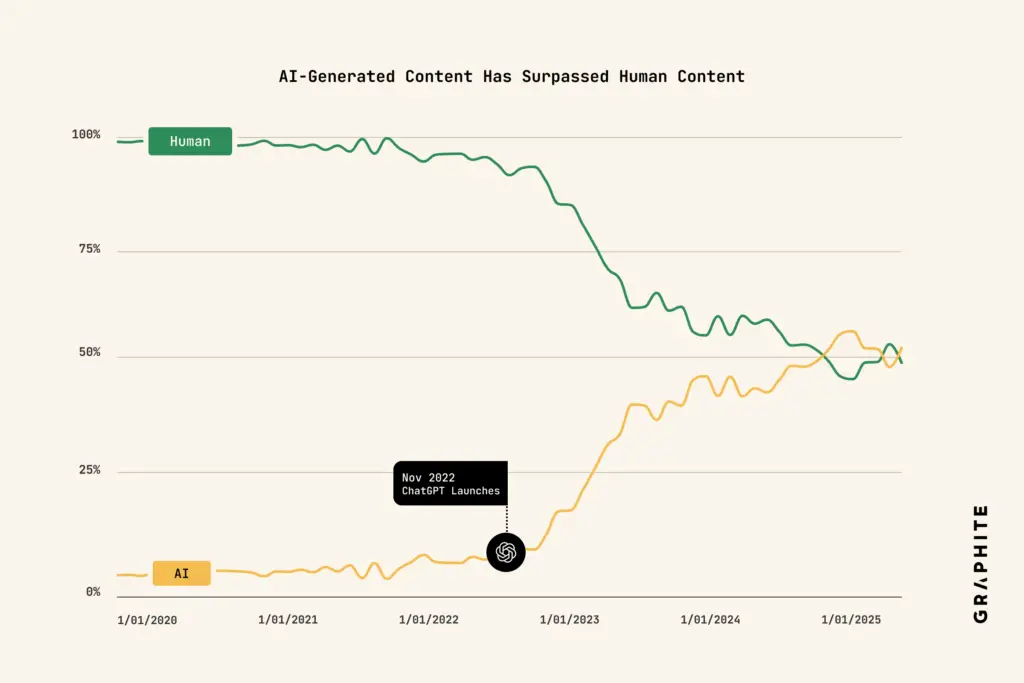
This revelation comes from research firm **Five Percent**, which recently released a white paper analyzing online content published from January 2020 to May 2025. Their findings suggest that material crafted using advanced machine learning tools initially outpaced human-authored content late last year.
Crucially, the data also indicates a stabilization in the proportion of **AI-synthesized material**. In fact, the exponential rise of **AI content** began to decelerate significantly around mid-2023.
The Role of Search Engine Performance in the Plateau
The study posits a compelling hypothesis for this plateau: content creators discovered that articles generated by artificial intelligence often underperform in search engine rankings, a trend corroborated by separate research.
This finding offers a hopeful perspective that Google’s ongoing efforts to filter out low-quality **AI slop** are proving effective, potentially serving as a primary driver behind this observed plateau.
Methodology and Accuracy Concerns of the Study
However, the study’s accuracy has drawn criticism, chiefly due to its reliance on a single **AI content detection algorithm**—a free tool provided by **Surfer**.
**Five Percent** reports testing this algorithm on 15,000 articles published between 2020 and 2022, largely presumed to be human-authored, which yielded an implied 4.2% false positive rate.
To assess false negatives, the researchers leveraged **OpenAI’s GPT-4o** to generate 6,009 articles, which were then processed by the **Surfer detector**. This test correctly identified 99.4% of the samples as being **AI-composed**.
Despite these validation attempts, significant questions persist regarding the study’s overall accuracy. A particular concern lies in the methodology: the specific prompting techniques used to generate test articles with **GPT-4o** may not adequately represent the immense diversity of real-world prompts and use cases.
This raises a crucial lingering question for our readers at Digital Tech Explorer: could the very advancement and sophistication of **AI-generated content** itself be making it harder to detect, thereby subtly influencing the observed plateau effect? It remains challenging to definitively ascertain.
Nevertheless, it’s a plausible scenario that Google is indeed making headway in suppressing some of the more egregious **AI slop**, and this alone could be a significant factor motivating content publishers to invest in human writers despite the higher costs.
As a ‘flesh-and-bones’ content generator and storyteller, I, TechTalesLeo, express a cautious optimism, having yet to personally feel the cold, mechanical grip of an AI takeover. For our community of developers and tech enthusiasts at Digital Tech Explorer, this study offers a glimmer of hope that the future trajectory of **digital content creation** won’t be entirely dictated by artificial intelligence.