
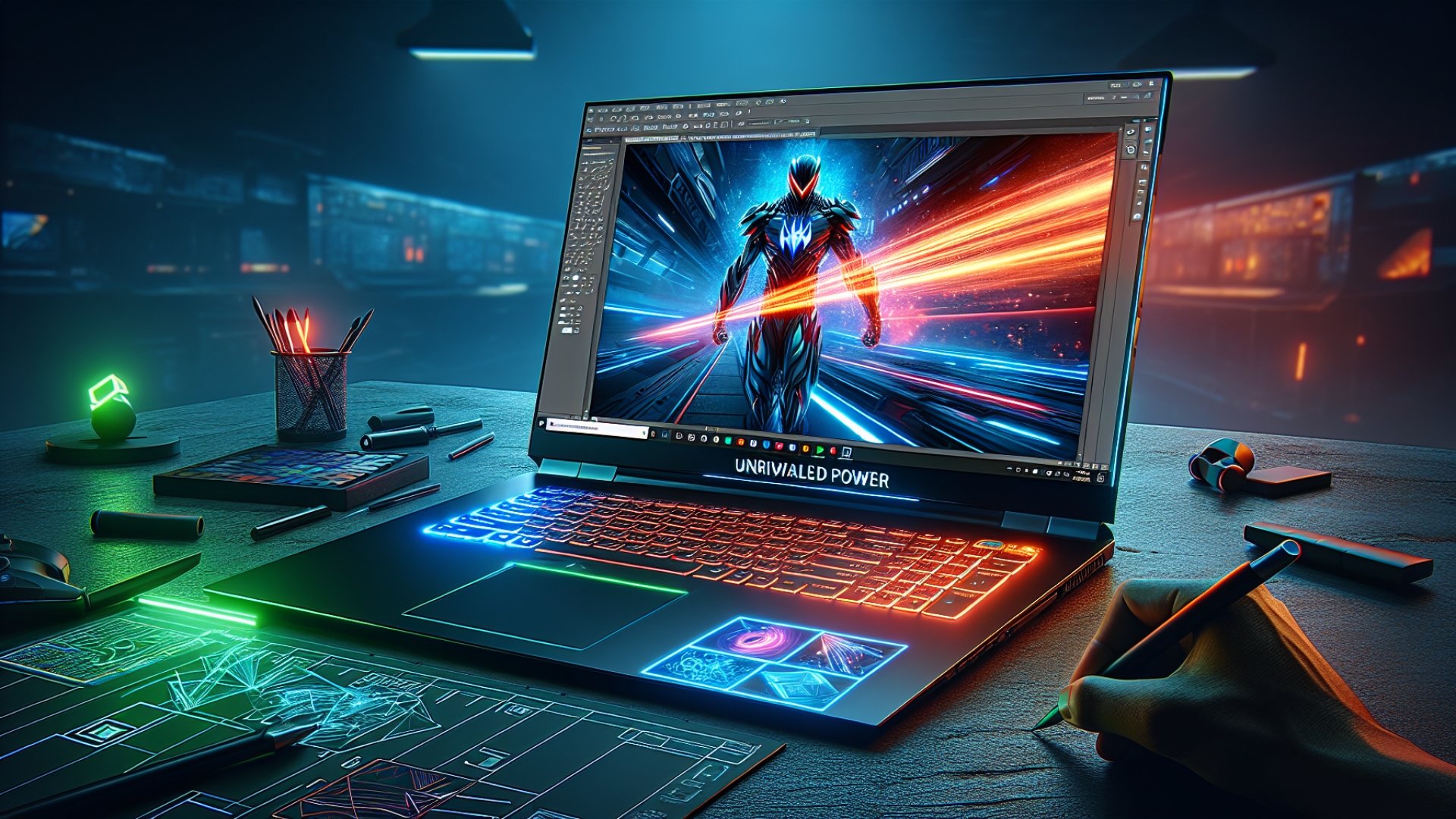
At Digital Tech Explorer, we consistently seek out hardware that pushes the boundaries of innovation, and the Acer Predator Helios 18 AI is a prime example. This gaming laptop is designed to obliterate the performance gap between desktops and portable machines, boasting specs that are genuinely future-proof for the modern tech enthusiast and professional alike. Its strengths are compelling, including a vibrant display, an industry-leading port selection, and an efficient cooling system. However, such extreme power comes with its own set of trade-offs: a premium price tag, inconsistent HDR performance, and notably short battery life. This is an unapologetically extreme machine, meticulously crafted for the gamer or creator who demands nothing less than peak performance.
The Helios 18 AI’s design proudly announces its gaming pedigree, featuring a matte black chassis accented with blue highlights and extensive customizable RGB lighting across its bold rear shelf, a front LED bar, and per-key keyboard illumination. Built like a fortress, its substantial 3.5 kg (nearly four-kilo) weight firmly positions it as a desktop replacement rather than a travel companion. The port selection is thoughtfully arranged for optimal desk management, with dual Thunderbolt 4 ports and a full-size HDMI 2.1 conveniently located at the rear. The sides offer essential connectivity with an audio jack, SD card reader, RJ-45 Ethernet port, and three versatile USB-A ports.
Display and Audio Experience
The visual centerpiece of the Acer Predator Helios 18 AI is its expansive 18-inch 4K Dual-mode Mini-LED display. This panel delivers exceptional brightness and crispness, thanks to its impressive 3840 x 2400 resolution. Its standout innovation is the dual-mode functionality, offering users the flexibility to switch between a high-refresh 1080p at 240 Hz for fluid, competitive gaming and a high-resolution 4K at 120 Hz, ideal for productivity tasks and immersive, cinematic single-player experiences. This adaptability caters directly to the diverse needs of gaming and creative professionals, a key focus for Digital Tech Explorer.
In SDR mode, the display is truly stunning, showcasing vibrant colors and profound blacks. However, our testing reveals that the HDR implementation exhibits some inconsistencies. Aggressive local dimming can unfortunately introduce a hazy effect in scenes with mixed brightness, and the common halo effect—where bright objects subtly bleed into darker areas—is more pronounced than ideal. While highlights can pop brilliantly in games, tasks like reading white text on a black background become challenging as letters can appear to fade into murky darkness. This is a scenario where the superior contrast of an OLED panel is noticeably absent.
Despite the laptop’s impressive size, the integrated speakers are somewhat underwhelming. The audio experience feels secondary, providing a flat soundstage with a noticeable lack of bass. For a truly immersive experience in gaming, streaming, or music, investing in a quality headset or external speakers is unequivocally essential.
Technical Specifications
| Acer Predator Helios 18 AI (PH18-73) | |
|---|---|
| Model reviewed | PH18-73 |
| CPU | Intel Core Ultra 9 275HX |
| GPU | RTX 5090 (175 W) |
| RAM | 192 GB DDR5-6400 |
| Storage | 2 TB PCIe 5.0 NVMe |
| Screen size | 18-inch |
| Refresh rate | 4K 120 Hz/ FHD 240 Hz |
| Resolution | 3840 x 2400 |
| I/O | 3 x USB-A, 2 Thunderbolt 4, 1 x RJ-45, 1 x SD card, 1 x HDMI, 1 x 3.5mm audio in/out |
| Additional | Wi-Fi 7, Bluetooth 5.4, 1080p IR webcam |
| Battery | 99 Wh |
| Dimensions | 401 x 308 x 29.6mm |
| Weight | 3.5 kg |
| Price | $4,499 | £4,999 | AUD $7,999 |
Raw Power and Thermal Management
Beneath its robust exterior, the Predator Helios 18 AI stands as an absolute powerhouse. It’s driven by the pinnacle of mobile GPUs, the NVIDIA RTX 5090, operating at its full 175 W TGP. This formidable GPU is seamlessly paired with Intel’s cutting-edge Core Ultra 9 275HX processor and an astonishing 192 GB of DDR5 RAM. While this level of memory might seem excessive for gaming alone, it transforms the Helios 18 AI into a versatile workstation, making it a dream machine for demanding professionals such as content creators, engineers, and those actively engaged in intense AI workloads or running multiple virtual machines. As we often discuss at Digital Tech Explorer, optimizing for these high-demand scenarios is key for staying ahead in tech.
The performance, as expected, is nothing short of outrageous. This machine effortlessly handles everything from immersive 4K gaming in the latest titles to complex Blender renders without a single stutter. It empowers users to maximize every setting, activate all ray tracing options, and still maintain incredibly smooth frame rates well above 60 fps. The sophisticated cooling system, integrating a vapor chamber and multiple high-performance fans, adeptly manages these powerful components, maintaining impressively low CPU and GPU temperatures even during extended, intense sessions. However, the efficacy of this robust thermal management system comes with a trade-off: significant fan noise. When the laptop is under heavy load, it operates at a volume that is distinctly audible to everyone in the room.
Usability, Price, and Comparative Value
The keyboard on the Acer Predator Helios 18 AI represents a notable improvement over typical Predator models, offering satisfying key travel, a tactile feel, and comprehensive per-key RGB lighting for a personalized touch. The trackpad, while functional, is simply adequate and doesn’t quite match the premium feel of the rest of the device. As is often the case with such high-end components, battery life is a significant limitation, typically lasting only a couple of hours with real-world use and even less during intensive gaming sessions. This fundamentally positions the Helios 18 AI as a device designed to remain tethered to its substantial power brick, further reinforcing its role as a powerful, stationary desktop replacement. Its sheer size also necessitates considerable desk space, and while its Mini-LED display is undeniably gorgeous, it lacks the perfect black levels characteristic of an OLED panel, which might be a consideration for users prioritizing ultimate contrast.
The eye-watering price, starting at $4,499, is a direct reflection of its bleeding-edge specifications and the bragging rights that come with owning such a machine. When evaluated against its competitors, the Acer Predator Helios 18 AI consistently holds its own in terms of raw power and innovation. It is undeniably bulkier than the more understated MSI Stealth 18 HX AI but compensates with superior horsepower and an unparalleled memory capacity. Compared to the Alienware 18 Area-51, the Predator delivers top-tier performance with a significant advantage in RAM capacity and a highly effective cooling system, even if the Alienware’s processor can maintain slightly cooler temperatures under certain heavy productivity loads.
Buy if…
- ✅ You demand true desktop power: You require a no-compromises desktop replacement capable of true 4K gaming and robust workstation performance, aligning with the needs of serious hardware enthusiasts.
- ✅ You’re an AI guru or 3D animator: You are a creative professional or power user who will genuinely leverage the massive amount of RAM and unparalleled GPU muscle for tasks like machine learning, 3D rendering, or complex simulations.
Don’t buy if…
- ❌ You’re on a realistic budget: The substantial price tag could easily fund a top-tier gaming desktop alongside a capable gaming laptop and high-quality peripherals.
- ❌ You’re solely a gamer: This machine offers far more power than is strictly necessary for gaming alone. Dedicated gamers can achieve excellent results with more budget-friendly alternatives, making this an over-investment for that sole purpose.
In summary, the Acer Predator Helios 18 AI, as reviewed by TechTalesLeo for Digital Tech Explorer, is a ludicrously powerful and unapologetically large laptop. It stands as a luxury item meticulously crafted for power users who demand the absolute pinnacle of performance for tasks such as 4K gaming with maxed-out settings, professional video editing, or running local AI models. For those willing and able to meet its steep price, it represents the ultimate convergence of portable and desktop power in the 2024 releases, designed to help developers and tech enthusiasts stay ahead of trends and make informed decisions about their high-end hardware investments.