
At Digital Tech Explorer, we’re always intrigued by the journey of technology, from its initial concept to the final product in consumers’ hands. It’s often surprising how different early engineering samples can be from the retail versions. Recently, a Redditor, Substantial-Mark-959, shared a fascinating discovery: an early engineering sample of the Nvidia GeForce RTX 2080 Ti, boasting significantly higher specifications than the card eventually released. By flashing a Founders Edition BIOS and utilizing a modified Nvidia driver, this rare card was brought to life, revealing some compelling details about what could have been.
Unpacking the Differences: Engineering Sample vs. Retail RTX 2080 Ti
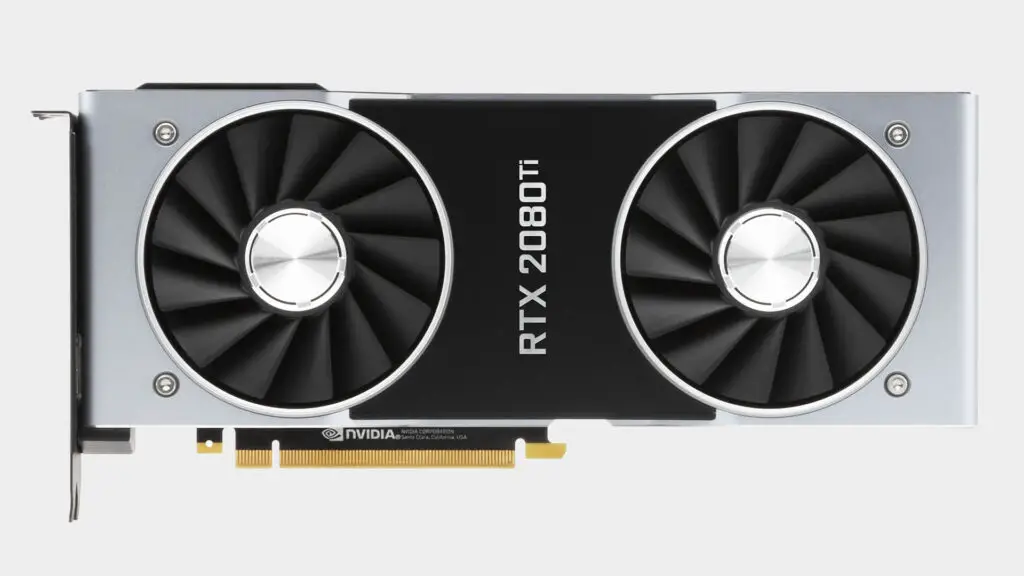
A GPU-Z readout of this engineering sample unveils impressive specifications: a robust 4480 shaders, 96 ROPs, and 280 TMUs. Most notably, it features 12GB of VRAM, a full gigabyte more than its retail counterpart. In contrast, the standard release version of the RTX 2080 Ti comes with 4352 shaders, 88 ROPs, and 272 TMUs. This suggests the prototype could offer a theoretical performance edge, further bolstered by its wider 384-bit memory bus, which surpasses the 352-bit bus found on the standard card. Upon physical inspection, with the cooler removed, the chip appears to be a stock TU102 die, though it notably lacks any distinguishing model markings.
Why the Downgrade? Speculating on the Final Product’s Specifications
This intriguing find leads us to ponder why the final retail product launched with seemingly reduced specifications. While we can only speculate, several factors could influence such a pivotal decision in hardware development. A primary reason could be linked to chip yields. In the early engineering stages, manufacturing yields are often unpredictable, and Nvidia likely adjusted the final specifications to optimize the utilization of chips that could be reliably mass-produced.
Another strong possibility is that the higher-spec configuration presented significant technical challenges. The increased core counts and additional memory might have introduced complex cooling requirements or compatibility issues with other critical components, such as the GDDR6 modules. Cost is always a critical factor in product development; a higher-specced card would inevitably be more expensive to manufacture, potentially impacting its market competitiveness. It’s also conceivable that this was a later-stage prototype designed to test the feasibility of a future “Super” or “Mega Edition” variant, or even to utilize leftover chip stock. Ultimately, developing a sophisticated product like a graphics card involves a delicate balancing act of performance, cost, and manufacturability, and this particular configuration apparently didn’t meet Nvidia’s final criteria.
Despite the mysteries surrounding its origin and the minor power issues (such as refusing to wake from sleep and preventing proper PC shutdown), the prototype is largely functional. The owner has successfully put it through its paces, running demanding benchmarks like 3DMark’s Port Royal Extreme and even modern games like Tony Hawk’s Pro Skater 1 + 2. For a prototype that was likely destined for the scrap bin, its performance is remarkably impressive. This unique find offers a captivating glimpse into an alternative reality of the RTX 2080 Ti—a powerful iteration that could have been, providing invaluable insight for tech enthusiasts like those here at Digital Tech Explorer.