
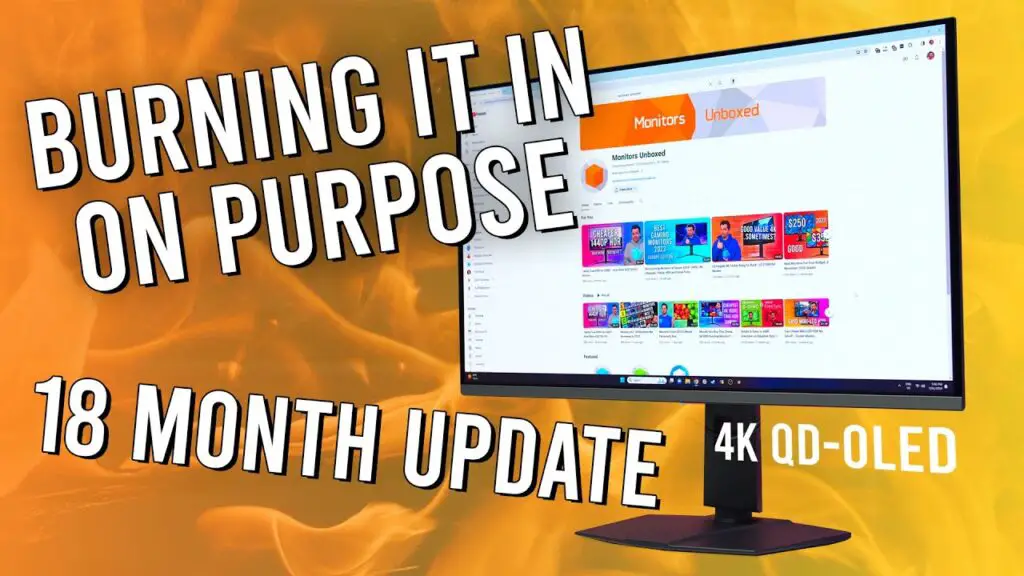
At Digital Tech Explorer, we’re dedicated to bringing you the most insightful tech analyses. TechTalesLeo dives into the latest 18-month update on a rigorous, long-term OLED burn-in test conducted by Monitors Unboxed. After more than 4,000 hours of intensive, worst-case usage, the 32-inch 4K QD-OLED panel is finally beginning to show signs of burn-in that might be considered “distracting.” This comprehensive test offers invaluable insight into the long-term durability of modern OLED displays, even under the most extreme conditions, empowering our readers to make informed hardware decisions.
Extreme Testing Conditions and Usage Profile
This isn’t your average tech review; the test setup’s usage profile was intentionally brutal, far exceeding typical gaming or even mixed-use scenarios. The MSI MPG 321URX QD-OLED monitor endured an astonishing 95% static content and productivity work, with minimal gaming and only occasional video playback. Clocking in at approximately 60 hours a week, or 250 hours per month, the monitor reached between 4,000 and 4,500 total usage hours by the 18-month mark.
To push the limits further, the monitor operated at a calibrated 200 nits in Windows Light mode, complete with a perpetually dark taskbar. Critically, the panel’s recommended pixel compensation cycle—a vital maintenance routine usually run every four hours—was deliberately delayed, running only after each extended work session (approximately every eight hours) to simulate extreme neglect. Across 18 months, the display managed only 486 compensation cycles, a testament to the harsh testing protocol.
Detailed Burn-in Observations After 18 Months
After a grueling 18 months, the visual evidence is clear: there’s a noticeable increase in artifact visibility on uniform dark grey test images compared to earlier observations. While the burn-in has “universally” worsened since the 15-month update, the degradation remains a continuous, gradual process rather than an abrupt shift. The primary visual indicators include a distinct line bisecting the screen—a direct consequence of daily dual-app window usage—and an inverse shadow where the persistently dark taskbar has actually mitigated wear on the panel. Reassuringly, no specific app icons have permanently etched themselves onto the display.
A closer examination of subpixel degradation provides fascinating insights. The red subpixel has proven the most resilient, degrading the least. The blue subpixel shows the second most impact, while the green subpixel has clearly endured the most significant wear. This uneven degradation has nudged the panel’s color slightly towards red, with the measured white point shifting from its initial 6450K to 6350K after 12 months, and maintaining that point since. Crucially for performance, the panel’s peak full-screen brightness has held steady at 243 nits, unchanged from its debut.
Impact on User Experience and Perceived Distraction
Shifting to practical implications, the burn-in’s impact on the user experience is indeed becoming more apparent. The persistent taskbar burn-in, surprisingly, remains a non-issue, largely unnoticeable in day-to-day operation. However, the central vertical line and the resulting left-right uniformity imbalance are now reaching a point of being genuinely distracting. These effects are most pronounced in applications featuring dark grey backgrounds, though they’re also subtly perceptible when reviewing game capture footage – a critical detail for gaming enthusiasts.
Despite these emerging artifacts, the overall sentiment remains largely reassuring. Even at the 18-month milestone, the test engineers are “only now starting to get a little bothered by the level of burn-in.” For the vast majority of tasks, the monitor still performs admirably.
This absolute worst-case scenario is estimated to mimic at least three years of heavy mixed-use for an average individual, and potentially even longer. Such robust endurance aligns perfectly with recent assurances from MSI, which stated that burn-in effects on its displays are “basically none” after their own extensive testing. Ultimately, while OLED burn-in is an undeniable physical phenomenon, these real-world findings from Monitors Unboxed, brought to you by Digital Tech Explorer, provide strong evidence. For gamers, developers, and even heavy general computing users, you can approach QD-OLED technology with confidence, expecting reliable display longevity for many years to come.